








Finding value amid a new generation of price-agnostic investors: Part 1

 Part 1: Passive investing

The very essence of value investing is the search for securities which are incorrectly priced, i.e. where the market price is trading at a substantial discount to the intrinsic value of the underlying business. This will sometimes happen because the average investor is prone to behavioural biases such as extrapolation, herding and risk aversion, which might lead them to make emotional decisions such as selling a cyclical stock whose share price has declined at the low point of the economic cycle because they cannot see how things will ever get any better.

Another factor that leads to the mispricing of securities, however, is when investors are forced (or choose) to invest in a way that simply does not incorporate valuation into the decision-making process (we frequently refer to this as valuation agnostic investing).  We have previously discussed one example of this which was UK pension funds reducing their exposure to UK equities from above 50% in 2000 to around 3% today[1] even during a period in which the UK equity market appeared to be one of the lowest valued equity markets in the world. As this process had been largely forced upon them by regulation, however, the low valuation of UK equities was completely irrelevant (and on the other side, the low yield and high valuation of the fixed income securities they were buying was also irrelevant). For investors like us, who use valuation as a cornerstone of their process, this behaviour is welcome as indiscriminate sellers drive share prices ever further away from intrinsic value and creates the opportunity to purchase significantly undervalued securities.

In this series, we intend to explore the subject of how the increase in the number of market participants who are valuation agnostic creates opportunities for those who focus on valuation, exploring the impact of participants such as multi-manager hedge funds, or ‘Pod shops’, and retail traders. In Part 1, however, we start with a look at how the enormous growth in passive investing – in particular, market capitalisation-weighted passive investing – has potentially increased the number of stocks that are incorrectly priced.

Definition of passive investing

Whilst passive investing can mean different things to different people, for the purposes of this paper we define it as index-tracking strategies such as those funds that hold the constituents of an index like the S&P500 exactly in line with their weightings in the index. Importantly, most of the major indices that are passively replicated are market cap-weighted, meaning that constituent companies are weighted by total market value: the larger the company, the larger the position in the index.

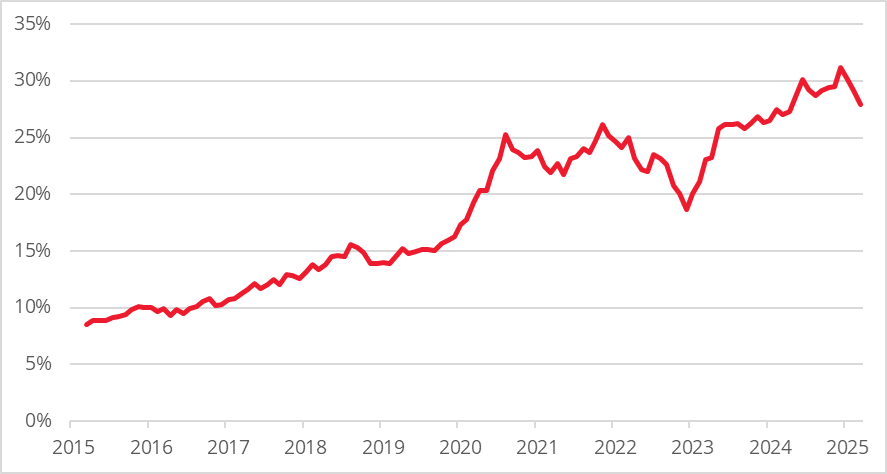
Passive investing has grown very significantly over the last twenty years and now accounts for over 50% of total equity investing in mutual funds and exchange-traded funds (ETF’s) globally today [2]. Some of the largest index-tracking ETFs are now very big indeed. For instance, the SPDR S&P 500 ETF Trust has assets of $561.7 billion [3], the iShares Core S&P 500 ETF [3] has assets of $548.6 billion and the Vanguard 500 Index Fund (VOO) has assets of $622.1 billion [3] .

Chart 1: Passive investing makes up 43% of global equity mutual funds and ETFs​

Source: Morningstar, Redwheel, April 2025. US dollars. Calculated using monthly total net assets of passive funds as a percentage of the Morningstar Global universe of mutual funds and ETFs, excluding money market funds and fund of funds. The information shown above is for illustrative purposes.

Why does it lead to mispricing of individual securities?

Put very simply, as the market share of participants who care about fundamentals and valuation is shrinking and being replaced by those who are completely indifferent to valuation, it must inevitably lead to mispricing. One of leading commentators on how passive investing is distorting markets is Mike Green, Chief Strategist and Portfolio Manager at Simplify Asset Management, a US-based ETF provider specialising in alternative strategies who sums it up as follows.

“Passive is really just the world’s simplest algorithm. Investors who analyse a company’s prospects and attempt to value businesses have been replaced by machines that are simply saying, ‘Did you give me cash? If so, then buy. Did you ask for cash? If so, then sell’.[4]

When those with no interest in valuation crowd out those trying to figure out what a stock is worth, it eventually destroys the markets price discovery mechanism and leads to what David Einhorn of Greenlight Capital has described as ‘a broken market’:

“We are such marginal players in terms of the amount of trading that’s going on, so the price discovery from professional people who have a valuation framework, not as the dominant part of their process but as any part of their process, is much, much smaller than it used to be. And so effectively, instead of the valuation becoming the signal, the valuation people were just noise and everybody else is sort of the signal. And this is why I think we have a structurally dysfunctional market, a bit of a broken market.”[5]

How does this create a distortion?

Chart 2 below highlights the huge disparity in funds flowing into passive strategies compared to active strategies. While new money such as pension contributions can account for some this, the magnitude of the disparity suggests that considerable sums are shifting from active to passive funds.

Chart 2: Passive flows are increasing while active flows are stagnating
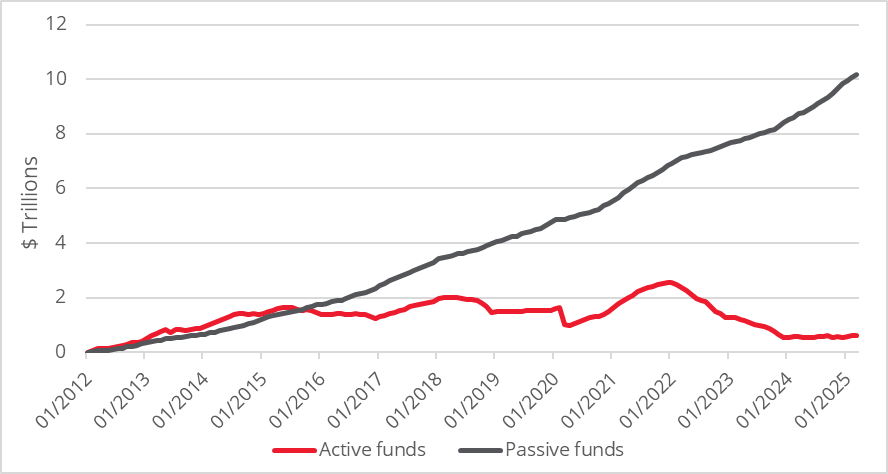
Source: Morningstar, Redwheel, April 2025. Cumulative fund flows in US dollars from January 2012. Morningstar Global universe of mutual funds and ETFs, excluding money market funds and fund of funds. The information shown above is for illustrative purposes.

Active managers, particularly those who employ a value-driven approach, are typically underweight the more expensive mega cap stocks and overweight smaller but cheaper stocks. [6][7] As they receive redemptions, these stocks are sold, and the passive managers allocate a greater proportion of the money they receive to larger more expensive stocks. This impact is exacerbated by the fact that liquidity does not scale in a linear fashion with market capitalisation. For instance, Apple’s market cap is 187 times larger than Clorox but the difference in average daily traded volumes is only 35 times [8]. This means that as money flows into passive funds, not only is more money being allocated to Apple than Clorox, but each dollar will have a price impact that is greater than the differential in market cap.

Passive has, in essence, become a giant momentum strategy. This undoubtedly has contributed to the highly distorted nature of the US stock market whereby seven very large companies have just got bigger and bigger until they eventually make up almost a third of the index. The fact that most passive funds buy more larger companies creates a reinforcing positive feedback loop: as companies get more expensive – and thus larger – the passive index buys more of them with each incremental dollar invested, further driving up the price, the company size, and the weight in the index, in a huge loop that rewards size and overvaluation.

Chart 3: Magnificent 7 as percentage of S&P 500 index​

Source: Bloomberg, Redwheel, 31 March 2025. Past performance is not a guide to the future.

What could go wrong?

It has been pointed out above that inflows into passive funds are related to income, for instance, contributions into retirement plans, whilst outflows are a function of the overall value of savings. Passive investing works well so long as people are employed and making contributions into their 401(k)s or SIPPs. But if people started losing their jobs and ceased these contributions, the passive flows would decrease. Alternatively, the outflows from those retiring could eventually exceed the inflows from those in work and saving. Either or both would turn passive buying into passive selling and it is not clear who the natural buyers for the shares they are selling would be because the active management industry has shrunk so much. The passive algorithm would remain valuation agnostic and would just sell if asked for money regardless of how far the stock had fallen the previous day or week. Mike Green worries that this could create a situation where the market gaps down and is unable to find a floor.

The implication for value-oriented investors

Simply put, the distortions described above are driving the valuations of the large cap stocks which receive a disproportionate share of inflows significantly above their intrinsic value. Conversely, they are driving the valuations of smaller stocks being sold down by active managers significantly below their intrinsic value. Whilst it is possible to see the passive industry as a steam roller which will just flatten anything that tries to get in its way, my inclination is that this is a finite process. At some level of undervaluation, entire companies are bid for by competitors or private equity firms. Other companies use their low valuation to create enormous value by buying back their own shares. And eventually, the equal-weighted index should return to beating the market cap-weighted index and money flows out of passive and back to active.

Key Information

No investment strategy or risk management technique can guarantee returns or eliminate risks in any market environment. Past performance is not a guide to the future. The prices of investments and income from them may fall as well as rise and investors may not get back the full amount invested. Forecasts and estimates are based upon subjective assumptions about circumstances and events that may not yet have taken place and may never do so. The statements and opinions expressed in this article are those of the author as of the date of publication, and do not necessarily represent the view of Redwheel. This article does not constitute investment advice and the information shown is for illustrative purposes only.

Sources:

1] Portfolio-institutional.co.uk, February 2025

[2] Morningstar, March 2025

[3] Company websites, Redwheel, April 2025

[4] https://www.yesigiveafig.com/p/why-bother-being-better
[5] CNBC.com, November 2024

[6] GMO.com, Q1 2024

[7] Financial Post, October 2024

[8] ETFCentral.com, April 2025

In case you missed it

Emerging and Frontier Markets
The ‘Fab 4’ become the ‘FOMO 3’
27 July, 2026 | 01:48pm
UK Value & income
When it rhymes it pours
20 July, 2026 | 07:58pm
UK Value & income
Two beautiful games
6 July, 2026 | 07:29pm

Disclaimer

Redwheel ® and Ecofin ® are registered trademarks of RWC Partners Limited (“RWC”). The term “Redwheel” may include any one or more Redwheel branded regulated entities including RWC Asset Management LLP, which is authorised and regulated by the UK Financial Conduct Authority and the US Securities and Exchange Commission (“SEC”); RWC Asset Advisors (US) LLC, which is registered with the SEC;  RWC Singapore (Pte) Limited, which is licensed as a Licensed Fund Management Company by the Monetary Authority of Singapore; Redwheel Australia Pty Ltd is an Australian Financial Services Licensee with the Australian Securities and Investment Commission; and Redwheel Europe Fondsmæglerselskab A/S which is regulated by the Danish Financial Supervisory Authority.

Redwheel may act as investment manager or adviser, or otherwise provide services, to more than one product pursuing a similar investment strategy or focus to the product detailed in this document. Redwheel and RWC (together “Redwheel Group”) seeks to minimise any conflicts of interest, and endeavours to act at all times in accordance with its legal and regulatory obligations as well as its own policies and codes of conduct.

This document is directed only at professional, institutional, wholesale or qualified investors. The services provided by Redwheel are available only to such persons. It is not intended for distribution to and should not be relied on by any person who would qualify as a retail or individual investor in any jurisdiction or for distribution to, or use by, any person or entity in any jurisdiction where such distribution or use would be contrary to local law or regulation.

This document has been prepared for general information purposes only and has not been delivered for registration in any jurisdiction nor has its content been reviewed or approved by any regulatory authority in any jurisdiction.

The information contained herein does not constitute: (i) a binding legal agreement; (ii) legal, regulatory, tax, accounting or other advice; (iii) an offer, recommendation or solicitation to buy or sell shares in any fund, security, commodity, financial instrument or derivative linked to, or otherwise included in a portfolio managed or advised by Redwheel; or (iv) an offer to enter into any other transaction whatsoever (each a “Transaction”). Redwheel Group bears no responsibility for your investment research and/or investment decisions and you should consult your own lawyer, accountant, tax adviser or other professional adviser before entering into any Transaction. No representations and/or warranties are made that the information contained herein is either up to date and/or accurate and is not intended to be used or relied upon by any counterparty, investor or any other third party.

Redwheel Group uses information from third party vendors, such as statistical and other data, that it believes to be reliable. However, the accuracy of this data, which may be used to calculate results or otherwise compile data that finds its way over time into Redwheel Group research data stored on its systems, is not guaranteed. If such information is not accurate, some of the conclusions reached or statements made may be adversely affected. Any opinion expressed herein, which may be subjective in nature, may not be shared by all directors, officers, employees, or representatives of Group and may be subject to change without notice. Redwheel Group is not liable for any decisions made or actions or inactions taken by you or others based on the contents of this document and neither Redwheel Group nor any of its directors, officers, employees, or representatives (including affiliates) accepts any liability whatsoever for any errors and/or omissions or for any direct, indirect, special, incidental, or consequential loss, damages, or expenses of any kind howsoever arising from the use of, or reliance on, any information contained herein.

Information contained in this document should not be viewed as indicative of future results. Past performance of any Transaction is not indicative of future results. The value of investments can go down as well as up. Certain assumptions and forward looking statements may have been made either for modelling purposes, to simplify the presentation and/or calculation of any projections or estimates contained herein and Redwheel Group does not represent that that any such assumptions or statements will reflect actual future events or that all assumptions have been considered or stated. There can be no assurance that estimated returns or projections will be realised or that actual returns or performance results will not materially differ from those estimated herein. Some of the information contained in this document may be aggregated data of Transactions executed by Redwheel that has been compiled so as not to identify the underlying Transactions of any particular customer.

No representations or warranties of any kind are intended or should be inferred with respect to the economic return from, or the tax consequences of, an investment in a Redwheel-managed fund.

This document expresses no views as to the suitability or appropriateness of the fund or any other investments described herein to the individual circumstances of any recipient.

The information transmitted is intended only for the person or entity to which it has been given and may contain confidential and/or privileged material. In accepting receipt of the information transmitted you agree that you and/or your affiliates, partners, directors, officers and employees, as applicable, will keep all information strictly confidential. Any review, retransmission, dissemination or other use of, or taking of any action in reliance upon, this information is prohibited. Any distribution or reproduction of this document is not authorised and is prohibited without the express written consent of Redwheel Group.

Funds managed by Redwheel are not, and will not be, registered under the Securities Act of 1933 (the “Securities Act”) and are not available for purchase by US persons (as defined in Regulation S under the Securities Act) except to persons who are “qualified purchasers” (as defined in the Investment Company Act of 1940) and “accredited investors” (as defined in Rule 501(a) under the Securities Act).

This document does not constitute an offer to sell, purchase, subscribe for or otherwise invest in units or shares of any fund managed by Redwheel. Any offering is made only pursuant to the relevant offering document and the relevant subscription application. Prospective investors should review the offering memorandum in its entirety, including the risk factors in the offering memorandum, before making a decision to invest.

AIFMD and Distribution in the European Economic Area (“EEA”)

The Alternative Fund Managers Directive (Directive 2011/61/EU) (“AIFMD”) is a regulatory regime which came into full effect in the EEA on 22 July 2014. RWC Asset Management LLP is an Alternative Investment Fund Manager (an “AIFM”) to certain funds managed by it (each an “AIF”). The AIFM is required to make available to investors certain prescribed information prior to their investment in an AIF. The majority of the prescribed information is contained in the latest Offering Document of the AIF. The remainder of the prescribed information is contained in the relevant AIF’s annual report and accounts. All of the information is provided in accordance with the AIFMD.

In relation to each member state of the EEA (each a “Member State”), this document may only be distributed and shares in a Redwheel fund (“Shares”) may only be offered and placed to the extent that (a) the relevant Redwheel fund is permitted to be marketed to professional investors in accordance with the AIFMD (as implemented into the local law/regulation of the relevant Member State); or (b) this document may otherwise be lawfully distributed and the Shares may lawfully be offered or placed in that Member State (including at the initiative of the investor).

Information Required for Offering in Switzerland of Foreign Collective Investment Schemes to Qualified Investors within the meaning of Article 10 CISA.

This is an advertising document.

The representative and paying agent of the Redwheel-managed funds in Switzerland (the “Representative in Switzerland”) FIRST INDEPENDENT FUND SERVICES LTD, Feldeggstrasse 12, CH-8008 Zurich. Swiss Paying Agent: Helvetische Bank AG, Seefeldstrasse 215, CH-8008 Zurich. In respect of the units of the Redwheel-managed funds offered in Switzerland, the place of performance is at the registered office of the Swiss Representative. The place of jurisdiction is at the registered office of the Swiss Representative or at the registered office or place of residence of the investor.