











Indonesia: MSCI reclassification proposal

Key takeaways
  • MSCI’s proposed reclassification of Indonesia would exclude it from Emerging and Frontier indices, triggering passive outflows.


  • Material progress this year on market reforms calls into question the case for a market-wide downgrade.


  • Depressed valuations contrast with resilient economic fundamentals and long-term growth prospects.


  • The Redwheel Next Generation Emerging Markets Equity strategy has 4% exposure to Indonesia across five mining and e-commerce holdings, including two listed overseas.

On 15 October 2026, MSCI opened a consultation on a proposal to reclassify Indonesia from Emerging Market to Standalone Market status. No final decision has been made and the consultation runs until 30 April 2027, with a decision expected on or before 30 June 2027[1]. Standalone status was not mentioned until this month and would place Indonesia outside MSCI’s Emerging and Frontier indices. Such an exclusion would lead to forced selling by index-tracker funds but the market would remain open to active investors.

This move follows a review process initiated in January 2026 as MSCI assessed the Indonesian authorities’ reform response and the results were expected in November. The initial review process arose from concerns over opaque ownership, limited genuinely tradeable shares and suspected coordinated trading, which called into question the reliability of free-float estimates and market pricing. It sought improvements in ownership disclosure and market functioning, with MSCI subsequently emphasising the need for consistent implementation and meaningful enforcement. The review was intended to encourage market reforms or consider reclassification to Frontier Market status.

The timing of this month’s consultation and the lack of clearly defined criteria underpinning the proposal have surprised the investment community. MSCI stated: “Market participants have indicated that, to date, sufficient progress has not been observed consistently across the Indonesian equity market. Significant concerns remain around market dysfunction, including continued suspected coordinated trading behaviour and lack of evidence of meaningful enforcement.”1

Reform progress and the case for reclassification

Over the last few years, we have made our concerns about the opacity and quirks of the capital market known to the Indonesian Stock Exchange. This has led us to reduce exposure to Indonesia in recent years, despite the attractive bottom-up opportunities in this fast-growing and exciting economy. Indeed, we had originally welcomed MSCI’s initial consultation and were encouraged to see the Indonesian authorities respond with material reforms.

We have observed healthy progress since the April 2026 review, with many of MSCI’s initial demands regarding disclosure and free float requirements having been met or being addressed. MSCI acknowledges that the Indonesian Stock Exchange, IDX, has made significant progress in providing enhanced disclosure of ownership of shareholdings above 1%, including high shareholder concentration (HSC) lists on a regular basis. MSCI also acknowledges that IDX has provided a roadmap for a minimum free float of 15%1; our conversations with companies with free float below 15% have revealed that many have already started to work with bankers to float additional shares to satisfy the IDX requirement. For companies with a market capitalisation above Rp 5 trillion (approximately $275 million), the minimum free float must reach 12.5% by March 2027 and 15% by March 2028[2]. Since May 2026, MSCI removed five companies from the MSCI Indonesia index after they failed to meet free float and trading requirements.[3]

Interestingly, other index providers have taken a different approach. As recently as 6 October 2026, FTSE Russell acknowledged progress by regulators and listed companies and retained Indonesia’s Secondary Emerging Market classification.[4]

Historically, MSCI’s decisions to downgrade markets from Emerging Market to either Frontier Market or Standalone Market status have been based on three objective criteria: capital controls, lack of liquidity or an insufficient number of securities. None of these grounds for a downgrade applies to Indonesia, which has consistently met the corresponding requirements since attaining Emerging Market status.

In contrast, a downgrade for “market dysfunction” is subjective and raises questions about how such concerns are assessed and what would constitute sufficient evidence of improvement. If MSCI proceeds with downgrading Indonesia, it could set a concerning precedent for more subjective classification decisions – a concern also raised by the prospect of Turkey’s reclassification under a similar review process. In our view, any reclassification should be based on clear, measurable and consistently applied criteria; otherwise, confidence in the reliability of MSCI’s indices could be undermined. Excluding companies that fail investability standards and restricting new index additions pending reform would be more proportionate than the proposed market-wide reclassification.

We understand from our conversations with other EM investors that MSCI’s proposal comes as a surprise. Few of the investors that we have spoken to felt that their views had been properly considered during earlier reviews. MSCI’s reference to “market participants” is unclear and we have yet to see any single investment firm publicly supporting MSCI’s announcement and acknowledging themselves to be one of said “market participants”.

Market reaction and potential outflows

The consultation is open until 30 April 2027, with a final decision expected by 30 June. Many well-known investment banks estimate that a downgrade to Standalone Market status would result in passive outflows of approximately $4.5bn from the equity market[5], which would depress valuations. However, we believe local domestic institutions have in excess of $100bn liquidity which could easily absorb even 100% of both active and passive international outflows of approximately $15bn in total.  We intend to engage with MSCI during the consultation to make our views understood.

Nevertheless, the market has already begun to recover from what we believe was an overreaction to MSCI’s proposal. Indonesian equities rebounded sharply on 20 October, recovering a substantial portion of the initial sell-off: the MSCI Indonesia Index’s month-to-date loss narrowed from 19.1% to 11.0% in USD terms.

Table 1: Performance of the five largest companies in MSCI Indonesia by market capitalisation                    
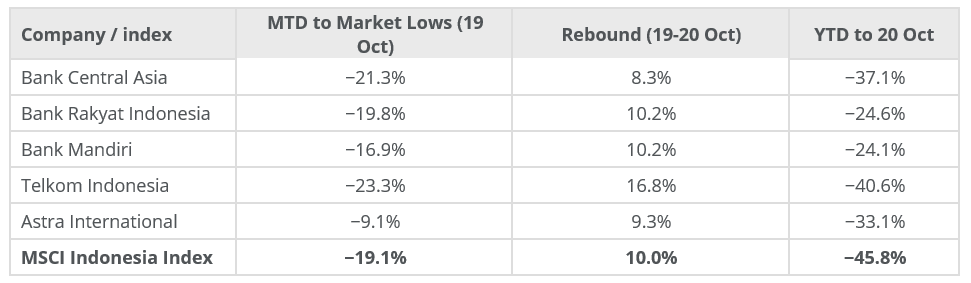
Source: Redwheel, Bloomberg, MSCI, as of 20 October 2026. Total returns in USD. MTD measured from 30 September 2026, YTD from 30 December 2025. The information shown above is for illustrative purposes. Past performance is not a guide to the future.
Valuations and portfolio positioning

We have materially reduced exposure to Indonesia since 2024 in response to uncertainty surrounding Indonesia’s MSCI index status. However, in our assessment, valuations are beginning to look dislocated from fundamentals. With the index trading on 7.6x forward earnings[6] – more than two standard deviations below its long-run historical average – Indonesia is beginning to present what could be a compelling entry point into a structurally attractive economy. We believe that credible implementation of ownership-transparency and free-float reforms could restore international investor confidence and unlock meaningful re-rating potential. As an index-agnostic strategy, we retain the flexibility to increase our allocation materially as evidence of reform progress accumulates.

As of 20 October 2026, the Redwheel Next Gen EM Equity strategy has 4.0% exposure in Indonesia, comprising holdings in three mining companies and two e-commerce companies. Three holdings are listed in Indonesia, one is listed in the US and another in Australia. The latter two companies should be unaffected by an index reclassification.

Table 2: Portfolio exposure to Indonesia                 
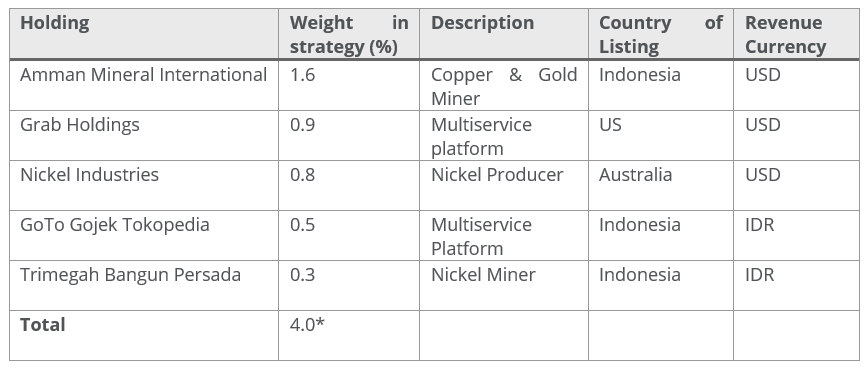
Source: Redwheel, 20 October 2026 *Figures may not sum due to rounding. Portfolio holdings are subject to change at any time without notice. This information should not be construed as a recommendation to purchase or sell any security.
Indonesia’s underlying fundamentals

Real GDP Growth Forecast: (Redwheel economist estimates)

2026: 4.8%

2027: 5.2%

Our conviction in Indonesia rests on its demographic scale, abundant natural resources – including coal, palm oil, nickel and copper – industrial transformation and tourism industry. With 286 million people, the world’s fourth most populous nation offers substantial opportunities across consumer goods, financial services and digital products. Economic growth of 5.4% in the first half of 2026 reinforces the case. Supplying roughly two-thirds of global mined nickel, Indonesia is investing in downstream processing to capture greater value across industrial and battery supply chains. Tourism offers a further growth avenue, with foreign arrivals expected to surpass pre-pandemic levels for the first time in 2026, and rising foreign-exchange earnings providing a source of support for the rupiah.6

Macroeconomic buffers provide additional support, with foreign reserves of $146.3bn and public debt of approximately 40% of GDP. Inflation of 3.3% remains within Bank Indonesia’s target range, while the fiscal deficit in the year-to-date through September was 1.2% of GDP.6 Notably, the recent equity sell-off likely reflects uncertainty over MSCI’s proposed reclassification rather than a deterioration in economic fundamentals.

Indonesia’s equity market capitalisation to GDP ratio is now well below its long-run average.

Chart 1: Indonesia: Equity market cap to GDP ratio
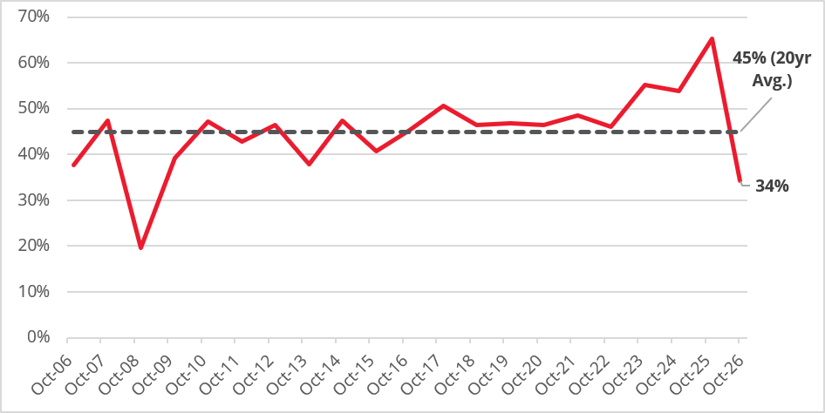
Source: Redwheel, Bloomberg, 20 October 2026. The information shown above is for illustrative purposes. Past performance is not a guide to the future.

In the early 2000s, Asian equities were booming and global investors began treating ASEAN as an asset class of its own. The case rested on a large and young population, resilient domestic spending and healthier balance sheets. The table below compares each argument for Indonesia today.

Table 3: Indonesia’s investment case: then and now
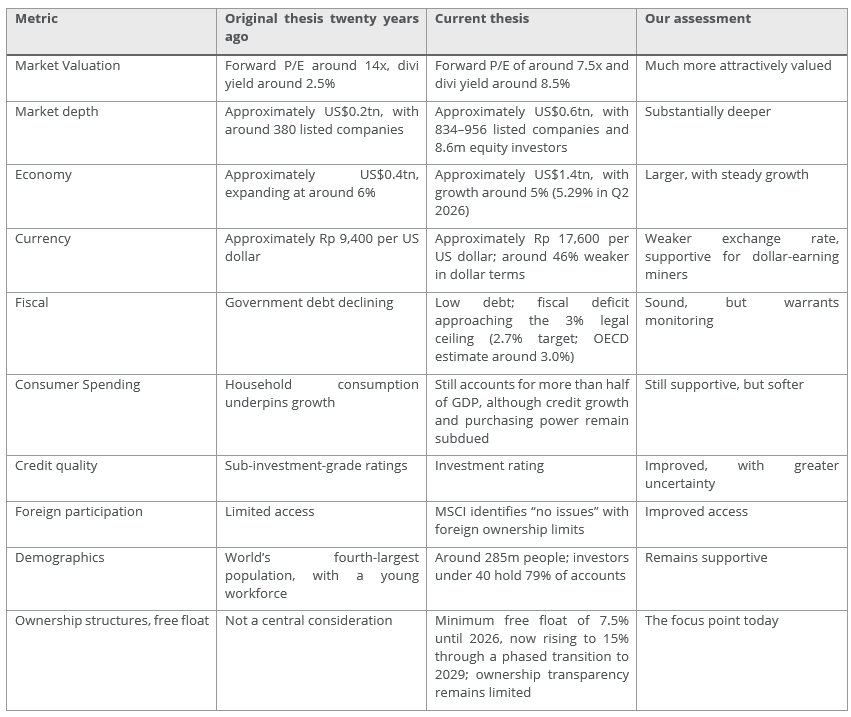
Sources: Redwheel, Bank Indonesia, OECD, 20 October 2026. The information shown above is for illustrative purposes. Past performance is not a guide to the future.

Key Information

No investment strategy or risk management technique can guarantee returns or eliminate risks in any market environment. Past performance is not a guide to the future. The prices of investments and income from them may fall as well as rise and investors may not get back the full amount invested. Forecasts and estimates are based upon subjective assumptions about circumstances and events that may not yet have taken place and may never do so. The statements and opinions expressed in this article are those of the author as of the date of publication, and do not necessarily represent the view of Redwheel. This article does not constitute investment advice and the information shown is for illustrative purposes only.

References 

[1] MSCI, 15 October 2026

[2] PWC, April 2026

[3] Bloomberg, 20 October 2026

[4] FTSE Russell, October 2026

[5] Bloomberg News, 20 October 2026

[6] Bloomberg, 20 October 2026
In case you missed it

Global Intrinsic Value

Redwheel’s Shaul Rosten looks at past market cycles to challenge the assumption that US equity dominance is here to stay. Read why he believes today’s valuations and market concentration could set the stage for a shift in leadership—and why his team’s value-investing lens points towards cheaper international markets.

13 October, 2026 | 10:09am
Infrastructure

Ecofin Portfolio Manager Michel Sznajer examines his strategy’s performance after previous peaks in bond yields and identifies potential takeover targets amid falling valuations and improving earnings prospects. Read his latest insight on the investment case for the sector—and the risks that could keep it under pressure.

8 October, 2026 | 09:03am
Convertible Bonds

Balanced convertibles are once again delivering meaningful equity participation while outpacing investment grade credit. Davide Basile, Portfolio Manager, Redwheel Convertible Bonds, argues that convertibles have reached a turning point, read more in his latest insight.

29 September, 2026 | 10:02am

Disclaimer

Redwheel ® and Ecofin ® are registered trademarks of RWC Partners Limited (“RWC”). The term “Redwheel” may include any one or more Redwheel branded regulated entities including RWC Asset Management LLP, which is authorised and regulated by the UK Financial Conduct Authority and the US Securities and Exchange Commission (“SEC”); RWC Asset Advisors (US) LLC, which is registered with the SEC;  RWC Singapore (Pte) Limited, which is licensed as a Licensed Fund Management Company by the Monetary Authority of Singapore; Redwheel Australia Pty Ltd is an Australian Financial Services Licensee with the Australian Securities and Investment Commission; and Redwheel Europe Fondsmæglerselskab A/S which is regulated by the Danish Financial Supervisory Authority.

Redwheel may act as investment manager or adviser, or otherwise provide services, to more than one product pursuing a similar investment strategy or focus to the product detailed in this document. Redwheel and RWC (together “Redwheel Group”) seeks to minimise any conflicts of interest, and endeavours to act at all times in accordance with its legal and regulatory obligations as well as its own policies and codes of conduct.

This document is directed only at professional, institutional, wholesale or qualified investors. The services provided by Redwheel are available only to such persons. It is not intended for distribution to and should not be relied on by any person who would qualify as a retail or individual investor in any jurisdiction or for distribution to, or use by, any person or entity in any jurisdiction where such distribution or use would be contrary to local law or regulation.

This document has been prepared for general information purposes only and has not been delivered for registration in any jurisdiction nor has its content been reviewed or approved by any regulatory authority in any jurisdiction.

The information contained herein does not constitute: (i) a binding legal agreement; (ii) legal, regulatory, tax, accounting or other advice; (iii) an offer, recommendation or solicitation to buy or sell shares in any fund, security, commodity, financial instrument or derivative linked to, or otherwise included in a portfolio managed or advised by Redwheel; or (iv) an offer to enter into any other transaction whatsoever (each a “Transaction”). Redwheel Group bears no responsibility for your investment research and/or investment decisions and you should consult your own lawyer, accountant, tax adviser or other professional adviser before entering into any Transaction. No representations and/or warranties are made that the information contained herein is either up to date and/or accurate and is not intended to be used or relied upon by any counterparty, investor or any other third party.

Redwheel Group uses information from third party vendors, such as statistical and other data, that it believes to be reliable. However, the accuracy of this data, which may be used to calculate results or otherwise compile data that finds its way over time into Redwheel Group research data stored on its systems, is not guaranteed. If such information is not accurate, some of the conclusions reached or statements made may be adversely affected. Any opinion expressed herein, which may be subjective in nature, may not be shared by all directors, officers, employees, or representatives of Group and may be subject to change without notice. Redwheel Group is not liable for any decisions made or actions or inactions taken by you or others based on the contents of this document and neither Redwheel Group nor any of its directors, officers, employees, or representatives (including affiliates) accepts any liability whatsoever for any errors and/or omissions or for any direct, indirect, special, incidental, or consequential loss, damages, or expenses of any kind howsoever arising from the use of, or reliance on, any information contained herein.

Information contained in this document should not be viewed as indicative of future results. Past performance of any Transaction is not indicative of future results. The value of investments can go down as well as up. Certain assumptions and forward looking statements may have been made either for modelling purposes, to simplify the presentation and/or calculation of any projections or estimates contained herein and Redwheel Group does not represent that that any such assumptions or statements will reflect actual future events or that all assumptions have been considered or stated. There can be no assurance that estimated returns or projections will be realised or that actual returns or performance results will not materially differ from those estimated herein. Some of the information contained in this document may be aggregated data of Transactions executed by Redwheel that has been compiled so as not to identify the underlying Transactions of any particular customer.

No representations or warranties of any kind are intended or should be inferred with respect to the economic return from, or the tax consequences of, an investment in a Redwheel-managed fund.

This document expresses no views as to the suitability or appropriateness of the fund or any other investments described herein to the individual circumstances of any recipient.

The information transmitted is intended only for the person or entity to which it has been given and may contain confidential and/or privileged material. In accepting receipt of the information transmitted you agree that you and/or your affiliates, partners, directors, officers and employees, as applicable, will keep all information strictly confidential. Any review, retransmission, dissemination or other use of, or taking of any action in reliance upon, this information is prohibited. Any distribution or reproduction of this document is not authorised and is prohibited without the express written consent of Redwheel Group.

Funds managed by Redwheel are not, and will not be, registered under the Securities Act of 1933 (the “Securities Act”) and are not available for purchase by US persons (as defined in Regulation S under the Securities Act) except to persons who are “qualified purchasers” (as defined in the Investment Company Act of 1940) and “accredited investors” (as defined in Rule 501(a) under the Securities Act).

This document does not constitute an offer to sell, purchase, subscribe for or otherwise invest in units or shares of any fund managed by Redwheel. Any offering is made only pursuant to the relevant offering document and the relevant subscription application. Prospective investors should review the offering memorandum in its entirety, including the risk factors in the offering memorandum, before making a decision to invest.

AIFMD and Distribution in the European Economic Area (“EEA”)

The Alternative Fund Managers Directive (Directive 2011/61/EU) (“AIFMD”) is a regulatory regime which came into full effect in the EEA on 22 July 2014. RWC Asset Management LLP is an Alternative Investment Fund Manager (an “AIFM”) to certain funds managed by it (each an “AIF”). The AIFM is required to make available to investors certain prescribed information prior to their investment in an AIF. The majority of the prescribed information is contained in the latest Offering Document of the AIF. The remainder of the prescribed information is contained in the relevant AIF’s annual report and accounts. All of the information is provided in accordance with the AIFMD.

In relation to each member state of the EEA (each a “Member State”), this document may only be distributed and shares in a Redwheel fund (“Shares”) may only be offered and placed to the extent that (a) the relevant Redwheel fund is permitted to be marketed to professional investors in accordance with the AIFMD (as implemented into the local law/regulation of the relevant Member State); or (b) this document may otherwise be lawfully distributed and the Shares may lawfully be offered or placed in that Member State (including at the initiative of the investor).

Information Required for Offering in Switzerland of Foreign Collective Investment Schemes to Qualified Investors within the meaning of Article 10 CISA.

This is an advertising document.

The representative and paying agent of the Redwheel-managed funds in Switzerland (the “Representative in Switzerland”) FIRST INDEPENDENT FUND SERVICES LTD, Feldeggstrasse 12, CH-8008 Zurich. Swiss Paying Agent: Helvetische Bank AG, Seefeldstrasse 215, CH-8008 Zurich. In respect of the units of the Redwheel-managed funds offered in Switzerland, the place of performance is at the registered office of the Swiss Representative. The place of jurisdiction is at the registered office of the Swiss Representative or at the registered office or place of residence of the investor.