
We use strictly necessary cookies to enable our site to work and performance cookies to improve the visitor experience when visiting the site. We will only set performance cookies if you permit us to.
For more detailed information about the cookies we use, see the „Cookie Usage“ section of our Privacy Policy

Wandelanleihen bieten eine hybride Lösung für Anleger, die ein ausgewogenes Engagement am Finanzmarkt wünschen, welches die Vorteile von Aktien und Anleihen kombiniert. Seit mehr als einem Jahrzehnt verwendet unser Team proprietäre Modelle und Systeme, um die attraktivsten Chancen innerhalb dieser Anlageklasse zu identifizieren. Wir bieten eine Auswahl an aktiv verwalteten Lösungen, welche darauf ausgelegt sind, das attraktive, asymmetrische Renditeprofil von Wandelanleihen mit unterschiedlichen Risikotoleranzen zu nutzen.
Das Ecofin-Team verwaltet eine Reihe globaler thematischer Aktienstrategien mit dem Ziel, den Kunden hohe risikobereinigte Renditen zu bieten und gleichzeitig einige der größten ökologischen Herausforderungen unseres Planeten anzugehen, wie die Dekarbonisierung der Energieversorgung und der Infrastruktur.
Schwellenländer und Frontier Märkte sind die am schnellsten wachsenden Volkswirtschaften der Welt. Wir sind überzeugt, dass das anhaltende Wachstum in diesen Märkten in unterschiedlichen Branchen attraktive Chancen bietet. Unser indexunabhängiger, opportunistischer Ansatz wurde über mehr als zwei Jahrzehnte lang verfeinert. In Kombination mit der ausgewiesenen Erfahrung unseres Teams erlaubt uns dies, an attraktiven und häufig noch unerschlossenen Wachstumschancen teilzunehmen.
Wir investieren in eine kleine Auswahl hochwertiger europäischer Unternehmen, bei denen wir durch die Lösung bestimmter unternehmensspezifischer Probleme potenziell bedeutende Möglichkeiten zur Schaffung von Mehrwert erkennen. Wir wirken als Katalysator für Veränderungen, indem wir konstruktiv mit den Unternehmen und mit anderen Aktionären zusammenarbeiten.
Ein sehr erfahrenes Team mit einer nachgewiesenen Erfolgsbilanz bei der Erzielung positiver Ergebnisse für Anleger. Die bewährte Anlagemethode, die Dividendenkraft der Titel voll auszuschöpfen, bietet das Potential, langfristig mehr Rendite bei unterdurchschnittlichen Volatilitätsraten einzufahren. Wir suchen gezielt nach der seltenen Kombination aus hohen Renditen, nachhaltigen Dividenden und einer attraktiven Bewertung, welche nur dann auftritt, wenn es gewisse Kontroversen gibt. Indem wir alles daran setzen, diese Kontroveren im Kern zu verstehen, erhöhen wir für Sie aktiv die Wahrscheinlichkeit eines Investitionserfolges.
Japan ist die drittgrösste Volkswirtschaft der Welt. Die Unternehmenslandschaft des Landes befindet sich seit einigen Jahren im Umbruch. Durch unser Joint Venture mit dem in Tokio ansässigen Nissay Asset Management (NAM) investieren wir in eine kleine Anzahl ausgewählter japanischer Unternehmen, deren Bewertung aufgrund von Faktoren, welche wir für korrigierbar halten, nicht ihr volles Potenzial widerspiegelt. Wir agieren für diese Unternehmen als Partner im Change-Prozess, damit der Wandel, der zur Freisetzung des Potenzials notwendig ist, vollzogen werden kann.
Nachhaltigkeit im weitesten Sinne verändert das Anlageumfeld strukturell – sowohl von der Risiko- als auch von der Chancenbetrachtung her betrachtet. Das Redwheel Sustainable Growth Team ist bestrebt, strukturelle längerfristige Themen und Dynamiken in der Wirtschaft und der Gesellschaft zu identifizieren.
Wir sind langfristige Value-Investoren und glauben fest daran, dass kurzfristige Faktoren viele Marktteilnehmer bei entsprechender Nachrichtenlage zu Überreaktionen verleiten, auch wenn die Informationen nur geringe oder gar keine Auswirkungen auf den Wert des betroffenen Unternehmens haben. In solchen Situationen können die Aktienkurse vom intrinsischen Wert des Unternehmens abweichen, was langfristig orientierten Anlegern wie uns die Möglichkeit bietet, Aktien zu einem attraktiven Preis zu erwerben. Dies schafft eine Sicherheitsmarge und bietet gleichzeitig ein signifikantes langfristiges Renditepotenzial durch Dividendenerträge und Kapitalzuwachs.
Unser Nachhaltigkeitsansatz bei der Anlagetätigkeit beruht auf drei Säulen: einer soliden Unternehmensführung und einem strengen Richtlinien Regelwerk für alle Redwheel-Fonds, einer zentralisierten Stewardship-Expertise für unsere Anlageteams, von denen jedes sein eigenes individuelles Engagement für die Unternehmen, in die es investiert, durchführt, und Greenwheel, unserem hauseigenen Team von Experten für Nachhaltigkeitsresearch.
Die Abteilung ‚Stewardship and Regulatory Change‘ von Redwheel ist für die operative Unterstützung des Stewardship bei Redwheel zuständig.
Das Team für Nachhaltigkeitsstrategie, Governance und Richtlinien berät und unterstützt Redwheel und seine Anlageteams bei der Integration von Nachhaltigkeitsaspekten in die Anlageprozesse und trägt dazu bei, dass sich Redwheel‘s Ansatz für verantwortungsbewusste Anlagen im Einklang mit den Kundenbedürfnissen und regulatorischen Anforderungen weiterentwickelt.
Greenwheel ist der Partner für die Nachhaltigkeitsanalysen der Redwheel-Fonds ‘Sustainable, Transition und Enhanced Integration’. Greenwheel bietet Redwheel-Fondsmanagern in jeder Phase des Lebenszyklus nachhaltiger Produkte maßgeschneidertes Nachhaltigkeits-Research und Beratung auf thematischer und sektoraler Ebene, von der Fondsgestaltung bis hin zu Investment-Research und Engagement-Unterstützung, abhängig von den Bedürfnissen und Anforderungen des jeweiligen Teams. Das von den Fondsmanagern in Auftrag gegebene Modell gewährleistet, dass das Research auf das Anlageprodukt und das Kundenergebnis zugeschnitten ist
Disciplined, value-driven equity investors may be seeing a rise in tracking error – the measure of how much a portfolio’s returns diverge from its benchmark. While risk systems often flag tracking error as a negative, the true story can be more nuanced.
For a strategy committed to consistent, long-term returns and downside protection, an increase in tracking error may signal that it is doing exactly what it’s supposed to: providing diversification and risk management when it matters most.
Rising tracking error is often seen as a danger sign – but the real question is why it’s rising. Is increased volatility due to changes made by the portfolio manager, or is it because the broader market itself is becoming more volatile?
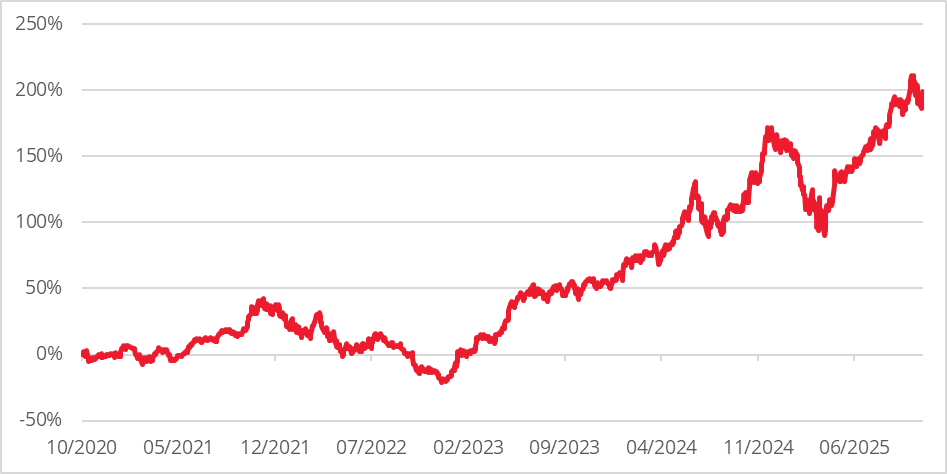
Recent years have seen a major shift in global equity markets, with returns becoming increasingly concentrated in a handful of highly valued technology giants. These “Magnificent 7” stocks have been responsible for much of the headline gains but are also driving volatility higher for the overall benchmark. Chart 1 clearly indicates an acceleration in Mag 7 outperformance in Q4 2024, a sharp deterioration during Q1 2025 followed by another period of acceleration in Q2 and Q3 2025.
Chart 1: Magnificent 7 relative to the MSCI World benchmark
For disciplined equity income strategies, this market environment presents a challenge—but also a reaffirmation of core principles. Stringent buy or yield disciplines mean that these stocks fall outside the eligible universe for strategies like the Redwheel Global Equity Income strategy, which prioritises durable yields at a premium to market over short-term growth at any price.
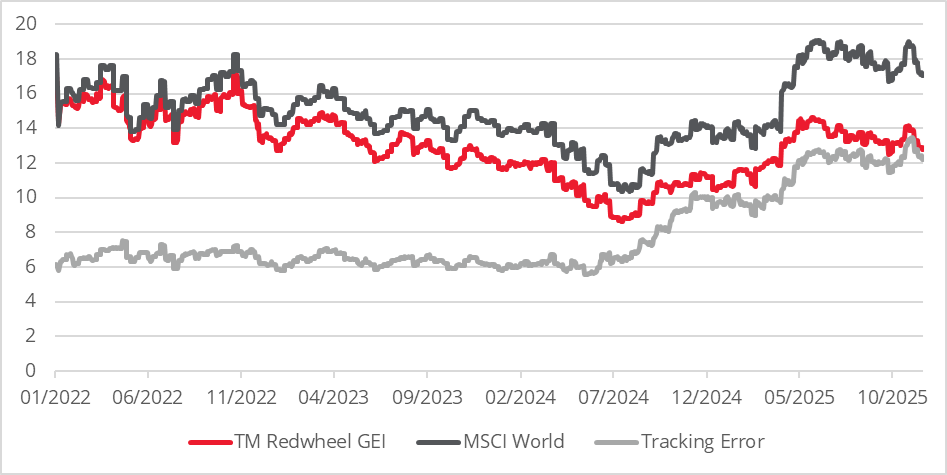
This deliberate exclusion means tracking error rises—not due to risk-taking or a breach of discipline, but because the strategy refuses to compromise its standards even as the index becomes riskier. Investment discipline, not deliberate risk-taking, is behind the divergence from the benchmark.
Chart 2: : Volatility and tracking error – Redwheel Global Equity Income vs MSCI World index
However, most risk systems are not equipped to distinguish this nuance. Ironically, what flags as added risk within models may in fact reflect sensible, long-term risk management—particularly when index returns are being driven by a very narrow cadre of expensive and increasingly volatile stocks.
It’s in these conditions where the true benefit of a disciplined, income-oriented process comes to the fore. Over time, the power of compounding premium dividends, combined with a lower beta profile, can provide a pathway to more consistent, defensible returns. This effect is often amplified during periods of volatility when not losing money becomes mathematically more important than making money, even if the end results are positive. These strategies can therefore deliver their strongest outperformance when the broader index experiences increased volatility or a pullback.
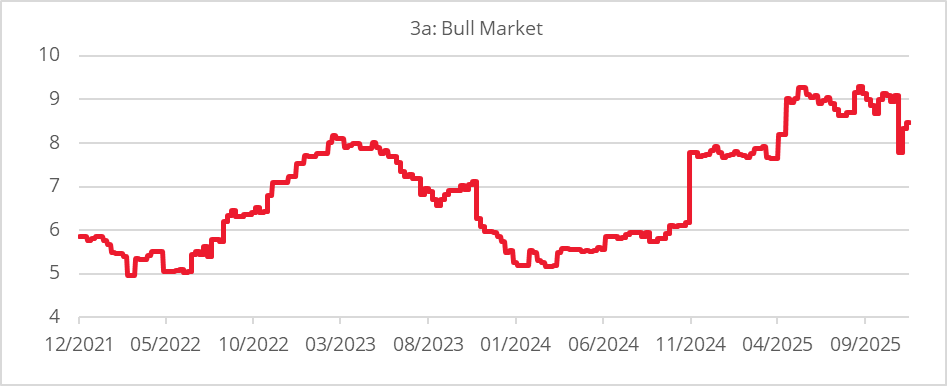
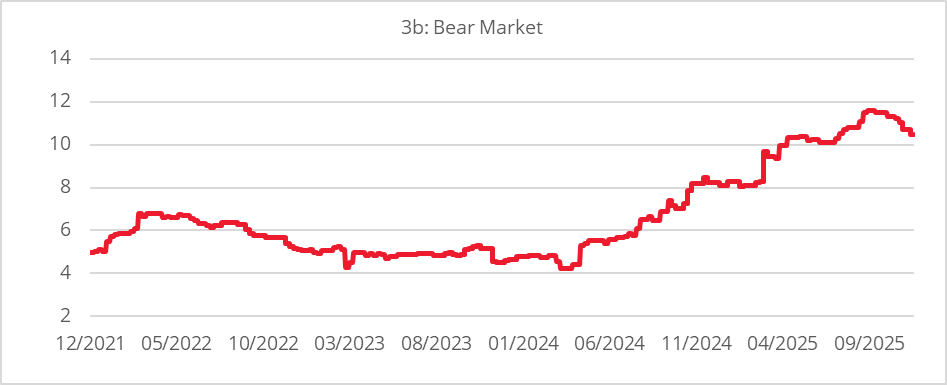
Chart 3 shows that, for Redwheel’s strategy, tracking error and the increase in tracking error are both greatest in bear market scenarios: rising from 4 to 11 in the bottom chart (bear market) vs. 5 to 9 in the top chart (bull market).
Charts 3a and 3b: Redwheel Global Equity Income strategy – tracking error in bull and bear markets
Increasing tracking error can therefore be less a sign of recklessness and more an indicator of smart, intentional risk allocation as volatility rises. The strategy’s smoothing effect on returns becomes paramount when compounding through more challenging cycles.
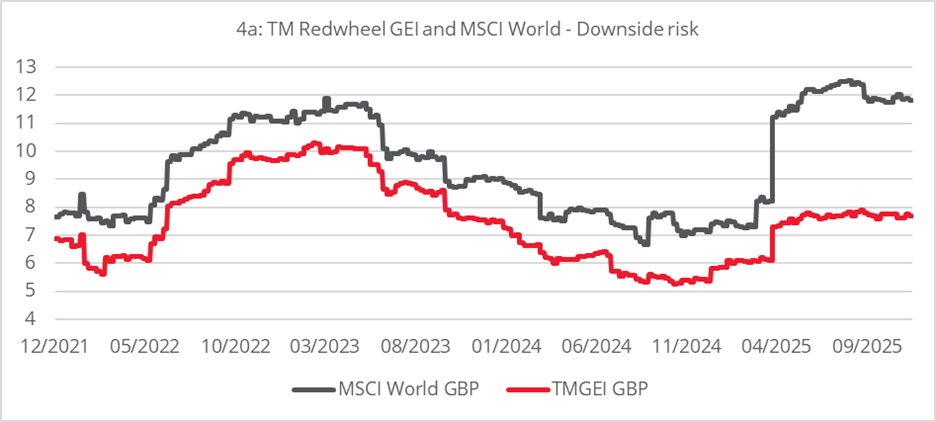
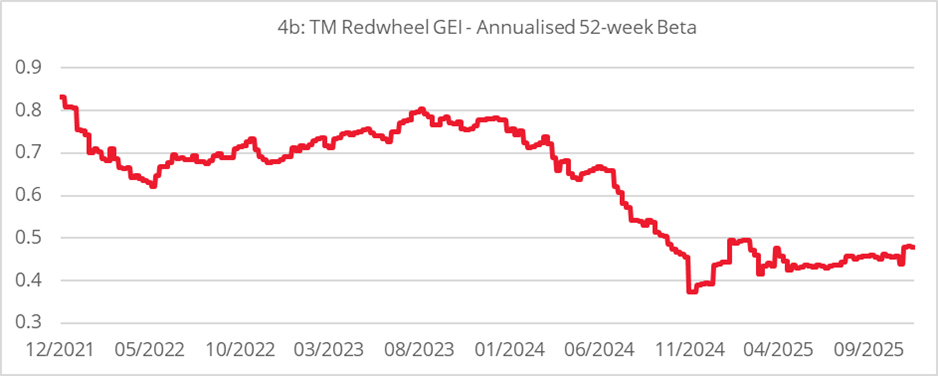
Chart 4 adds further support to this point, showing how downside risk is rising more for the benchmark than the strategy in combination with a declining beta.
Charts 4a and 4b: Redwheel Global Equity Income strategy – Downside risk and declining beta
We see three possible scenarios from here:
Disciplined equity income strategies will naturally lag the index in the first scenario, when steady, low-volatility rallies favour concentrated, high-beta plays. But in the second and third scenarios—both of which now seem increasingly likely as volatility returns and concentration risks build—an approach grounded in yield, quality, and risk discipline is far more likely to deliver resilient, attractive returns for long-term investors.
Tracking error is often misunderstood as a pure risk metric, requiring a deeper analysis than those provided by risk systems. For strategies focused on quality and value, a rise in tracking error may be a mark of discipline, rather than deviation.
As market conditions shift from straight-line growth toward greater volatility or correction, the ability to hold course—delivering consistent returns uncorrelated to a concentrated index—will be essential for investors. Not all tracking error reflects risk to be feared; for resilient strategies, it may be a leading indicator that the manager is doing exactly what is needed for sustainable, long-term returns.
Key Information
No investment strategy or risk management technique can guarantee returns or eliminate risks in any market environment. Past performance is not a guide to the future. The prices of investments and income from them may fall as well as rise and investors may not get back the full amount invested. Forecasts and estimates are based upon subjective assumptions about circumstances and events that may not yet have taken place and may never do so. The statements and opinions expressed in this article are those of the author as of the date of publication, and do not necessarily represent the view of Redwheel. This article does not constitute investment advice and the information shown is for illustrative purposes only.
Representative Portfolio
Portfolio characteristics, top ten holdings, sector allocation, country allocation, attribution, volatility, yield, dividend and ESG information are based on a representative portfolio, which is TM Redwheel Global Equity Income Fund.
Redwheel believes that precisely this account within the strategy most closely reflects the current portfolio management style for the Redwheel Global Equity Income Strategy. Portfolio holdings are subject to change without notice. The information shown is for illustrative purposes only and is not intended to be, and should not be interpreted as, recommendations or advice.
Watch the latest video from Portfolio Manager, Davide Basile, to learn more about Redwheel's Enhanced Index Focus Convertibles Strategy.
Watch a recent video from John Malloy, Co-Head, Redwheel Global Emerging & Frontier Markets team to learn how global emerging markets are positioned amid rising oil prices and renewed geopolitical tensions.
In his recent insight, Nick Clay argues that today’s pickup in inflation, AI disruption and private markets stress signals a return to historically normal, higher volatility. He explains why consistent compounding, downside protection, resilient cash flows and valuation discipline are crucial to turning volatile markets from a risk into an opportunity.
Redwheel ® and Ecofin ® are registered trademarks of RWC Partners Limited (“RWC”). The term “Redwheel” may include any one or more Redwheel branded regulated entities including RWC Asset Management LLP, which is authorised and regulated by the UK Financial Conduct Authority and the US Securities and Exchange Commission (“SEC”); RWC Asset Advisors (US) LLC, which is registered with the SEC; RWC Singapore (Pte) Limited, which is licensed as a Licensed Fund Management Company by the Monetary Authority of Singapore; Redwheel Australia Pty Ltd is an Australian Financial Services Licensee with the Australian Securities and Investment Commission; and Redwheel Europe Fondsmæglerselskab A/S which is regulated by the Danish Financial Supervisory Authority.
Redwheel may act as investment manager or adviser, or otherwise provide services, to more than one product pursuing a similar investment strategy or focus to the product detailed in this document. Redwheel and RWC (together “Redwheel Group”) seeks to minimise any conflicts of interest, and endeavours to act at all times in accordance with its legal and regulatory obligations as well as its own policies and codes of conduct.
This document is directed only at professional, institutional, wholesale or qualified investors. The services provided by Redwheel are available only to such persons. It is not intended for distribution to and should not be relied on by any person who would qualify as a retail or individual investor in any jurisdiction or for distribution to, or use by, any person or entity in any jurisdiction where such distribution or use would be contrary to local law or regulation.
This document has been prepared for general information purposes only and has not been delivered for registration in any jurisdiction nor has its content been reviewed or approved by any regulatory authority in any jurisdiction.
The information contained herein does not constitute: (i) a binding legal agreement; (ii) legal, regulatory, tax, accounting or other advice; (iii) an offer, recommendation or solicitation to buy or sell shares in any fund, security, commodity, financial instrument or derivative linked to, or otherwise included in a portfolio managed or advised by Redwheel; or (iv) an offer to enter into any other transaction whatsoever (each a “Transaction”). Redwheel Group bears no responsibility for your investment research and/or investment decisions and you should consult your own lawyer, accountant, tax adviser or other professional adviser before entering into any Transaction. No representations and/or warranties are made that the information contained herein is either up to date and/or accurate and is not intended to be used or relied upon by any counterparty, investor or any other third party.
Redwheel Group uses information from third party vendors, such as statistical and other data, that it believes to be reliable. However, the accuracy of this data, which may be used to calculate results or otherwise compile data that finds its way over time into Redwheel Group research data stored on its systems, is not guaranteed. If such information is not accurate, some of the conclusions reached or statements made may be adversely affected. Any opinion expressed herein, which may be subjective in nature, may not be shared by all directors, officers, employees, or representatives of Group and may be subject to change without notice. Redwheel Group is not liable for any decisions made or actions or inactions taken by you or others based on the contents of this document and neither Redwheel Group nor any of its directors, officers, employees, or representatives (including affiliates) accepts any liability whatsoever for any errors and/or omissions or for any direct, indirect, special, incidental, or consequential loss, damages, or expenses of any kind howsoever arising from the use of, or reliance on, any information contained herein.
Information contained in this document should not be viewed as indicative of future results. Past performance of any Transaction is not indicative of future results. The value of investments can go down as well as up. Certain assumptions and forward looking statements may have been made either for modelling purposes, to simplify the presentation and/or calculation of any projections or estimates contained herein and Redwheel Group does not represent that that any such assumptions or statements will reflect actual future events or that all assumptions have been considered or stated. There can be no assurance that estimated returns or projections will be realised or that actual returns or performance results will not materially differ from those estimated herein. Some of the information contained in this document may be aggregated data of Transactions executed by Redwheel that has been compiled so as not to identify the underlying Transactions of any particular customer.
No representations or warranties of any kind are intended or should be inferred with respect to the economic return from, or the tax consequences of, an investment in a Redwheel-managed fund.
This document expresses no views as to the suitability or appropriateness of the fund or any other investments described herein to the individual circumstances of any recipient.
The information transmitted is intended only for the person or entity to which it has been given and may contain confidential and/or privileged material. In accepting receipt of the information transmitted you agree that you and/or your affiliates, partners, directors, officers and employees, as applicable, will keep all information strictly confidential. Any review, retransmission, dissemination or other use of, or taking of any action in reliance upon, this information is prohibited. Any distribution or reproduction of this document is not authorised and is prohibited without the express written consent of Redwheel Group.
Funds managed by Redwheel are not, and will not be, registered under the Securities Act of 1933 (the “Securities Act”) and are not available for purchase by US persons (as defined in Regulation S under the Securities Act) except to persons who are “qualified purchasers” (as defined in the Investment Company Act of 1940) and “accredited investors” (as defined in Rule 501(a) under the Securities Act).
This document does not constitute an offer to sell, purchase, subscribe for or otherwise invest in units or shares of any fund managed by Redwheel. Any offering is made only pursuant to the relevant offering document and the relevant subscription application. Prospective investors should review the offering memorandum in its entirety, including the risk factors in the offering memorandum, before making a decision to invest.
AIFMD and Distribution in the European Economic Area (“EEA”)
The Alternative Fund Managers Directive (Directive 2011/61/EU) (“AIFMD”) is a regulatory regime which came into full effect in the EEA on 22 July 2014. RWC Asset Management LLP is an Alternative Investment Fund Manager (an “AIFM”) to certain funds managed by it (each an “AIF”). The AIFM is required to make available to investors certain prescribed information prior to their investment in an AIF. The majority of the prescribed information is contained in the latest Offering Document of the AIF. The remainder of the prescribed information is contained in the relevant AIF’s annual report and accounts. All of the information is provided in accordance with the AIFMD.
In relation to each member state of the EEA (each a “Member State”), this document may only be distributed and shares in a Redwheel fund (“Shares”) may only be offered and placed to the extent that (a) the relevant Redwheel fund is permitted to be marketed to professional investors in accordance with the AIFMD (as implemented into the local law/regulation of the relevant Member State); or (b) this document may otherwise be lawfully distributed and the Shares may lawfully be offered or placed in that Member State (including at the initiative of the investor).
Information Required for Offering in Switzerland of Foreign Collective Investment Schemes to Qualified Investors within the meaning of Article 10 CISA.
This is an advertising document.
The representative and paying agent of the Redwheel-managed funds in Switzerland (the “Representative in Switzerland”) FIRST INDEPENDENT FUND SERVICES LTD, Feldeggstrasse 12, CH-8008 Zurich. Swiss Paying Agent: Helvetische Bank AG, Seefeldstrasse 215, CH-8008 Zurich. In respect of the units of the Redwheel-managed funds offered in Switzerland, the place of performance is at the registered office of the Swiss Representative. The place of jurisdiction is at the registered office of the Swiss Representative or at the registered office or place of residence of the investor.

Redwheel ® and Ecofin ® are registered trademarks of RWC Partners Limited. The term “Redwheel” may include any one or more Redwheel regulated entities including RWC Asset Management LLP, which is authorised and regulated by the Financial Conduct Authority in the United Kingdom (“RWC”). RWC is incorporated in England and Wales with its registered office at Verde 4th Floor, 10 Bressenden Place, London, SW1E 5DH, United Kingdom and its registered number is OC332015.