








Convertible Bonds (Wandelanleihen) bieten eine hybride Lösung für Anleger, die ein ausgewogenes Engagement an den Finanzmärkten anstreben, welches die attraktiven Merkmale von Aktien und Anleihen kombiniert. Sie zielen darauf ab, in starken Marktphasen an Kursgewinnen teilzuhaben und gleichzeitig das Kapital in schwächeren Märkten zu schützen.
Emerging- und Frontier-Märkte-Strategien konzentrieren sich darauf, Wachstumschancen in den weltweit am schnellsten wachsenden Volkswirtschaften zu erschließen. Mit einem langjährigen, indexunabhängigen Ansatz investiert das Team sowohl direkt in diese Märkte als auch in Unternehmen aus den entwickelten Märkten, die dort ein bedeutendes Exposure haben.
Durch die Nutzung der Dividendenrenditen strebt das Redwheel Team an, mit Investitionen in ein diversifiziertes Portfolio globaler Aktien eine Kombination aus Erträgen und langfristigem Kapitalwachstum zu erzielen. Der Fonds richtet sich an Anleger, die einen disziplinierten Ansatz suchen und eine einzigartige Kombination aus überdurchschnittlicher Rendite, beständigen Erträgen und attraktiver Bewertung anstreben, während sie selektiv in übersehene Chancen investieren, bei denen kurzfristige Kontroversen zu potenziellen Fehlbewertungen geführt haben.
Ian Lance und Nick Purves führen das Global Intrinsic Value Team. Sie verfügen über mehr als 30 Jahre Erfahrung im Investmentbereich und arbeiten seit fast 20 Jahren gemeinsam in unterschiedlichen Marktzyklen. Mit ihrem Team globaler Analysten sind sie überzeugte Value-Investoren, die unterbewertete, zukunftsfähige Unternehmen mit starken Cashflows und soliden Bilanzen identifizieren.
Strukturelle Veränderungen, die durch neue Regulierungen, technologische Innovationen und die globale Energiewende vorangetrieben werden, schaffen langfristige Wachstumschancen in allen Infrastruktursektoren. Unsere börsennotierte Infrastrukturstrategie „Listed Infrastructure“ investiert in börsennotierte Unternehmen in Industrie- und Schwellenländern, die wesentliche Dienstleistungen und Anlagen bereitstellen, welche die Wirtschaftstätigkeit und die gesellschaftliche Entwicklung vorantreiben. Das Anlagespektrum umfasst Strom- und Gasversorger, Verkehrsinfrastruktur sowie Umweltdienstleister, die von der steigenden Stromnachfrage, der Dekarbonisierung und dem Elektrifizierungstrend profitieren dürften.
Unsere Natural Capital Strategie strebt langfristiges Kapitalwachstum an, indem sie in globale Unternehmen investiert, die zur Erhaltung und Wiederherstellung der natürlichen Ressourcen unseres Planeten beitragen. Während Ökosysteme trotz ihrer grundlegenden Bedeutung für die wirtschaftliche und gesellschaftliche Stabilität einem zunehmenden Druck durch Umweltverschmutzung und Ressourcenverknappung ausgesetzt sind, sehen wir in naturbejahenden Lösungen eine vielversprechende Chance.
Unsere Active-Ownership-Strategien basieren auf der Überzeugung, dass Unternehmen mit aktiven, engagierten Aktionären mit größerer Wahrscheinlichkeit überdurchschnittliche langfristige Renditen erzielen. Der Schwerpunkt der Strategien liegt auf Investitionen in konzentrierte Portfolios europäischer und japanischer Unternehmen, die offen für Engagement sind, wobei gezielt fundamental solide Geschäftsmodelle mit erheblichem Aufwärtspotenzial über einen Zeithorizont von drei bis fünf Jahren ausgewählt werden.

Bei Redwheel ist Stewardship unser übergeordneter Ansatz für verantwortungsbewusstes Investieren, der Nachhaltigkeit, Active Ownership sowie Greenwheel Research & Insights in einem einheitlichen, disziplinierten Rahmen vereint. Im Rahmen dieses Ansatzes integrieren wir wesentliche Nachhaltigkeitsaspekte in unsere Anlageentscheidungen, unterstützen unsere Investmentteams mit zentral gebündelter Expertise und nutzen gezieltes Engagement, Stimmrechtsausübung sowie thematische Analysen, um langfristige Kundenergebnisse zu schützen und zu verbessern.


The winter holidays are a time for many different family traditions, but one that seems to be most widespread is using the time off to settle down to a movie – often, a cultural classic. In my case, this year’s film was the romantic icon Casablanca, in which our hero, Rick – played by an ice-cool Humphrey Bogart – is thrust into a wartime intrigue, and forced to confront the sudden arrival of his long-lost love, Ilsa, the role which catapulted Ingrid Bergman to new heights of stardom.
Watching it again, I was struck by a theme that seems to flow through the story: the importance of being in the right place, at the right time, and making the right decisions. For those unfamiliar with the story – and a modest spoiler alert here – Rick just happens to run the bar where all the shady deals in town get done, and as such just happens to be slipped two Letters of Transit, worth their weight in gold to refugees desperate to escape the clutches of the Nazis. By pure coincidence, after obtaining the letters, the former love of his life Ilsa shows up with her husband in urgent need of someone to help them flee from the regime; Gestapo officers arrive in short order seeking to bring the two into custody.
Baffled by this sudden series of events, Bogart’s character memorably laments at the coincidence of it all:
“Of all the gin joints in all the towns in all the world, she walks into mine”
Ultimately, Rick is at the right place in the right time to help Ilsa flee to a better life, and must find within himself the fortitude to seize his opportunity to come to her aid, even if it means he will never see her again.
Whilst the tears of other viewers were flowing at the passion of it all, my thoughts, as they often do, turned to investing: as we have noted before, all forms of art hold an important lesson for the shrewd investor, and, to my mind, Casablanca is no exception. The message that the effortlessly smooth Humphry Bogart relays to investors is that, when one finds oneself fortuitously in the right place at the right time, one must act decisively to take advantage of the opportunity – and prevaricate at your peril.
From where we sit, the right place and the right time align today in one area in particular: small companies, especially cheap small companies (in light of our general investment philosophy, the emphasis on buying things cheap should hopefully come as no surprise to our regular readers).
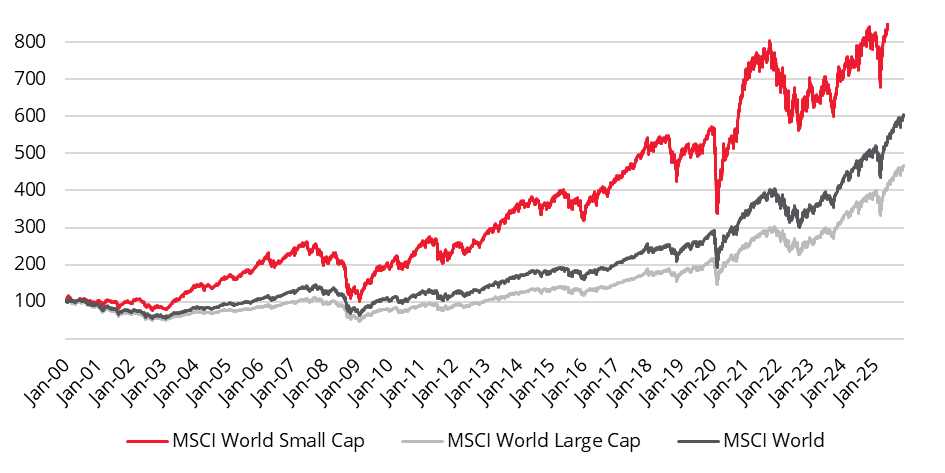
For starters, as a rule, small companies – which, using the MSCI World Small Cap index as a guide, are typically those companies smaller than ~$20bn in market capitalisation [1] – are a great place to look for long-term investing outperformance: for any given long-term time horizon, an investment in a small cap index will likely have beaten an investment made at the same time in larger companies, or indeed in the market in general. For example, $100 invested in the MSCI World Small Cap Index in 2000 would have been worth $951 at the end of 2025 – an annualised return of 9.1% – compared with $599 for the MSCI World, and just $463 for the MSCI World Large Cap index (annualised returns of 7.2% and 6.1%, respectively):
Chart 1: MSCI World Small Cap vs MSCI World and MSCI World Large Cap – long-term performance
Whilst this is certainly a soothing backdrop for the small company enthusiast, what stands out to us today is the recent underperformance of small cap companies when compared with larger companies, a gap which, when one looks to history, appears to be highly anomalous, and potentially profitable.
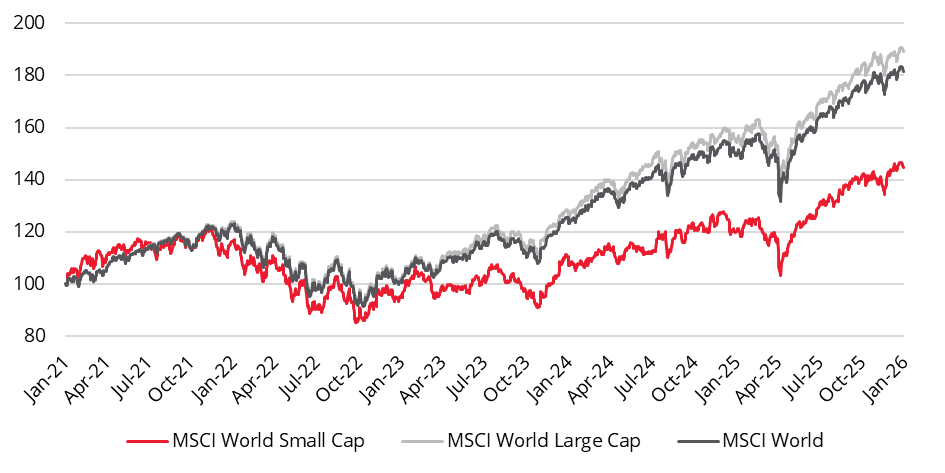
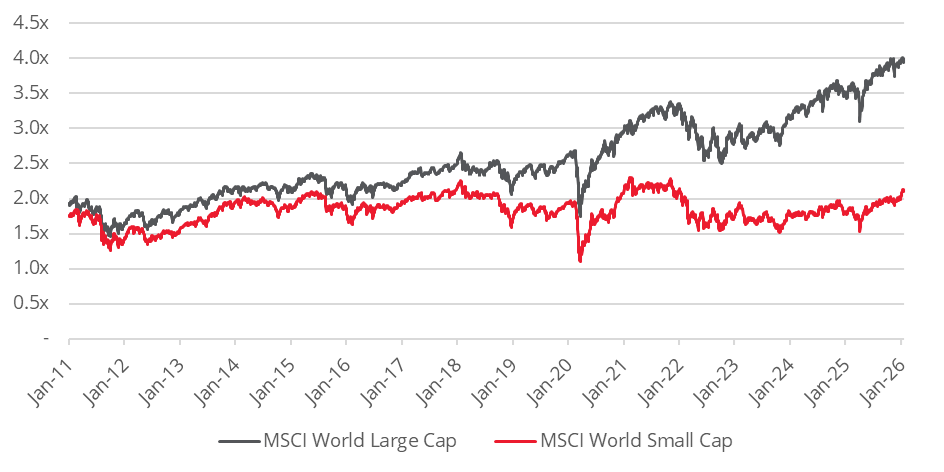
Take, for example the most recent five years of performance of both small and large companies from across the world, as shown below by the figures for the MSCI World Small Cap and MSCI World Large Cap, respectively. In a reversal of the long-term trend, large companies have hugely outperformed small companies since 2021, pushing up global markets as they become more and more concentrated, led by a handful of massive companies, and leaving smaller companies in the dust.
Chart 2: MSCI World Small Cap vs MSCI World and MSCI World Large Cap – 5-year performance
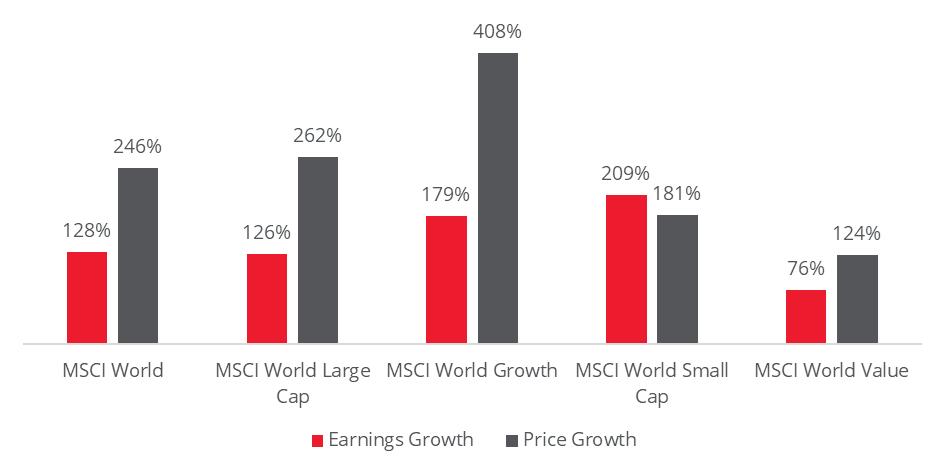
Whilst it might appear that the recent outperformance of large cap companies is driven by the exceptional earnings growth achieved by today’s leading tech giants, a closer look demonstrates that the aggregate earnings growth of large cap companies has been perfectly comparable to their smaller counterparts: from 2010 – 2025, MSCI World Large Cap companies have seen earnings grow by 126%, whilst the MSCI World Small Cap companies have grown their earnings by 209% over the same period – see Chart 3.
Despite this, the basket of larger companies will cost you 262% more than in 2010, compared with only 181% more for the smaller companies – much more in line with the improvement in earnings.
Chart 3: MSCI World Small Cap vs key global indices – relative earnings growth, 2010 – 2025
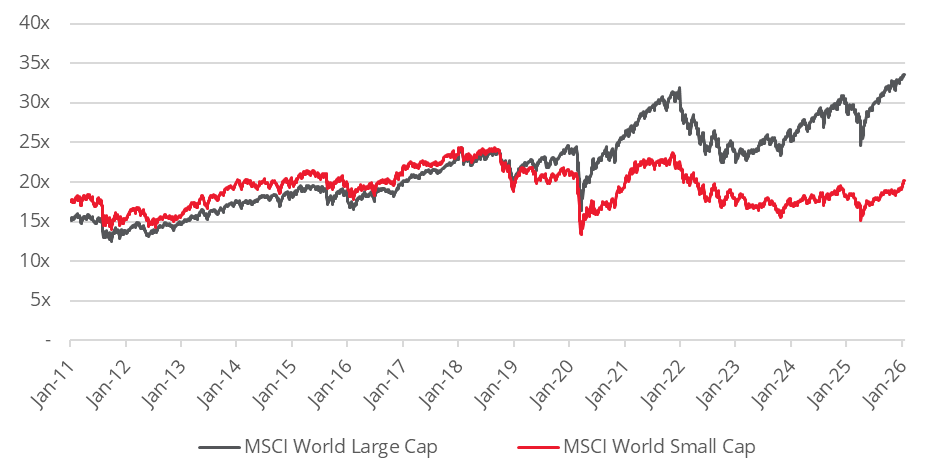
What this shows is that the large cap outperformance is simply a function of an expansion of valuation: investors have been willing to pay higher and higher prices for each $1 of earnings for large companies in the last five years, implying ever greater expectations that their futures will look as rosy as their past. An important corollary of this fact is that the returns from this valuation expansion are finite, and are at risk of unwinding: having a company go from 15x earnings to 30x earnings – with no change in income – does double your investment, but it would be imprudent to assume, on the back of an initial doubling, that your investment will double again. Indeed, continuing to own the same company at 30x runs the very real risk that you in fact end up on a round trip back to 15x – and are no better off than when you started.
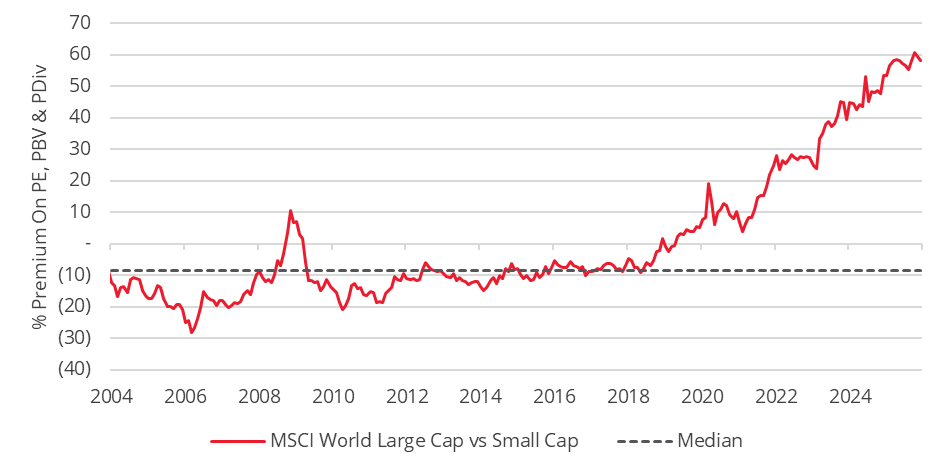
Alternatively, to make the valuation difference more explicit, we can chart simple valuation metrics, based on the fundamental earnings power and value embedded in each type of company. Again, what is clear is that larger companies, whilst certainly admirable and making great strides in business growth, are benefitting hugely of late from investors simply being willing to pay up for their earnings:
Chart 4a: MSCI World Small Cap vs Large Cap – CAPE, 2010 – 2025
Chart 4b: MSCI World Small Cap vs Large Cap – P/B, 2010 – 2025
Chart 4c: MSCI World Large Cap vs Small Cap – % premium on P/E, PBV and PDvd
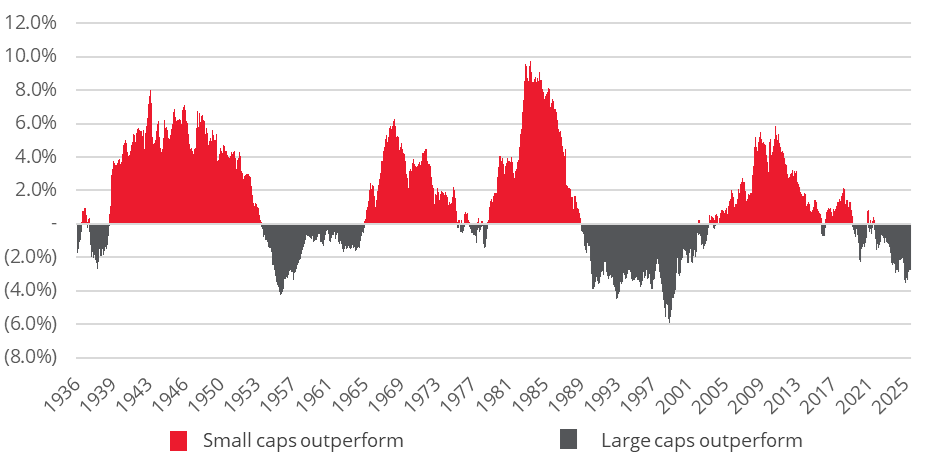
For us, this translates into opportunity. Not only is the small cap pond an excellent one in which to fish – given the long-run trend of superior performance – but it is being discounted today by investors whose eyes and wallets are glued to the very largest players, making it likely to be a wonderful place to find inexpensive companies with the potential for highly attractive returns. Looking back through history, we can be comforted that in similar periods, where large cap returns have outstripped those from their smaller brethren, the subsequent returns for the investor willing to take the plunge and buy cheap small cap companies have been material:
Chart 5: Small Cap vs Large Cap – relative trailing 10yr annualised return
The key, therefore, is to realise that we may just be in the right place at the right time – and to strike whilst the iron is hot.
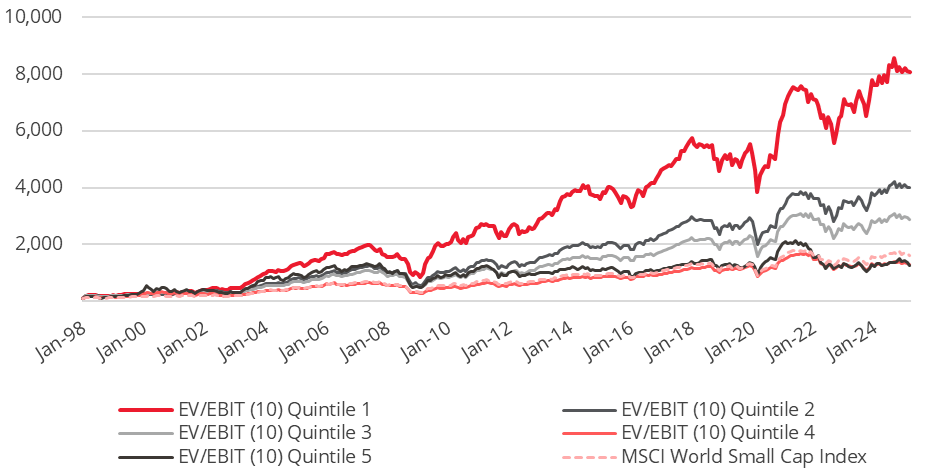
As well as feeling giddy at today’s opportunity set from buying small companies, investors should recall the return potential of value investing, the practice of buying companies with the widest discounts to intrinsic business value. Over time, this approach has tended to deliver persistent outperformance compared with owning more expensive companies, and this phenomenon – the bedrock of the value investing approach, and our investment philosophy – is similarly found in small companies:
Chart 6: MSCI World Small Cap by valuation quintile – performance
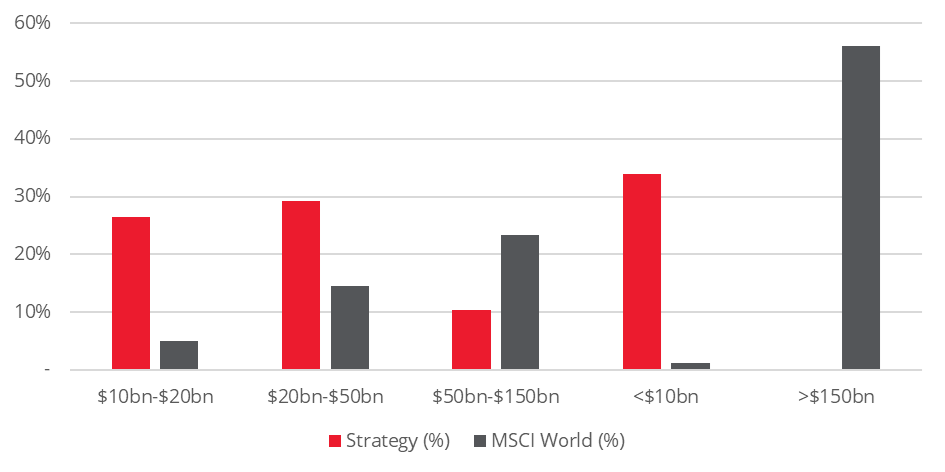
As a result, as disciplined value investors able to buy small cap companies, today we feel like children in a chocolate factory. The environment is ripe with opportunities for the discerning investor in small companies – opportunities that we are actively seeking to take. And as you’d expect, our money is very much where our mouth is: in our Global Intrinsic Value fund [2], we have 30% of our investments in companies smaller than $10bn in size (compared with 1% for the MSCI World), and a full 62% in companies smaller than $20bn (MSCI World: 6%) [2]. This is not something arrived at from some top-down plan, but instead merely a function of our fundamental, bottom-up approach: we go where we feel the value is to be had, and today – as our positioning can attest – we feel that there is more value on offer in small and medium sized companies:
Chart 7: Redwheel Global Intrinsic Value Strategy vs MSCI World – positioning by market cap
Indeed, so compelled are we by small cap’s prospects that we have recently launched a new, dedicated fund – the Redwheel Global Small Cap Value fund [4] – to apply our seasoned value investing disciplined to small companies in a focussed and unconstrained way. Of course, adding in a plug for our new fund makes these observations admittedly entirely self-serving – but it does not make them wrong. We see clear value today in smaller companies across the world, are invested accordingly, and intend to capitalise on that value.
Mindful of the imperative to seize the rewards of being in the right place at the right time, we are reminded of Rick’s iconic line at the end of Casablanca:
“If that plane leaves the ground and you’re not with him, you’ll regret it. Maybe not today. Maybe not tomorrow, but soon, and for the rest of your life”
As the small cap plane heads down the tarmac, we intend to be on it – and in the cheap seats.
Key Information
No investment strategy or risk management technique can guarantee returns or eliminate risks in any market environment. Past performance is not a guide to the future. The prices of investments and income from them may fall as well as rise and investors may not get back the full amount invested. Forecasts and estimates are based upon subjective assumptions about circumstances and events that may not yet have taken place and may never do so. The statements and opinions expressed in this article are those of the author as of the date of publication, and do not necessarily represent the view of Redwheel. This article does not constitute investment advice and the information shown is for illustrative purposes only.
References
[1] Formally, the MSCI World Small Cap Index includes the smallest c.14% of each country’s companies, adjusted for their free float
[2] This is a marketing communication. Please refer to the Fund’s Prospectus and KID/KIID before making any investment decisions.
[3] Portfolio holdings are subject to change at any time without notice. This information should not be construed as a recommendation to purchase or sell any security.
[4] This is a marketing communication. Please refer to the Fund’s Prospectus and KID/KIID before making any investment decisions.

Ecofin Portfolio Manager Michel Sznajer examines his strategy’s performance after previous peaks in bond yields and identifies potential takeover targets amid falling valuations and improving earnings prospects. Read his latest insight on the investment case for the sector—and the risks that could keep it under pressure.
Balanced convertibles are once again delivering meaningful equity participation while outpacing investment grade credit. Davide Basile, Portfolio Manager, Redwheel Convertible Bonds, argues that convertibles have reached a turning point, read more in his latest insight.
Two holdings in the Redwheel Global Equity Income strategy have agreed to be acquired this year, while a third has attracted takeover speculation – rare for a strategy invested in large, liquid companies. Nick Clay, Portfolio Manager, considers what this may reveal about the opportunity in durable businesses overlooked by a market fixated on a single theme.
Redwheel ® and Ecofin ® are registered trademarks of RWC Partners Limited (“RWC”). The term “Redwheel” may include any one or more Redwheel branded regulated entities including RWC Asset Management LLP, which is authorised and regulated by the UK Financial Conduct Authority and the US Securities and Exchange Commission (“SEC”); RWC Asset Advisors (US) LLC, which is registered with the SEC; RWC Singapore (Pte) Limited, which is licensed as a Licensed Fund Management Company by the Monetary Authority of Singapore; Redwheel Australia Pty Ltd is an Australian Financial Services Licensee with the Australian Securities and Investment Commission; and Redwheel Europe Fondsmæglerselskab A/S which is regulated by the Danish Financial Supervisory Authority.
Redwheel may act as investment manager or adviser, or otherwise provide services, to more than one product pursuing a similar investment strategy or focus to the product detailed in this document. Redwheel and RWC (together “Redwheel Group”) seeks to minimise any conflicts of interest, and endeavours to act at all times in accordance with its legal and regulatory obligations as well as its own policies and codes of conduct.
This document is directed only at professional, institutional, wholesale or qualified investors. The services provided by Redwheel are available only to such persons. It is not intended for distribution to and should not be relied on by any person who would qualify as a retail or individual investor in any jurisdiction or for distribution to, or use by, any person or entity in any jurisdiction where such distribution or use would be contrary to local law or regulation.
This document has been prepared for general information purposes only and has not been delivered for registration in any jurisdiction nor has its content been reviewed or approved by any regulatory authority in any jurisdiction.
The information contained herein does not constitute: (i) a binding legal agreement; (ii) legal, regulatory, tax, accounting or other advice; (iii) an offer, recommendation or solicitation to buy or sell shares in any fund, security, commodity, financial instrument or derivative linked to, or otherwise included in a portfolio managed or advised by Redwheel; or (iv) an offer to enter into any other transaction whatsoever (each a “Transaction”). Redwheel Group bears no responsibility for your investment research and/or investment decisions and you should consult your own lawyer, accountant, tax adviser or other professional adviser before entering into any Transaction. No representations and/or warranties are made that the information contained herein is either up to date and/or accurate and is not intended to be used or relied upon by any counterparty, investor or any other third party.
Redwheel Group uses information from third party vendors, such as statistical and other data, that it believes to be reliable. However, the accuracy of this data, which may be used to calculate results or otherwise compile data that finds its way over time into Redwheel Group research data stored on its systems, is not guaranteed. If such information is not accurate, some of the conclusions reached or statements made may be adversely affected. Any opinion expressed herein, which may be subjective in nature, may not be shared by all directors, officers, employees, or representatives of Group and may be subject to change without notice. Redwheel Group is not liable for any decisions made or actions or inactions taken by you or others based on the contents of this document and neither Redwheel Group nor any of its directors, officers, employees, or representatives (including affiliates) accepts any liability whatsoever for any errors and/or omissions or for any direct, indirect, special, incidental, or consequential loss, damages, or expenses of any kind howsoever arising from the use of, or reliance on, any information contained herein.
Information contained in this document should not be viewed as indicative of future results. Past performance of any Transaction is not indicative of future results. The value of investments can go down as well as up. Certain assumptions and forward looking statements may have been made either for modelling purposes, to simplify the presentation and/or calculation of any projections or estimates contained herein and Redwheel Group does not represent that that any such assumptions or statements will reflect actual future events or that all assumptions have been considered or stated. There can be no assurance that estimated returns or projections will be realised or that actual returns or performance results will not materially differ from those estimated herein. Some of the information contained in this document may be aggregated data of Transactions executed by Redwheel that has been compiled so as not to identify the underlying Transactions of any particular customer.
No representations or warranties of any kind are intended or should be inferred with respect to the economic return from, or the tax consequences of, an investment in a Redwheel-managed fund.
This document expresses no views as to the suitability or appropriateness of the fund or any other investments described herein to the individual circumstances of any recipient.
The information transmitted is intended only for the person or entity to which it has been given and may contain confidential and/or privileged material. In accepting receipt of the information transmitted you agree that you and/or your affiliates, partners, directors, officers and employees, as applicable, will keep all information strictly confidential. Any review, retransmission, dissemination or other use of, or taking of any action in reliance upon, this information is prohibited. Any distribution or reproduction of this document is not authorised and is prohibited without the express written consent of Redwheel Group.
Funds managed by Redwheel are not, and will not be, registered under the Securities Act of 1933 (the “Securities Act”) and are not available for purchase by US persons (as defined in Regulation S under the Securities Act) except to persons who are “qualified purchasers” (as defined in the Investment Company Act of 1940) and “accredited investors” (as defined in Rule 501(a) under the Securities Act).
This document does not constitute an offer to sell, purchase, subscribe for or otherwise invest in units or shares of any fund managed by Redwheel. Any offering is made only pursuant to the relevant offering document and the relevant subscription application. Prospective investors should review the offering memorandum in its entirety, including the risk factors in the offering memorandum, before making a decision to invest.
AIFMD and Distribution in the European Economic Area (“EEA”)
The Alternative Fund Managers Directive (Directive 2011/61/EU) (“AIFMD”) is a regulatory regime which came into full effect in the EEA on 22 July 2014. RWC Asset Management LLP is an Alternative Investment Fund Manager (an “AIFM”) to certain funds managed by it (each an “AIF”). The AIFM is required to make available to investors certain prescribed information prior to their investment in an AIF. The majority of the prescribed information is contained in the latest Offering Document of the AIF. The remainder of the prescribed information is contained in the relevant AIF’s annual report and accounts. All of the information is provided in accordance with the AIFMD.
In relation to each member state of the EEA (each a “Member State”), this document may only be distributed and shares in a Redwheel fund (“Shares”) may only be offered and placed to the extent that (a) the relevant Redwheel fund is permitted to be marketed to professional investors in accordance with the AIFMD (as implemented into the local law/regulation of the relevant Member State); or (b) this document may otherwise be lawfully distributed and the Shares may lawfully be offered or placed in that Member State (including at the initiative of the investor).
Information Required for Offering in Switzerland of Foreign Collective Investment Schemes to Qualified Investors within the meaning of Article 10 CISA.
This is an advertising document.
The representative and paying agent of the Redwheel-managed funds in Switzerland (the “Representative in Switzerland”) FIRST INDEPENDENT FUND SERVICES LTD, Feldeggstrasse 12, CH-8008 Zurich. Swiss Paying Agent: Helvetische Bank AG, Seefeldstrasse 215, CH-8008 Zurich. In respect of the units of the Redwheel-managed funds offered in Switzerland, the place of performance is at the registered office of the Swiss Representative. The place of jurisdiction is at the registered office of the Swiss Representative or at the registered office or place of residence of the investor.