









The equalizer

In the 1980s TV crime drama series, The Equalizer, and the more recent films of the same name, the ex-intelligence officer turned vigilante, Robert McCall, pursues justice on behalf of innocent people that have been in some way wronged. We aren’t looking to exact justice via this article, but we do wish to explore the inequality that currently exists within equity markets and society, with a view to understanding how they may, over time, normalise.

In the money

Global stock markets have rarely been this narrow. The biggest five stocks now account for 15% of the world index [1]. This handful of US stocks have been holding up the rest of the market, to the extent that, despite all the volatility we’ve seen so far this year, the S&P 500 index is, at the time of writing, only 8% off its all-time high [2]. Rising inflation, the expectation of multiple interest rate hikes this year, war in Ukraine – stock markets have done their best to shrug off all these concerns in an attempt to maintain their upward trajectory.

The headline index level masks a significant disparity within markets. The tech-heavy Nasdaq index has fared worse, down 17% from its November 2021 all-time high, and in March, it was reported that more than half of Nasdaq constituents has fallen at least 50% from their 52-week highs [3]. This suggests that all is not well in the stock market, but the continued positive fortunes of most of the tech titans that dominate the US stock market hides the pain being felt elsewhere.

Some history illustrates that this inequality – between the large stocks that have continued to do well, and practically everything else which has weakened – cannot last for much longer. Recent market behaviour adds to the valuation stretch that has been observable for some time – the expensive stocks have remained expensive, but the cheap ones have become even cheaper.

Breakpoint

It is in conditions like these that genuine long-term opportunities may be unearthed. We remain very wary of the valuation risk that exists among the index behemoths but are increasingly positive about some of the valuation anomalies that are developing elsewhere.

Take Inditex (Industria de Diseño Textil), for example, a Spanish-listed business that is best known for its Zara brand. Inditex is the largest fast fashion group in the world. Life has clearly not been easy for any retailer over the last couple of years. Indeed, in the spring of 2020, all of Inditex’s more than 6,000 physical stores were closed for a protracted period as we navigated the early, unsettling stages of the global Covid pandemic. Unsurprisingly, its share price was profoundly weak during the Covid sell-off, as the chart below illustrates, bottoming at slightly below €20 per share on 16 March 2020[4].

However, Inditex has not been sat on its hands for the last two years. One of its enduring strengths has been its ability to move rapidly to adapt to changing consumer preferences, which is critical in the world of fast fashion and has been a key element of the successful long-term compounding growth story. This cultural focus on flexibility has stood it in good stead through two challenging years during which it has transformed its business. It has launched a revived online sales platform in multiple markets, to successfully pivot its business towards e-commerce. Meanwhile, disciplined management of the cost base has enabled it to maintain gross margins – despite the temporary interruption to its customers’ ability to visit its stores.
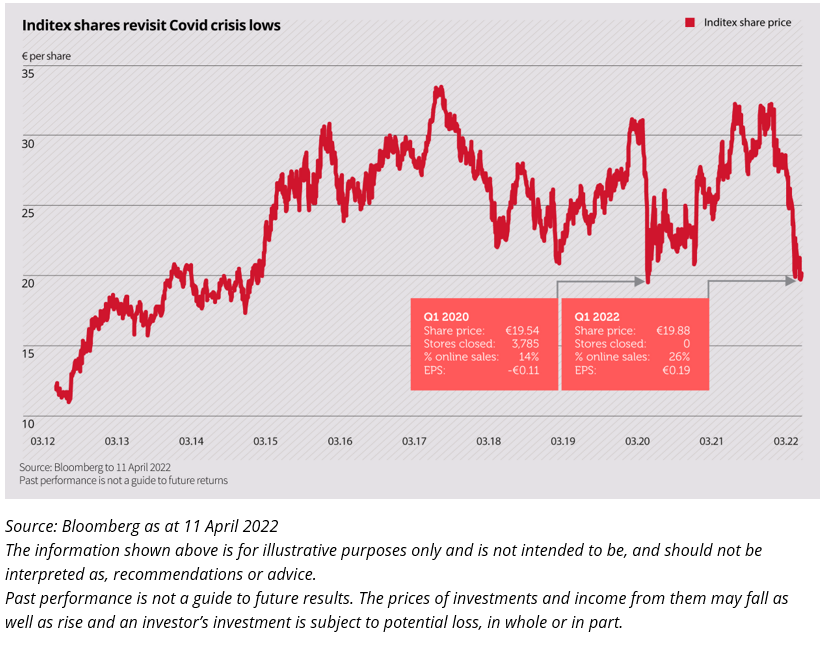
In short, the business is in a much stronger position today than it was in two years ago. So, it is surprising to see its share price revisiting the lows of 2020 in recent weeks.

Past imperfect

One further characteristic which we expect to be supportive to the long-term trading environment for Inditex – and indeed for all consumer facing companies – comes through the inequality that can be seen across society more broadly.
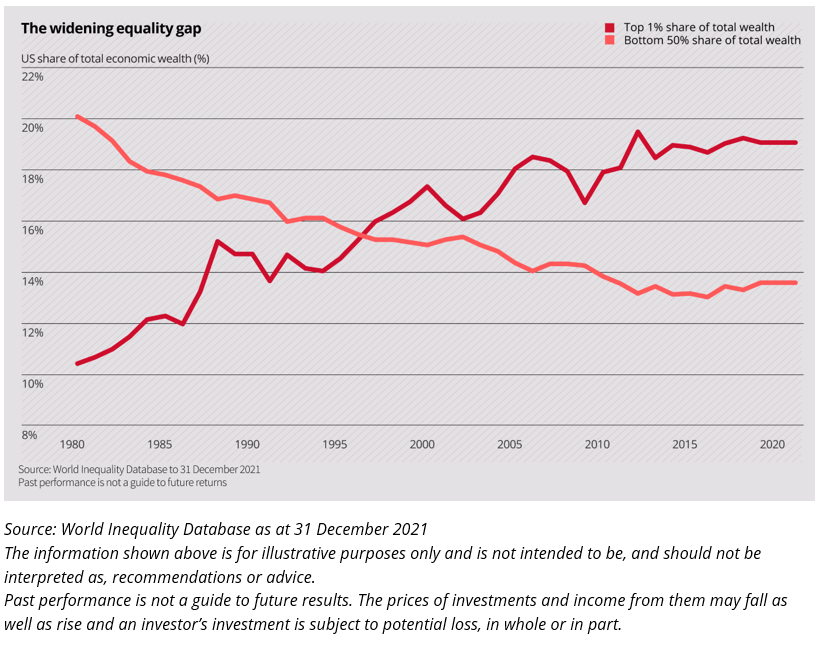
For more than a generation, wealth in most developed market economies has become more and more concentrated in the hands of fewer and fewer individuals. The trend is most observable in the United States, but it is by no means confined just to this economy. This equality gap started to emerge well before the era of extraordinary monetary policy, but quantitative easing (QE) has almost certainly played a role by rewarding those who own financial assets, while ignoring those who do not.

We may have crossed the Rubicon here. QE is in the process of being withdrawn, inflation is looking more and more entrenched, and, thanks to aging populations, labour forces are starting to shrink across much of the developed world. In pay negotiations, the hand of the employee looks stronger than it has for many, many years.

Perhaps more importantly, the concept of “levelling-up” is now a political debate. If politicians believe they can win extra votes by vowing to do something about it, they are bound to pursue the cause. Power to the people!

These factors are supportive of the idea that the gap between the wealthy and the rest may be beginning to shrink. The equality gap has taken decades to open and unwinding it will also inevitably take time. Overall, this is potentially a very positive development for consumers and consumer-facing businesses.

Endgame

The prospect of seeing labour gain a greater share of economic wealth is arguably a positive thing, not just for consumer-facing businesses, but for society and the economy as a whole.

This could be a theme which takes a long time to play out and it certainly doesn’t revolutionise the prospects of a retail business over night. But, in our view, it is incrementally positive, and it is something we are thinking about a lot more, as one of the many things we have to triangulate when building the portfolio. Coupled with the compelling valuation attraction that we see in the likes of Inditex, we are becoming increasingly positive about retail exposure within the portfolio.

As for the other inequality – that between the loved stocks and the loathed stocks – this is something which could be equalized much more rapidly. Timing such an eventuality is, of course, impossible to predict with any degree of certainty – even for Robert McCall. But history suggests the current bifurcation in markets cannot last for much longer.

[1] Source: Bloomberg as at 30 March 2022

[2] Source: Bloomberg as at 18 April 2022

[3] Source: Bloomberg / Societe Generale as at 09 March 2022

[4] Source: Bloomberg as at 16 March 2020

No investment strategy or risk management technique can guarantee returns or eliminate risks in any market environment.

Past performance is not a guide to future results. The prices of investments and income from them may fall as well as rise and an investor’s investment is subject to potential loss, in whole or in part.

The statements and opinions expressed in this article are those of the author as of the date of publication, and do not necessarily represent the view of Redwheel. This article does not constitute investment advice and the information shown is for illustrative purposes only.

In case you missed it

Convertible Bonds

Davide Basile, Lead Portfolio Manager, Redwheel Convertible Bonds, marks the first year of Redwheel’s Enhanced Index Focus Convertibles strategy. He explores the case for balanced global convertible exposure and explains how the Strategy’s three implementation levers seek to offset fees and enhance net returns.

9 September, 2026 | 03:10pm

Growing electricity demand and security of supply concerns put geothermal energy in the solutions spotlight. Geothermal provides near‑zero‑emissions baseload and flexible power plus direct heat at stable operating costs, with minimal land footprint and no fuel inputs.

7 September, 2026 | 12:38pm
Natural Capital

Natural capital is often framed as a narrow sustainability theme. A more useful way to think about it is that the biodiversity it supports and the ecosystem services that flow from it are part of the operating backbone of the real economy: the water, waste and environmental systems that allow cities to function, industries to expand and societies to remain productive under tightening resource and regulatory constraints. That is why the investable universe for natural capital solutions is broader, and more economically relevant, than it is often given credit for.

7 September, 2026 | 11:50am

Disclaimer

Redwheel ® and Ecofin ® are registered trademarks of RWC Partners Limited (“RWC”). The term “Redwheel” may include any one or more Redwheel branded regulated entities including RWC Asset Management LLP, which is authorised and regulated by the UK Financial Conduct Authority and the US Securities and Exchange Commission (“SEC”); RWC Asset Advisors (US) LLC, which is registered with the SEC;  RWC Singapore (Pte) Limited, which is licensed as a Licensed Fund Management Company by the Monetary Authority of Singapore; Redwheel Australia Pty Ltd is an Australian Financial Services Licensee with the Australian Securities and Investment Commission; and Redwheel Europe Fondsmæglerselskab A/S which is regulated by the Danish Financial Supervisory Authority.

Redwheel may act as investment manager or adviser, or otherwise provide services, to more than one product pursuing a similar investment strategy or focus to the product detailed in this document. Redwheel and RWC (together “Redwheel Group”) seeks to minimise any conflicts of interest, and endeavours to act at all times in accordance with its legal and regulatory obligations as well as its own policies and codes of conduct.

This document is directed only at professional, institutional, wholesale or qualified investors. The services provided by Redwheel are available only to such persons. It is not intended for distribution to and should not be relied on by any person who would qualify as a retail or individual investor in any jurisdiction or for distribution to, or use by, any person or entity in any jurisdiction where such distribution or use would be contrary to local law or regulation.

This document has been prepared for general information purposes only and has not been delivered for registration in any jurisdiction nor has its content been reviewed or approved by any regulatory authority in any jurisdiction.

The information contained herein does not constitute: (i) a binding legal agreement; (ii) legal, regulatory, tax, accounting or other advice; (iii) an offer, recommendation or solicitation to buy or sell shares in any fund, security, commodity, financial instrument or derivative linked to, or otherwise included in a portfolio managed or advised by Redwheel; or (iv) an offer to enter into any other transaction whatsoever (each a “Transaction”). Redwheel Group bears no responsibility for your investment research and/or investment decisions and you should consult your own lawyer, accountant, tax adviser or other professional adviser before entering into any Transaction. No representations and/or warranties are made that the information contained herein is either up to date and/or accurate and is not intended to be used or relied upon by any counterparty, investor or any other third party.

Redwheel Group uses information from third party vendors, such as statistical and other data, that it believes to be reliable. However, the accuracy of this data, which may be used to calculate results or otherwise compile data that finds its way over time into Redwheel Group research data stored on its systems, is not guaranteed. If such information is not accurate, some of the conclusions reached or statements made may be adversely affected. Any opinion expressed herein, which may be subjective in nature, may not be shared by all directors, officers, employees, or representatives of Group and may be subject to change without notice. Redwheel Group is not liable for any decisions made or actions or inactions taken by you or others based on the contents of this document and neither Redwheel Group nor any of its directors, officers, employees, or representatives (including affiliates) accepts any liability whatsoever for any errors and/or omissions or for any direct, indirect, special, incidental, or consequential loss, damages, or expenses of any kind howsoever arising from the use of, or reliance on, any information contained herein.

Information contained in this document should not be viewed as indicative of future results. Past performance of any Transaction is not indicative of future results. The value of investments can go down as well as up. Certain assumptions and forward looking statements may have been made either for modelling purposes, to simplify the presentation and/or calculation of any projections or estimates contained herein and Redwheel Group does not represent that that any such assumptions or statements will reflect actual future events or that all assumptions have been considered or stated. There can be no assurance that estimated returns or projections will be realised or that actual returns or performance results will not materially differ from those estimated herein. Some of the information contained in this document may be aggregated data of Transactions executed by Redwheel that has been compiled so as not to identify the underlying Transactions of any particular customer.

No representations or warranties of any kind are intended or should be inferred with respect to the economic return from, or the tax consequences of, an investment in a Redwheel-managed fund.

This document expresses no views as to the suitability or appropriateness of the fund or any other investments described herein to the individual circumstances of any recipient.

The information transmitted is intended only for the person or entity to which it has been given and may contain confidential and/or privileged material. In accepting receipt of the information transmitted you agree that you and/or your affiliates, partners, directors, officers and employees, as applicable, will keep all information strictly confidential. Any review, retransmission, dissemination or other use of, or taking of any action in reliance upon, this information is prohibited. Any distribution or reproduction of this document is not authorised and is prohibited without the express written consent of Redwheel Group.

Funds managed by Redwheel are not, and will not be, registered under the Securities Act of 1933 (the “Securities Act”) and are not available for purchase by US persons (as defined in Regulation S under the Securities Act) except to persons who are “qualified purchasers” (as defined in the Investment Company Act of 1940) and “accredited investors” (as defined in Rule 501(a) under the Securities Act).

This document does not constitute an offer to sell, purchase, subscribe for or otherwise invest in units or shares of any fund managed by Redwheel. Any offering is made only pursuant to the relevant offering document and the relevant subscription application. Prospective investors should review the offering memorandum in its entirety, including the risk factors in the offering memorandum, before making a decision to invest.

AIFMD and Distribution in the European Economic Area (“EEA”)

The Alternative Fund Managers Directive (Directive 2011/61/EU) (“AIFMD”) is a regulatory regime which came into full effect in the EEA on 22 July 2014. RWC Asset Management LLP is an Alternative Investment Fund Manager (an “AIFM”) to certain funds managed by it (each an “AIF”). The AIFM is required to make available to investors certain prescribed information prior to their investment in an AIF. The majority of the prescribed information is contained in the latest Offering Document of the AIF. The remainder of the prescribed information is contained in the relevant AIF’s annual report and accounts. All of the information is provided in accordance with the AIFMD.

In relation to each member state of the EEA (each a “Member State”), this document may only be distributed and shares in a Redwheel fund (“Shares”) may only be offered and placed to the extent that (a) the relevant Redwheel fund is permitted to be marketed to professional investors in accordance with the AIFMD (as implemented into the local law/regulation of the relevant Member State); or (b) this document may otherwise be lawfully distributed and the Shares may lawfully be offered or placed in that Member State (including at the initiative of the investor).

Information Required for Offering in Switzerland of Foreign Collective Investment Schemes to Qualified Investors within the meaning of Article 10 CISA.

This is an advertising document.

The representative and paying agent of the Redwheel-managed funds in Switzerland (the “Representative in Switzerland”) FIRST INDEPENDENT FUND SERVICES LTD, Feldeggstrasse 12, CH-8008 Zurich. Swiss Paying Agent: Helvetische Bank AG, Seefeldstrasse 215, CH-8008 Zurich. In respect of the units of the Redwheel-managed funds offered in Switzerland, the place of performance is at the registered office of the Swiss Representative. The place of jurisdiction is at the registered office of the Swiss Representative or at the registered office or place of residence of the investor.