










Convertible Bonds (Wandelanleihen) bieten eine hybride Lösung für Anleger, die ein ausgewogenes Engagement an den Finanzmärkten anstreben, welches die attraktiven Merkmale von Aktien und Anleihen kombiniert. Sie zielen darauf ab, in starken Marktphasen an Kursgewinnen teilzuhaben und gleichzeitig das Kapital in schwächeren Märkten zu schützen.
Emerging- und Frontier-Märkte-Strategien konzentrieren sich darauf, Wachstumschancen in den weltweit am schnellsten wachsenden Volkswirtschaften zu erschließen. Mit einem langjährigen, indexunabhängigen Ansatz investiert das Team sowohl direkt in diese Märkte als auch in Unternehmen aus den entwickelten Märkten, die dort ein bedeutendes Exposure haben.
Durch die Nutzung der Dividendenrenditen strebt das Redwheel Team an, mit Investitionen in ein diversifiziertes Portfolio globaler Aktien eine Kombination aus Erträgen und langfristigem Kapitalwachstum zu erzielen. Der Fonds richtet sich an Anleger, die einen disziplinierten Ansatz suchen und eine einzigartige Kombination aus überdurchschnittlicher Rendite, beständigen Erträgen und attraktiver Bewertung anstreben, während sie selektiv in übersehene Chancen investieren, bei denen kurzfristige Kontroversen zu potenziellen Fehlbewertungen geführt haben.
Ian Lance und Nick Purves führen das Global Intrinsic Value Team. Sie verfügen über mehr als 30 Jahre Erfahrung im Investmentbereich und arbeiten seit fast 20 Jahren gemeinsam in unterschiedlichen Marktzyklen. Mit ihrem Team globaler Analysten sind sie überzeugte Value-Investoren, die unterbewertete, zukunftsfähige Unternehmen mit starken Cashflows und soliden Bilanzen identifizieren.
Strukturelle Veränderungen, die durch neue Regulierungen, technologische Innovationen und die globale Energiewende vorangetrieben werden, schaffen langfristige Wachstumschancen in allen Infrastruktursektoren. Unsere börsennotierte Infrastrukturstrategie „Listed Infrastructure“ investiert in börsennotierte Unternehmen in Industrie- und Schwellenländern, die wesentliche Dienstleistungen und Anlagen bereitstellen, welche die Wirtschaftstätigkeit und die gesellschaftliche Entwicklung vorantreiben. Das Anlagespektrum umfasst Strom- und Gasversorger, Verkehrsinfrastruktur sowie Umweltdienstleister, die von der steigenden Stromnachfrage, der Dekarbonisierung und dem Elektrifizierungstrend profitieren dürften.
Unsere Natural Capital Strategie strebt langfristiges Kapitalwachstum an, indem sie in globale Unternehmen investiert, die zur Erhaltung und Wiederherstellung der natürlichen Ressourcen unseres Planeten beitragen. Während Ökosysteme trotz ihrer grundlegenden Bedeutung für die wirtschaftliche und gesellschaftliche Stabilität einem zunehmenden Druck durch Umweltverschmutzung und Ressourcenverknappung ausgesetzt sind, sehen wir in naturbejahenden Lösungen eine vielversprechende Chance.
Unsere Active-Ownership-Strategien basieren auf der Überzeugung, dass Unternehmen mit aktiven, engagierten Aktionären mit größerer Wahrscheinlichkeit überdurchschnittliche langfristige Renditen erzielen. Der Schwerpunkt der Strategien liegt auf Investitionen in konzentrierte Portfolios europäischer und japanischer Unternehmen, die offen für Engagement sind, wobei gezielt fundamental solide Geschäftsmodelle mit erheblichem Aufwärtspotenzial über einen Zeithorizont von drei bis fünf Jahren ausgewählt werden.

Bei Redwheel ist Stewardship unser übergeordneter Ansatz für verantwortungsbewusstes Investieren, der Nachhaltigkeit, Active Ownership sowie Greenwheel Research & Insights in einem einheitlichen, disziplinierten Rahmen vereint. Im Rahmen dieses Ansatzes integrieren wir wesentliche Nachhaltigkeitsaspekte in unsere Anlageentscheidungen, unterstützen unsere Investmentteams mit zentral gebündelter Expertise und nutzen gezieltes Engagement, Stimmrechtsausübung sowie thematische Analysen, um langfristige Kundenergebnisse zu schützen und zu verbessern.
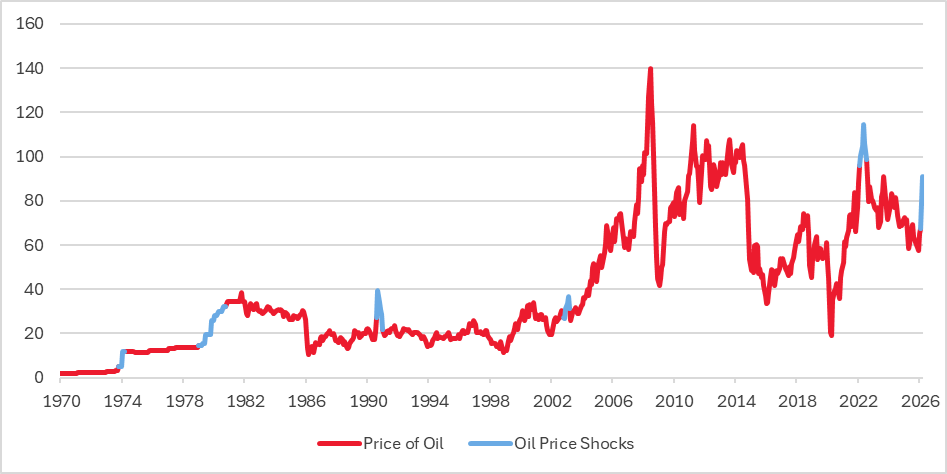
There have been several oil supply shocks since the 1970s that have caused oil price spikes, often caused by wars in the Middle East. Today’s jump in crude, triggered by renewed tensions with Iran, raises familiar but urgent questions: how high will oil prices go; how will they affect inflation and policy; and how can investors navigate the impact?
The Yom Kippur War of 1973 is the oldest and perhaps the most infamous example that disrupted post-war oil price stability, which was exacerbated by the Iranian Revolution in 1979. The Gulf War of 1990 and the Russian invasion of Ukraine are visible blips, as is the price reaction to Operation Epic Fury of March 2026.
Chart 1: The price of oil (US$)
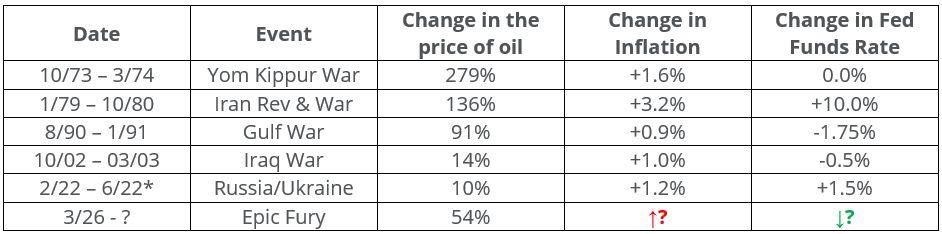
The percentage change in the price and duration of the shock are different on each occasion, leading to varying effects on growth, inflation and central bank monetary policy.
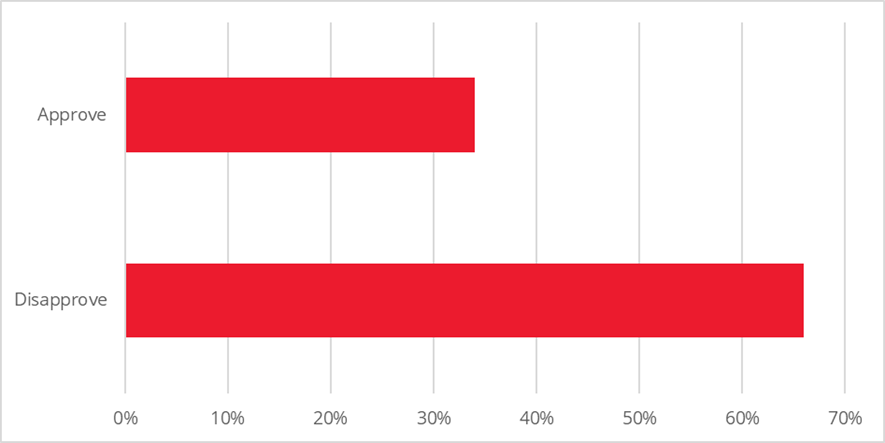
As seen above, the average increase in the price of oil has been about 100% over a 3-to-6-month period, except for the more extended Iranian Revolution and war with Iraq in 1979 -1980. Domestic political pressure to bring the war to a swift conclusion could bring the price of oil back down to the $80 range, and the market began to move in this direction after the two-week ceasefire announced on 8 April. [1]
Chart 2: Iran war approval ratings in the US – CNN poll
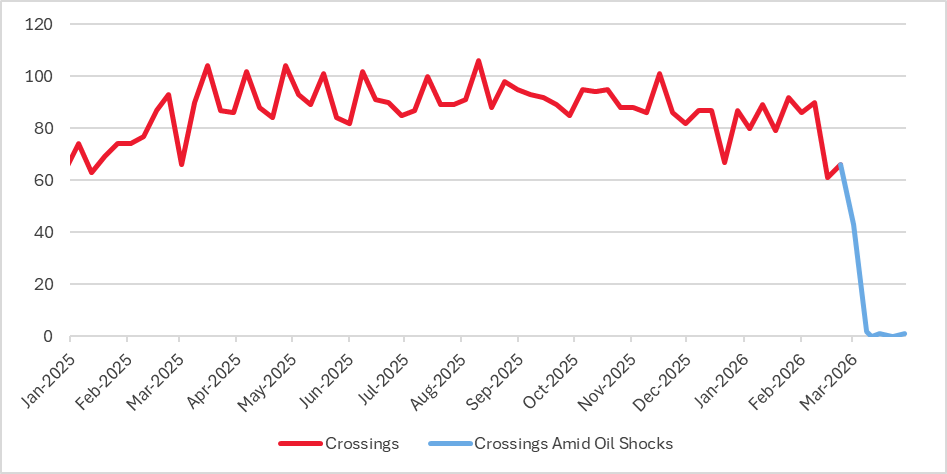
However, our advisers, Rice Hadley Gates & Manuel believe the ceasefire could be fragile due to disagreement over key demands from both sides. A more pessimistic outcome akin to the Arab oil embargo of late 1973 to early 1974 would imply a possible further increase in the oil price if tankers are unable to move freely through the Strait of Hormuz, which accounts for approximately 20% of daily shipments of crude oil and refined products. Rice Hadley Gates & Manuel emphasize that Iran is in control of the Straits of Hormuz; any renewed restrictions on free passage of shipping or a full blockade could make $150 – $200 per barrel of oil a possible outcome. We will continue to monitor the situation carefully over the next two weeks so that we can be in a position to respond to how events unfold.
Chart 3: Crude oil tankers crossing the Strait of Hormuz (7-day total)
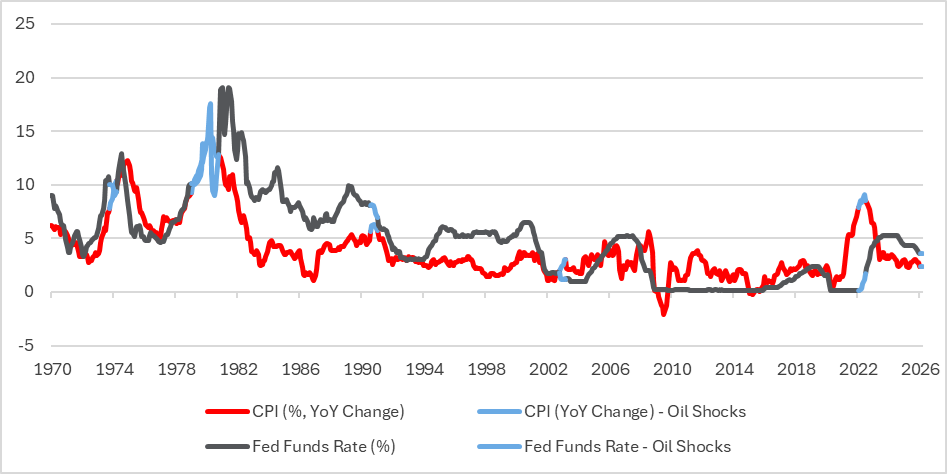
The rise in the price of oil has almost always caused an acceleration in the rate of inflation, and the Federal Reserve has responded either by raising rates to check inflation, or by cutting them to prevent recession. On this occasion, economic and political pressure is likely to push the Fed towards cutting.
Chart 4: Inflation and US Fed Funds Rate
In the 1970s, the Federal Reserve was slow to respond to the inflationary effect of the oil shocks and responded forcefully in the late 1970s and early 1980s. However, the Federal Reserve reduced the overnight rate in the Gulf War and the invasion of Iraq because of equity bear markets that were underway at the same time.
Today it is difficult to forecast the Federal Reserve’s likely reaction to the unknown effects of the war with Iran on inflation and growth. On the one hand, inflation is currently above target and the jump in the price of oil is likely to push it higher, as has happened in the past. On the other hand, the Fed tends to ignore temporary effects of energy and food prices on core inflation, and might be more concerned about a weak labour market; President Trump nominated the next Fed Chair, Kevin Warsh, explicitly to reduce the policy rate. Consequently, Fed Funds futures now predict no rate cuts in 2026, having started the year with the expectation of 50 basis points of easing. [2]
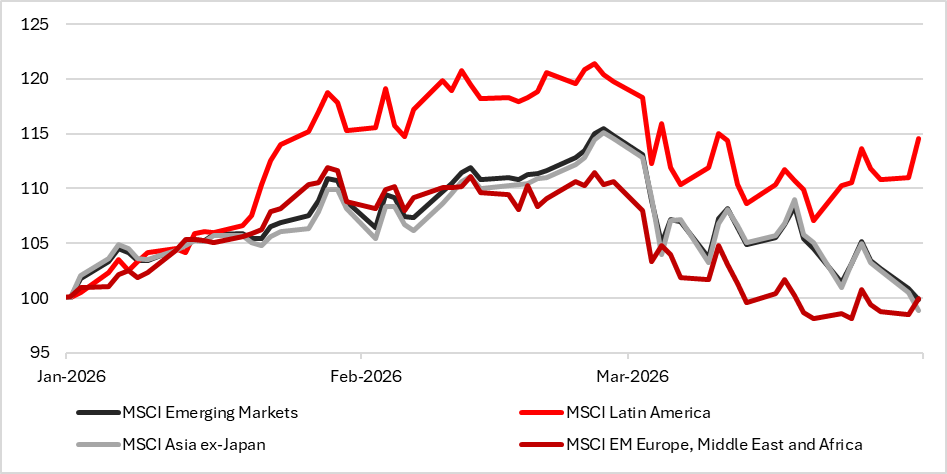
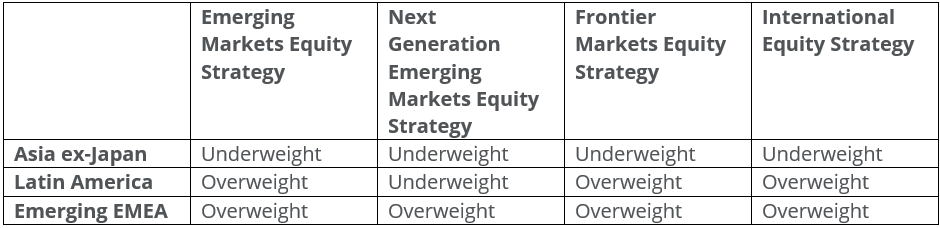
MSCI Emerging Market Indices were incepted on 1/1/88 and declined through the Gulf War, the invasion of Iraq and the Russian invasion of Ukraine. Our analysis indicates that Asia has always underperformed and Latin America has always outperformed during oil supply shocks, the former because of its reliance on imported oil and the latter because of its production of oil and agricultural commodities whose price increases improve terms of trade and support currencies. Regional performance has followed the historical trajectory so far in 2026, with Latin America outperforming the other regions.
Chart 5: Regional indices – total return (%)
Redwheel positioning – Regions
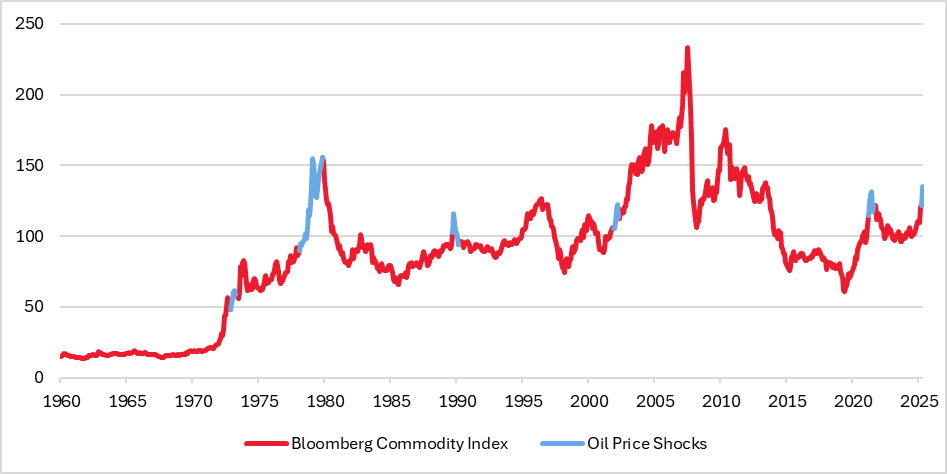
Sectoral analysis is less certain, for sectoral data are only available from 1995 and thus cover only two events, the Iraq war in 2003 and the Russian invasion of Ukraine in 2022, which caused Russia to be expelled from the MSCI Emerging Market indices. However, the Bloomberg Commodity Index, which contains 25 individual commodities, demonstrates that the commodity complex has moved in tandem with the oil price during previous energy crises.
Chart 6: Bloomberg Commodity Index
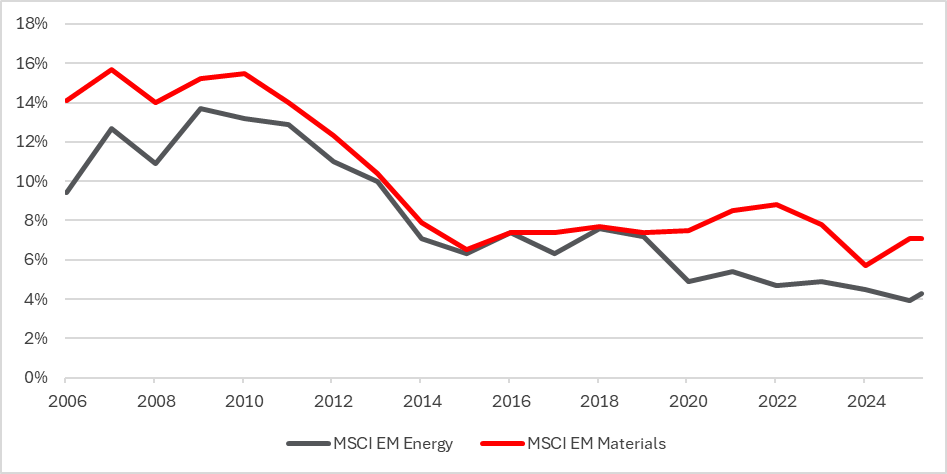
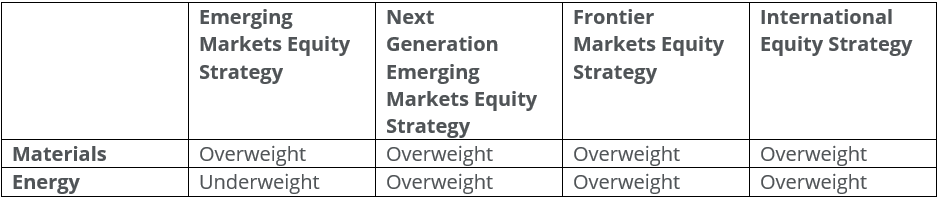
However, the Energy and Materials sectors of the MSCI Emerging Markets Index remain close to all-time low weights and should perform relatively better after the long bear market that followed the Global Financial Crisis in 2008. Energy is barely a third, and materials a half, of the weights that prevailed until 2010. We believe a renaissance for hard assets is overdue.
Chart 7: Energy and materials sectors – % weights of the MSCI EM Index
Redwheel positioning – Commodity sectors
Redwheel’s thematic approach to research identifies three trends that are likely to be affected by the sudden, sharp movement in the price of oil. First, the energy transition from hydrocarbons to sustainable production must be accelerated not only to reduce carbon dioxide emissions, but also to lessen dependence on fossil fuels with volatile prices. The transition requires growing quantities of industrial metals such as aluminium and copper, and the expertise of electrical, industrial and nuclear engineering firms to modernize and expand electricity grids worldwide.
Defence is an especially important theme for developed markets, with established large capitalization companies domiciled in Europe, UK and US. This theme is less obvious in emerging markets, but still apparent in the growing Aerospace and Defence sector.
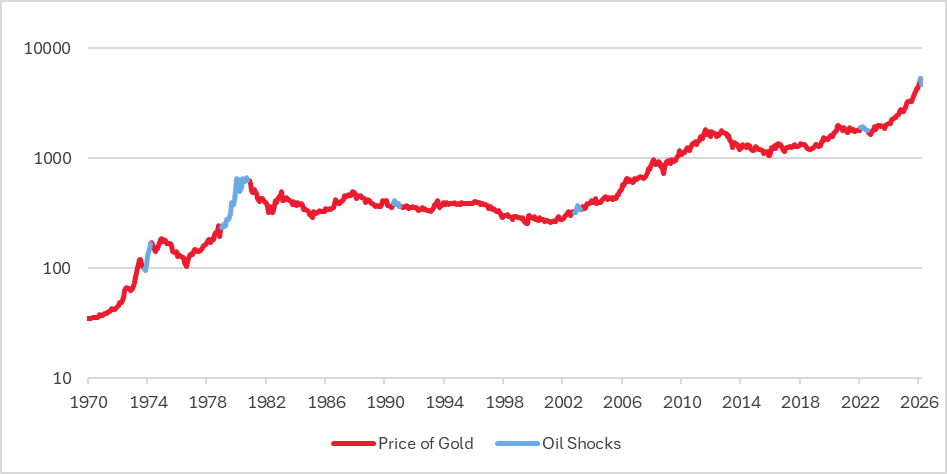
Second, gold traditionally acts as a haven in uncertain times and a hedge against inflation. The price of gold mirrored the price of oil in the 1970s, and, although the Gulf War did not initiate a flight to safety in 1990, gold began its long rally from the $300s during the Iraq War in 2003. The Russian invasion of Ukraine in 2022 elicited no immediate reaction from gold, but the bull market of the 2020s commenced a few months afterwards. Unlike oil, which spiked sharply on the invasion of Ukraine but ultimately faded, gold’s advance proved far more durable as the metal broke out to new all-time highs in late 2024 and eventually surpassed $5,000 per ounce. The long-term outlook remains constructive with the fundamental drivers still intact, though the current consolidation phase may persist as short-term trading profits are booked.
Chart 8: Gold price (US$/oz, log scale)
Redwheel positioning – Gold
While the scale and duration of the current disruption remain uncertain, the pattern of past crises suggests that investors should be prepared for more volatility in financial markets, renewed interest in hard assets and greater dispersion of returns across regions and sectors.
In such an environment, selective exposure to beneficiaries of higher energy and commodity prices, alongside structural themes such as the energy transition and defence, may offer a more resilient way to navigate the next phase of the cycle.
Key Information
No investment strategy or risk management technique can guarantee returns or eliminate risks in any market environment. Past performance is not a guide to the future. The prices of investments and income from them may fall as well as rise and investors may not get back the full amount invested. Forecasts and estimates are based upon subjective assumptions about circumstances and events that may not yet have taken place and may never do so. The statements and opinions expressed in this article are those of the author as of the date of publication, and do not necessarily represent the view of Redwheel. This article does not constitute investment advice and the information shown is for illustrative purposes only.
References
[1] Bloomberg, 9 April 2026
Redwheel ® and Ecofin ® are registered trademarks of RWC Partners Limited (“RWC”). The term “Redwheel” may include any one or more Redwheel branded regulated entities including RWC Asset Management LLP, which is authorised and regulated by the UK Financial Conduct Authority and the US Securities and Exchange Commission (“SEC”); RWC Asset Advisors (US) LLC, which is registered with the SEC; RWC Singapore (Pte) Limited, which is licensed as a Licensed Fund Management Company by the Monetary Authority of Singapore; Redwheel Australia Pty Ltd is an Australian Financial Services Licensee with the Australian Securities and Investment Commission; and Redwheel Europe Fondsmæglerselskab A/S which is regulated by the Danish Financial Supervisory Authority.
Redwheel may act as investment manager or adviser, or otherwise provide services, to more than one product pursuing a similar investment strategy or focus to the product detailed in this document. Redwheel and RWC (together “Redwheel Group”) seeks to minimise any conflicts of interest, and endeavours to act at all times in accordance with its legal and regulatory obligations as well as its own policies and codes of conduct.
This document is directed only at professional, institutional, wholesale or qualified investors. The services provided by Redwheel are available only to such persons. It is not intended for distribution to and should not be relied on by any person who would qualify as a retail or individual investor in any jurisdiction or for distribution to, or use by, any person or entity in any jurisdiction where such distribution or use would be contrary to local law or regulation.
This document has been prepared for general information purposes only and has not been delivered for registration in any jurisdiction nor has its content been reviewed or approved by any regulatory authority in any jurisdiction.
The information contained herein does not constitute: (i) a binding legal agreement; (ii) legal, regulatory, tax, accounting or other advice; (iii) an offer, recommendation or solicitation to buy or sell shares in any fund, security, commodity, financial instrument or derivative linked to, or otherwise included in a portfolio managed or advised by Redwheel; or (iv) an offer to enter into any other transaction whatsoever (each a “Transaction”). Redwheel Group bears no responsibility for your investment research and/or investment decisions and you should consult your own lawyer, accountant, tax adviser or other professional adviser before entering into any Transaction. No representations and/or warranties are made that the information contained herein is either up to date and/or accurate and is not intended to be used or relied upon by any counterparty, investor or any other third party.
Redwheel Group uses information from third party vendors, such as statistical and other data, that it believes to be reliable. However, the accuracy of this data, which may be used to calculate results or otherwise compile data that finds its way over time into Redwheel Group research data stored on its systems, is not guaranteed. If such information is not accurate, some of the conclusions reached or statements made may be adversely affected. Any opinion expressed herein, which may be subjective in nature, may not be shared by all directors, officers, employees, or representatives of Group and may be subject to change without notice. Redwheel Group is not liable for any decisions made or actions or inactions taken by you or others based on the contents of this document and neither Redwheel Group nor any of its directors, officers, employees, or representatives (including affiliates) accepts any liability whatsoever for any errors and/or omissions or for any direct, indirect, special, incidental, or consequential loss, damages, or expenses of any kind howsoever arising from the use of, or reliance on, any information contained herein.
Information contained in this document should not be viewed as indicative of future results. Past performance of any Transaction is not indicative of future results. The value of investments can go down as well as up. Certain assumptions and forward looking statements may have been made either for modelling purposes, to simplify the presentation and/or calculation of any projections or estimates contained herein and Redwheel Group does not represent that that any such assumptions or statements will reflect actual future events or that all assumptions have been considered or stated. There can be no assurance that estimated returns or projections will be realised or that actual returns or performance results will not materially differ from those estimated herein. Some of the information contained in this document may be aggregated data of Transactions executed by Redwheel that has been compiled so as not to identify the underlying Transactions of any particular customer.
No representations or warranties of any kind are intended or should be inferred with respect to the economic return from, or the tax consequences of, an investment in a Redwheel-managed fund.
This document expresses no views as to the suitability or appropriateness of the fund or any other investments described herein to the individual circumstances of any recipient.
The information transmitted is intended only for the person or entity to which it has been given and may contain confidential and/or privileged material. In accepting receipt of the information transmitted you agree that you and/or your affiliates, partners, directors, officers and employees, as applicable, will keep all information strictly confidential. Any review, retransmission, dissemination or other use of, or taking of any action in reliance upon, this information is prohibited. Any distribution or reproduction of this document is not authorised and is prohibited without the express written consent of Redwheel Group.
Funds managed by Redwheel are not, and will not be, registered under the Securities Act of 1933 (the “Securities Act”) and are not available for purchase by US persons (as defined in Regulation S under the Securities Act) except to persons who are “qualified purchasers” (as defined in the Investment Company Act of 1940) and “accredited investors” (as defined in Rule 501(a) under the Securities Act).
This document does not constitute an offer to sell, purchase, subscribe for or otherwise invest in units or shares of any fund managed by Redwheel. Any offering is made only pursuant to the relevant offering document and the relevant subscription application. Prospective investors should review the offering memorandum in its entirety, including the risk factors in the offering memorandum, before making a decision to invest.
AIFMD and Distribution in the European Economic Area (“EEA”)
The Alternative Fund Managers Directive (Directive 2011/61/EU) (“AIFMD”) is a regulatory regime which came into full effect in the EEA on 22 July 2014. RWC Asset Management LLP is an Alternative Investment Fund Manager (an “AIFM”) to certain funds managed by it (each an “AIF”). The AIFM is required to make available to investors certain prescribed information prior to their investment in an AIF. The majority of the prescribed information is contained in the latest Offering Document of the AIF. The remainder of the prescribed information is contained in the relevant AIF’s annual report and accounts. All of the information is provided in accordance with the AIFMD.
In relation to each member state of the EEA (each a “Member State”), this document may only be distributed and shares in a Redwheel fund (“Shares”) may only be offered and placed to the extent that (a) the relevant Redwheel fund is permitted to be marketed to professional investors in accordance with the AIFMD (as implemented into the local law/regulation of the relevant Member State); or (b) this document may otherwise be lawfully distributed and the Shares may lawfully be offered or placed in that Member State (including at the initiative of the investor).
Information Required for Offering in Switzerland of Foreign Collective Investment Schemes to Qualified Investors within the meaning of Article 10 CISA.
This is an advertising document.
The representative and paying agent of the Redwheel-managed funds in Switzerland (the “Representative in Switzerland”) FIRST INDEPENDENT FUND SERVICES LTD, Feldeggstrasse 12, CH-8008 Zurich. Swiss Paying Agent: Helvetische Bank AG, Seefeldstrasse 215, CH-8008 Zurich. In respect of the units of the Redwheel-managed funds offered in Switzerland, the place of performance is at the registered office of the Swiss Representative. The place of jurisdiction is at the registered office of the Swiss Representative or at the registered office or place of residence of the investor.