










UK Value & Income 2022 Outlook

Whilst I have never understood the need to write outlooks at the start of every year (why would the outlook change between 31st December and 1st January?), I thought it would be useful to provide an update on some of the themes that we have been discussing in the last eighteen months, particularly in light of some sharp price moves in the first couple of weeks of this year.

1. Inflation

Until recently, the market seems to have taken the view that inflation would be transitory and would eventually fall back to acceptable levels; this is the only way we can rationalise negative real (and in some cases negative nominal) bond yields, as well as the very high valuations of long duration assets such growth stocks. As time has gone by, however, this notion of transitory inflation has looked less plausible with even Jay Powell, Chairman of the Federal Reserve, recently saying “it’s probably a good time to retire that word (transitory) and try to explain more clearly what we mean when talking about inflation”.[1]

The following datapoints suggest that inflation is becoming a major issue and something that many investors have never had to contend with.

  • Producer price inflation in Spain, Italy and Germany is now running at 33%, 27% and 19% respectively (PPI YoY%, Bloomberg 31 December 2021).
  • In December 2021, US consumer price inflation was 7.0% year on year, the highest in 40 years; US producer price inflation came in at 9.6% year on year, the biggest annual gain ever (Bloomberg, 31 December 2021).
  • US house prices rose by 23% in 2021 which is faster than at the peak of the sub-prime bubble (Bloomberg, 31 December 2021).


One can no longer ignore the data, inflation is clearly picking up and continued supply disruption, as well as a potential energy crisis, suggest this could be with us for some time.

2. Central bank reaction

Understandably, many investors have been conditioned to believe that central banks will always prioritise supporting asset markets with low interest rates and quantitative easing over curbing inflation because this is how they have always behaved in the last decade. The so called ‘Powell pivot’ of 2018 was perhaps one of the clearest examples of this when Jay Powell’s attempt to unwind asset purchases by $50bn a month was met with a 20% decline in the stock market and complete capitulation by the Fed. This was easier to believe during a period when inflation was under control, but this no longer seems to be the case. A central bank that takes no action to curb inflation running at the levels noted above risks losing its credibility and if this happens, inflationary expectations become embedded in both consumers and manufacturers. It was, therefore, very notable that the recent minutes of the Federal Reserve Board meeting suggested that members felt it was appropriate to take firmer steps to control inflation.

”It may become warranted to increase the federal funds rate sooner or at a faster pace than participants had earlier anticipated. Some participants also noted that it could be appropriate to begin to reduce the size of the Federal Reserve’s balance sheet relatively soon after beginning to raise the federal funds rate. Some participants judged that a less accommodative future stance of policy would likely be warranted and that the Committee should convey a strong…”

Source: Federal Open Market Committee, as at 15th December 2021

This announcement has had a major impact. A few months ago, investors were assuming no rate rise in the US until April 2023 whereas they are now assuming four in 2022. In addition, the Fed has gone from talking about slowing down the pace of its quantitative easing programme to discussing shrinking the balance sheet which could involve selling bonds back into the market. This is a major shift. Central banks have been buying $26bn in assets every trading day since Covid began and hence added $10.5 trillion to their balance sheets between 2020-21. This year they are expected to subtract $0.6 trillion (Bloomberg, 31 December 2021).

Understandably, bond yields have moved up rapidly in reaction to this with the US ten-year yield approaching 1.8% (see chart below) and this has been accompanied by a sell-off in technology stocks with NASDAQ declining by 4.5% year to date (Bloomberg, 10 January 2022).
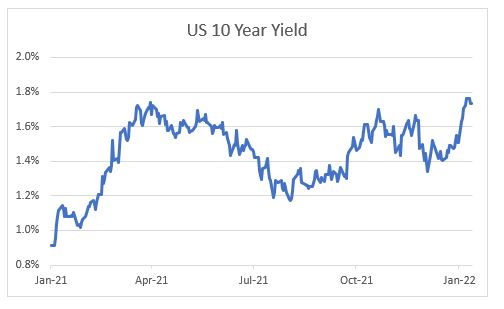
Source: Bloomberg, as at 10th January 2022 

The information shown above is for illustrative purposes only and is not intended to be, and should not be interpreted as, recommendations or advice.

Past performance is not a guide to future results. The prices of investments and income from them may fall as well as rise and an investor’s investment is subject to potential loss, in whole or in part.

3. Impact on long duration assets

This change of mindset from the Federal Reserve could have implications for overvalued long duration assets and technology stocks are possibly the most egregious example of this:

  • The median price to earnings ratio of the top ten largest stocks in the US is now 37x with the distinct possibility that these earnings represent peak margins which will come under pressure as input costs rise.
  • The largest five companies in the U.S. trade for 46x free cash flow or 57x if you remove the cash flow benefit of stock-based compensation. Stock compensation expenses were 19% of these firms’ collective free cash flow. 
  • Software stocks are almost twice as expensive as they were at the peak of the TMT bubble. The median stock in the sector now trades at 18x sales.
    (Bloomberg, 31 December 2021).


These sorts of valuations seem to assume that interest rates will remain low and that central banks will continue to supply the market with liquidity. As the Federal Reserve is now telling markets this is not the case, there would seem to be a lot of risk in this assumption and the implications of this are very significant.

4. Are markets starting to price in a regime change?

As we pointed out in a recent blog, Canary in the Coal Mine, investors could be forgiven for believing that markets remain very healthy if they merely looked at the large indices such as S&P 500 finishing +27% last year and NASDAQ +21% (Bloomberg, 31 December 2021). What these disguise, however, is the poor breadth of the market with four stocks (Microsoft, Apple, Nvidia and Google) generating over half of the S&P 500’s return in the final six months of the year (Bloomberg, 31 December 2021). We showed in that blog that beneath the surface things were far from healthy, for example, the Goldman Sachs non-profitable technology company index lost 28% in a month (16 November 2021 to 16 December 2021) whilst the ARK Innovation ETF had lost 40% from its peak in February 2021 (Bloomberg, 12 February 2021 to 31 December 2021). The Hang Seng tech index is down 48% (Bloomberg, 17 February 2021 to 31 December 2021), the SPDR biotech index is down 36% (Bloomberg, 08 February 2021 to 31 December 2021), bitcoin is down 31% from its high (Bloomberg, 10 November to 31 December 2021)

This was again highlighted in a recent article by Bloomberg[1] which pointed out that 40% of NASDAQ Composite stocks are down 50% or more from their 52-week high.

”Another way of thinking about the tech wreck: At no other point since the bursting of the dot-com bubble have so many companies fallen like this while the index itself was so close to a peak.”
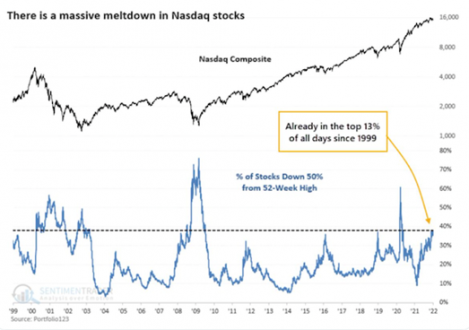
Source: Portfolio 123, as at 15th January 2022

The information shown above is for illustrative purposes only and is not intended to be, and should not be interpreted as, recommendations or advice.

Past performance is not a guide to future results. The prices of investments and income from them may fall as well as rise and an investor’s investment is subject to potential loss, in whole or in part.

It is worth noting that this has continued in to 2022, although the sell-off seems to have widened from the more speculative parts of the market. NASDAQ is down 4.5% in absolute terms including some the larger names with even Microsoft down 7% year to date and Google down 4%. Looking at sectors, there has been a marked divergence between energy related sectors such as Exploration and Production (+10.8) and Refiners (+11%) and Application Software (-13%) (Bloomberg, 10 January 2022).

5. Overvalued and over owned

When returns in a market become narrow fund managers normally have to own the stocks driving the market in order to have any chance of beating the index. Even taking this into account, every time I read a fund profile in the newspaper, I am simply staggered about the commonality of the names which appear in the top ten. It seems that everyone must now own Microsoft, Apple, Amazon, Alphabet, Visa, Mastercard, Paypal etc. In addition, because they are such a large part of the index, they often represent a large part of fund managers portfolios with 10% holdings in some of the biggest stocks not uncommon. Although the market still seems to favour these companies, it should be obvious that having such a large part of a portfolio allocated to such expensive stocks is not necessarily defensive – no matter how great you might think the companies are. I am also somewhat cynical of the view articulated by the owners of these stocks – that they were the perfect stocks to own in a low inflation, low interest rate environment and that they are also the perfect stocks to own in a high inflation, high interest rate environment. The performance of the Nifty Fifty stocks during the inflationary 1970’s doesn’t seem to support this thesis.

There is some evidence that the smart money is adjusting positioning. Among equity long short funds, net exposures are the least short value relative to growth in at least four years. On the quant side, value exposure has risen lately (and growth has fallen) such that net positioning between these two factors is at near highs once again.

6. Time to consider increasing exposure to value

There are numerous reasons to consider rotating to value at the moment:

  • Many investors seem to be heavily exposed to growth as recent returns have been so strong and they are extrapolating them forward. This ignores the fact that a good part of these gains has come as a result of a rerating (growth stocks getting more expensive). Not only is it mathematically unlikely that growth stocks can continue to rerate forever, it is actually more likely that future returns may be negatively impacted by a derating.
  • The gap in valuation between value and growth is greater now than it was in 2000. This should be an opportune time to rebalance from growth to value.
  • Some of the ‘value’ parts of the market are those that traditionally benefit during periods of rising inflation with energy, mining and banks being obvious examples.
  • A portfolio that mixes bonds with a variety of growth managers might look like it is diversified but it is actually a one-bet portfolio. If interest rates rise, then most of these assets are likely to suffer to varying degrees. Increasing exposure to value allows for greater diversification of risks.


We believe that continuous high inflation data has forced the central banks to finally take action before they lose what remains of their credibility and that this will have widespread implications after over a decade of loose monetary policy. Investors may be well advised to alter positioning to reflect this by reducing their exposure to growth equities and increasing exposure to value and particularly those sectors which benefit during a period of rising inflation such as energy, mining and banking.

The information shown above is for illustrative purposes only and is not intended to be, and should not be interpreted as, recommendations or advice.

The statements and opinions expressed in this article are those of the author as of the date of publication, and do not necessarily represent the view of RWC Partners Limited. This article does not constitute investment advice and the information shown is for illustrative purposes only.

[1] New York Post  November 30th 2021

[2] Number of Nasdaq Stocks Down 50% or More Is Almost at a Record By Vildana Hajric January 6th 2022


Unless otherwise stated, all opinions within this document are those of the RWC UK Value & Income team, as at 21st January 2022.

In case you missed it

Metal wheel element
Comments on the proposed takeover of insurance provider, Direct Line

Ian Lance, co-head of the UK Value & Income Strategy, comments on the proposed takeover of insurance provider, Direct Line

29 February, 2024 | 02:53pm
Metal wheel element
Comment on the proposed takeover of retailer Currys

Ian Lance, co-head of the UK Value & Income Strategy, comments on the proposed takeover of retailer Currys.

20 February, 2024 | 02:53pm
UK Value & income
A vegan Christmas?

Well, not for me. But this year’s increased focus on sustainability has made me think much more about our diet, our approach to farming and its impact on the planet. I’m personally close...

16 December, 2021 | 07:57am

Disclaimer

Redwheel ® and Ecofin ® are registered trademarks of RWC Partners Limited (“RWC”). The term “Redwheel” may include any one or more Redwheel branded regulated entities including RWC Asset Management LLP, which is authorised and regulated by the UK Financial Conduct Authority and the US Securities and Exchange Commission (“SEC”); RWC Asset Advisors (US) LLC, which is registered with the SEC;  RWC Singapore (Pte) Limited, which is licensed as a Licensed Fund Management Company by the Monetary Authority of Singapore; Redwheel Australia Pty Ltd is an Australian Financial Services Licensee with the Australian Securities and Investment Commission; and Redwheel Europe Fondsmæglerselskab A/S which is regulated by the Danish Financial Supervisory Authority.

Redwheel may act as investment manager or adviser, or otherwise provide services, to more than one product pursuing a similar investment strategy or focus to the product detailed in this document. Redwheel and RWC (together “Redwheel Group”) seeks to minimise any conflicts of interest, and endeavours to act at all times in accordance with its legal and regulatory obligations as well as its own policies and codes of conduct.

This document is directed only at professional, institutional, wholesale or qualified investors. The services provided by Redwheel are available only to such persons. It is not intended for distribution to and should not be relied on by any person who would qualify as a retail or individual investor in any jurisdiction or for distribution to, or use by, any person or entity in any jurisdiction where such distribution or use would be contrary to local law or regulation.

This document has been prepared for general information purposes only and has not been delivered for registration in any jurisdiction nor has its content been reviewed or approved by any regulatory authority in any jurisdiction.

The information contained herein does not constitute: (i) a binding legal agreement; (ii) legal, regulatory, tax, accounting or other advice; (iii) an offer, recommendation or solicitation to buy or sell shares in any fund, security, commodity, financial instrument or derivative linked to, or otherwise included in a portfolio managed or advised by Redwheel; or (iv) an offer to enter into any other transaction whatsoever (each a “Transaction”). Redwheel Group bears no responsibility for your investment research and/or investment decisions and you should consult your own lawyer, accountant, tax adviser or other professional adviser before entering into any Transaction. No representations and/or warranties are made that the information contained herein is either up to date and/or accurate and is not intended to be used or relied upon by any counterparty, investor or any other third party.

Redwheel Group uses information from third party vendors, such as statistical and other data, that it believes to be reliable. However, the accuracy of this data, which may be used to calculate results or otherwise compile data that finds its way over time into Redwheel Group research data stored on its systems, is not guaranteed. If such information is not accurate, some of the conclusions reached or statements made may be adversely affected. Any opinion expressed herein, which may be subjective in nature, may not be shared by all directors, officers, employees, or representatives of Group and may be subject to change without notice. Redwheel Group is not liable for any decisions made or actions or inactions taken by you or others based on the contents of this document and neither Redwheel Group nor any of its directors, officers, employees, or representatives (including affiliates) accepts any liability whatsoever for any errors and/or omissions or for any direct, indirect, special, incidental, or consequential loss, damages, or expenses of any kind howsoever arising from the use of, or reliance on, any information contained herein.

Information contained in this document should not be viewed as indicative of future results. Past performance of any Transaction is not indicative of future results. The value of investments can go down as well as up. Certain assumptions and forward looking statements may have been made either for modelling purposes, to simplify the presentation and/or calculation of any projections or estimates contained herein and Redwheel Group does not represent that that any such assumptions or statements will reflect actual future events or that all assumptions have been considered or stated. There can be no assurance that estimated returns or projections will be realised or that actual returns or performance results will not materially differ from those estimated herein. Some of the information contained in this document may be aggregated data of Transactions executed by Redwheel that has been compiled so as not to identify the underlying Transactions of any particular customer.

No representations or warranties of any kind are intended or should be inferred with respect to the economic return from, or the tax consequences of, an investment in a Redwheel-managed fund.

This document expresses no views as to the suitability or appropriateness of the fund or any other investments described herein to the individual circumstances of any recipient.

The information transmitted is intended only for the person or entity to which it has been given and may contain confidential and/or privileged material. In accepting receipt of the information transmitted you agree that you and/or your affiliates, partners, directors, officers and employees, as applicable, will keep all information strictly confidential. Any review, retransmission, dissemination or other use of, or taking of any action in reliance upon, this information is prohibited. Any distribution or reproduction of this document is not authorised and is prohibited without the express written consent of Redwheel Group.

Funds managed by Redwheel are not, and will not be, registered under the Securities Act of 1933 (the “Securities Act”) and are not available for purchase by US persons (as defined in Regulation S under the Securities Act) except to persons who are “qualified purchasers” (as defined in the Investment Company Act of 1940) and “accredited investors” (as defined in Rule 501(a) under the Securities Act).

This document does not constitute an offer to sell, purchase, subscribe for or otherwise invest in units or shares of any fund managed by Redwheel. Any offering is made only pursuant to the relevant offering document and the relevant subscription application. Prospective investors should review the offering memorandum in its entirety, including the risk factors in the offering memorandum, before making a decision to invest.

AIFMD and Distribution in the European Economic Area (“EEA”)

The Alternative Fund Managers Directive (Directive 2011/61/EU) (“AIFMD”) is a regulatory regime which came into full effect in the EEA on 22 July 2014. RWC Asset Management LLP is an Alternative Investment Fund Manager (an “AIFM”) to certain funds managed by it (each an “AIF”). The AIFM is required to make available to investors certain prescribed information prior to their investment in an AIF. The majority of the prescribed information is contained in the latest Offering Document of the AIF. The remainder of the prescribed information is contained in the relevant AIF’s annual report and accounts. All of the information is provided in accordance with the AIFMD.

In relation to each member state of the EEA (each a “Member State”), this document may only be distributed and shares in a Redwheel fund (“Shares”) may only be offered and placed to the extent that (a) the relevant Redwheel fund is permitted to be marketed to professional investors in accordance with the AIFMD (as implemented into the local law/regulation of the relevant Member State); or (b) this document may otherwise be lawfully distributed and the Shares may lawfully be offered or placed in that Member State (including at the initiative of the investor).

Information Required for Offering in Switzerland of Foreign Collective Investment Schemes to Qualified Investors within the meaning of Article 10 CISA.

This is an advertising document.

The representative and paying agent of the Redwheel-managed funds in Switzerland (the “Representative in Switzerland”) FIRST INDEPENDENT FUND SERVICES LTD, Feldeggstrasse 12, CH-8008 Zurich. Swiss Paying Agent: Helvetische Bank AG, Seefeldstrasse 215, CH-8008 Zurich. In respect of the units of the Redwheel-managed funds offered in Switzerland, the place of performance is at the registered office of the Swiss Representative. The place of jurisdiction is at the registered office of the Swiss Representative or at the registered office or place of residence of the investor.

No investment strategy or risk management technique can guarantee returns or eliminate risks in any market environment.The term “RWC” may include any one or more RWC branded entities including RWC Partners Limited and RWC Asset Management LLP, each of which is authorised and regulated by the UK Financial Conduct Authority and, in the case of RWC Asset Management LLP, the US Securities and Exchange Commission; RWC Asset Advisors (US) LLC, which is registered with the US Securities and Exchange Commission; and RWC Singapore (Pte) Limited, which is licensed as a Licensed Fund Management Company by the Monetary Authority of Singapore.RWC may act as investment manager or adviser, or otherwise provide services, to more than one product pursuing a similar investment strategy or focus to the product detailed in this audio. RWC seeks to minimise any conflicts of interest, and endeavours to act at all times in accordance with its legal and regulatory obligations as well as its own policies and codes of conduct.This audio is directed only at professional, institutional, wholesale or qualified investors. The services provided by RWC are available only to such persons. It is not intended for distribution to and should not be relied on by any person who would qualify as a retail or individual investor in any jurisdiction or for distribution to, or use by, any person or entity in any jurisdiction where such distribution or use would be contrary to local law or regulation.This audio has been prepared for general information purposes only and has not been delivered for registration in any jurisdiction nor has its content been reviewed or approved by any regulatory authority in any jurisdiction. The information contained herein does not constitute: (i) a binding legal agreement; (ii) legal, regulatory, tax, accounting or other advice; (iii) an offer, recommendation or solicitation to buy or sell shares in any fund, security, commodity, financial instrument or derivative linked to, or otherwise included in a portfolio managed or advised by RWC; or(iv) an offer to enter into any other transaction whatsoever (each a “Transaction”). No representations and/or warranties are made that the information contained herein is either up to date and/or accurate and is not intended to be used or relied upon by any counterparty, investor or any other third party.RWC uses information from third party vendors, such as statistical and other data, that it believes to be reliable. However, the accuracy of this data, which may be used to calculate results or otherwise compile data that finds its way over time into RWC research data stored on its systems, is not guaranteed. If such information is not accurate, some of the conclusions reached or statements made may be adversely affected. RWC bears no responsibility for your investment research and/or investment decisions and you should consult your own lawyer, accountant, tax adviser or other professional adviser before entering into any Transaction. Any opinion expressed herein, which may be subjective in nature, may not be shared by all directors, officers, employees, or representatives of RWC and may be subject to change without notice. RWC is not liable for any decisions made or actions or in actions taken by you or others based on the contents of this audio and neither RWC nor any of its directors, officers, employees, or representatives (including affiliates) accepts any liability whatsoever for any errors and/or omissions or for any direct, indirect, special, incidental, or consequential loss, damages, or expenses of any kind howsoever arising from the use of, or reliance on, any information contained herein.Information contained in this audio should not be viewed as indicative of future results. Past performance of any Transaction is not indicative of future results. The value of investments can go down as well as up. Certain assumptions and forward looking statements may have been made either for modelling purposes, to simplify the audio and/or calculation of any projections or estimates contained herein and RWC does not represent that that any such assumptions or statements will reflect actual future events or that all assumptions have been considered or stated. Forward-looking statements are inherently uncertain, and changing factors such as those affecting the markets generally, or those affecting particular industries or issuers, may cause results to differ from those discussed. Accordingly, there can be no assurance that estimated returns or projections will be realised or that actual returns or performance results will not materially differ from those estimated herein. Some of the information contained in this audio may be aggregated data of Transactions executed by RWC that has been compiled so as not to identify the underlying Transactions of any particular customer.The information transmitted is intended only for the person or entity to which it has been given and may contain confidential and/or privileged material. In accepting receipt of the information transmitted you agree that you and/or your affiliates, partners, directors, officers and employees, as applicable, will keep all information strictly confidential. Any review, retransmission, dissemination or other use of, or taking of any action in reliance upon, this information is prohibited. The information contained herein is confidential and is intended for the exclusive use of the intended recipient(s) to which this audio has been provided. Any distribution or reproduction of this audio is not authorised and is prohibited without the express written consent of RWC or any of its affiliates.Changes in rates of exchange may cause the value of such investments to fluctuate. An investor may not be able to get back the amount invested and the loss on realisation may be very high and could result in a substantial or complete loss of the investment. In addition, an investor who realises their investment in a RWC-managed fund after a short period may not realise the amount originally invested as a result of charges made on the issue and/or redemption of such investment. The value of such interests for the purposes of purchases may differ from their value for the purpose of redemptions. No representations or warranties of any kind are intended or should be inferred with respect to the economic return from, or the tax consequences of, an investment in a RWC-managed fund. Current tax levels and reliefs may change. Depending on individual circumstances, this may affect investment returns. Nothing in this document constitutes advice on the merits of buying or selling a particular investment. This audio expresses no views as to the suitability or appropriateness of the fund or any other investments described herein to the individual circumstances of any recipient.AIFMD and Distribution in the European Economic Area (“EEA”)The Alternative Fund Managers Directive (Directive 2011/61/EU)(“AIFMD”) is a regulatory regime which came into full effect in the EEA on 22 July 2014. RWC Asset Management LLP is an Alternative Investment Fund Manager (an “AIFM”) to certain funds managed by it (each an “AIF”). The AIFM is required to make available to investors certain prescribed information prior to their investment in an AIF. The majority of the prescribed information is contained in the latest Offering Document of the AIF. The remainder of the prescribed information is contained in the relevant AIF’s annual report and accounts. All of the information is provided in accordance with the AIFMD.In relation to each member state of the EEA (each a “Member State”),this document may only be distributed and shares in a RWC fund(“Shares”) may only be offered and placed to the extent that (a) the relevant RWC fund is permitted to be marketed to professional investors in accordance with the AIFMD (as implemented into the local law/regulation of the relevant Member State); or (b) this audio may otherwise be lawfully distributed and the Shares may lawfully offered or placed in that Member State (including at the initiative of the investor).Information Required for Distribution of Foreign Collective Investment Schemes to Qualified Investors in SwitzerlandThe representative and paying agent of the RWC-managed funds in Switzerland (the “Representative in Switzerland”) FIRST INDEPENDENT FUND SERVICES LTD, Klausstrasse 33, CH-8008 Zurich. Swiss Paying Agent: Helvetische Bank AG, Seefeldstrasse 215, CH-8008 Zurich. In respect of the units of the RWC-managed funds distributed in Switzerland, the place of performance and jurisdiction is at the registered office of the Representative in Switzerland.