








Are you sure about that? The folly of forecasting

“Some people are more certain of everything than I am of anything.” ― Robert Rubin, In an Uncertain World

Two recent events have inspired me to write (yet again) about the folly of forecasting when it comes to investment. The first was when the Danish healthcare company Novo Nordisk lowered their profit forecast for 2025, and the share price lost a fifth of its value in one day; as the chart below shows, the shares have now lost two thirds of their value in just over a year. This was less a story of the company suddenly losing money than it was of investors simply making assumptions that were overly optimistic: at DK1000, investors in June 2024 paid 52x the 2023 EPS of DK18.67, a price which implies a conviction that Novo’s diet drug, Ozempic, would very likely generate strong future profits growth.[1] Only twelve months later, the growth rates that such investors predicted failed to materialise, resulting in substantial losses. In our view, there are two lessons to take from this. Firstly, forecasting – even twelve months out – can be very hard. Note there will be Biochemistry PHDs at investment banks and hedge funds, armed with more industry data than you could possibly imagine, who got this one wrong. The second lesson is that when expectations are very high – reflected in a very high share price relative to historical earnings – even a slight disappointment can create a dramatic impact on valuations. In this case, expectations for the company’s full-year sales growth in 2025 were lowered to between 8% to 14% – down from an earlier target of 13% to 21% – and profit growth forecasts were lowered to between 10% to 16%, down from previous estimates of 16% to 24%.[2] So even though profit growth is still likely to be very healthy, it has disappointed very lofty expectations, which explains the savage share price reaction.

Chart 1: Novo Nordisk Share Price
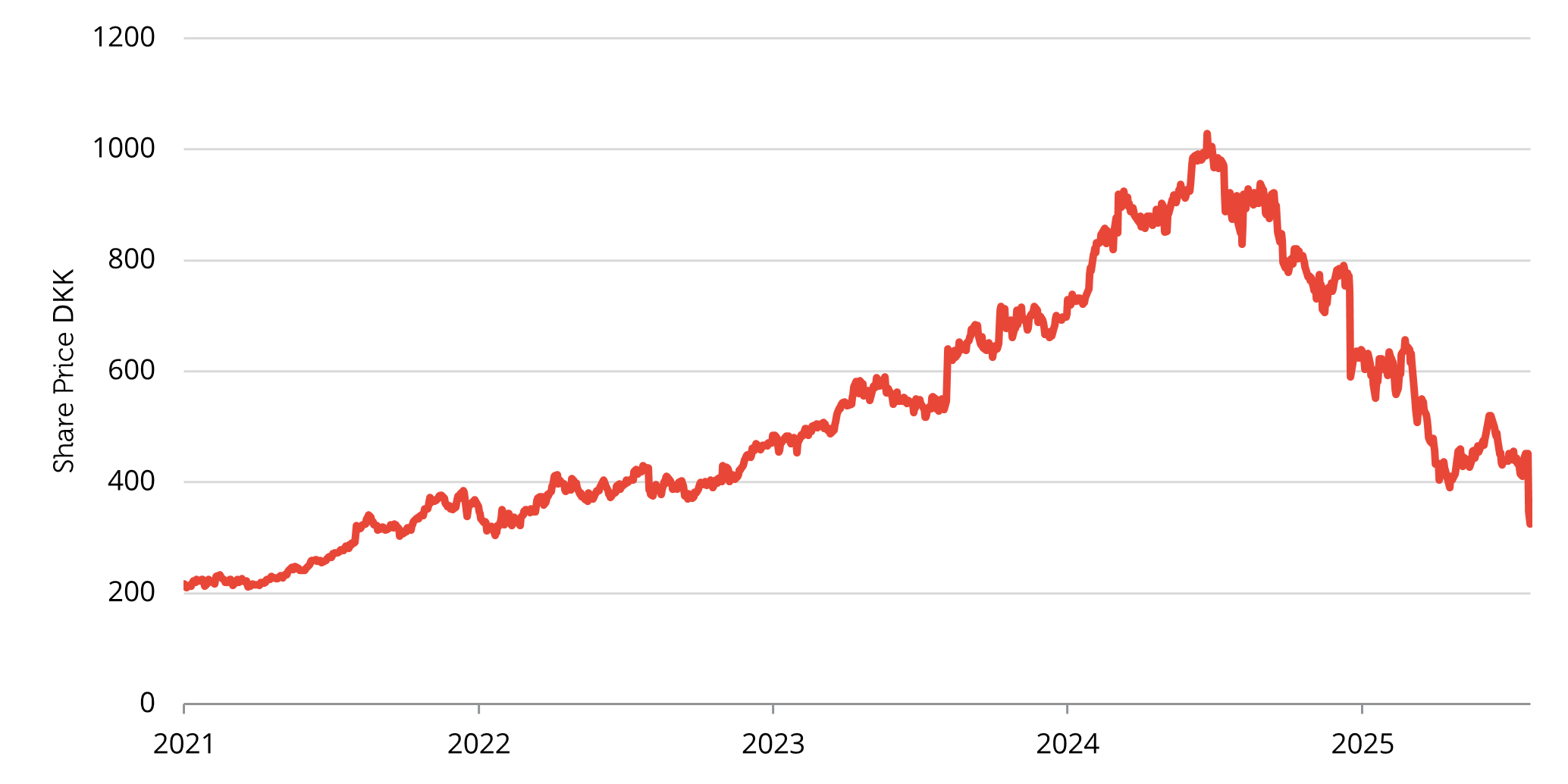
Source: Bloomberg, 01 January 2021 to 30 July 2025. Past performance is not a guide to the future. The prices of investments and income from them may fall as well as rise and investors may not get back the full amount invested.

The second recent inspiration on the subject was when I was flicking through Charts to Make You Go Wow! 2025 by Jim Reid of Deutsche Bank. Given the current euphoria around the Magnificent Seven stocks – which seems to be driven by a belief that all of them are going to invest billions in AI, and that all of them are going to be winners – I was intrigued by a chart that added some interesting historical context to those assumptions. The chart showed that only two of the ten largest companies in 2000 have outperformed the S&P500 since that date, those two being Microsoft and Oracle; incredibly, four of these companies actually made lower nominal earnings in 2024 than they did in 2000 (Citigroup, IBM, GE and Intel being the members of this unfortunate club). In 2000, these ten stocks were the largest in the market, and also highly valued, partly because investors were confident in their future growth rate. I suspect that if you had surveyed investors at the time, and asked for a probability that (nearly half?) four of these much-loved companies would have lower earnings twenty-four years later, most people would have put the probability at zero. Certainly, the valuations of those companies at the time reflected the market handicapping this probability as a completely outside-chance event.

Having now been investing for over thirty-five years, one of the most important lessons I have learnt is that the future is inherently unpredictable, and that it is therefore both a waste of time trying to forecast the unforecastable, and also potentially detrimental to investment returns. This may seem strange to readers, since most in our industry spend their time confidently making predictions about the future. I rarely hear a fund manager on Radio 4’s Today programme say “I really don’t know” in reply to a question on their outlook or admit that their recent outperformance may simply be down to (a) luck or (b) the waxing and waning of investment styles. I have seen interest rates at +15% and -1%, the oil price at $10 and $150, and the FTSE 100 at 6400 and 3500 in the same twelve-month period. Many things that I felt sure would happen have not come to pass, and there have been things that have occurred that I never would have predicted in a million years (central bankers printing money to buy equities, or fund managers buying negatively yielding bonds, being two very prominent examples). Once you accept that it is difficult to make accurate predictions, especially about the future, you will be more inclined to build an investment strategy that is robust to a range of outcomes, rather than one that is dependent on one forecast scenario playing out. This is one of the key reasons why we believe value investing delivers greater long run returns than growth investing: the value investor is buying stocks where expectations are low, which increases the chances of a ‘surprise’ being a positive one. By contrast, growth investors are buying stocks with heady expectations built into their prices, and – as the Novo Nordisk example demonstrates – when expectations disappoint, even when the absolute outcomes are impressive, the reaction can be savage.

Investing is always going to involve some sort of forecasting, but my own approach to forecasting changed in 2003 when someone I worked with gave me a paper called Intuitive Prediction: Biases and Corrective Procedures by Daniel Kahneman and Amos Tversky (long before the Thinking Fast and Slow and The Undoing Project became best sellers). This taught me that the accuracy of predictions can be improved by pulling them towards the class average, and hence using base rate rather than singular data:

One of the basic principles of statistical prediction, which is also one of the least intuitive, is that the extremeness of predictions must be moderated by considerations of predictability. ….prediction should be regressive; that is, it should fall between the class average and the value that best represents one’s impression of the case at hand.

Evidence suggests that people are insufficiently sensitive to distributional (base rate) data even when such data are available. Indeed, recent research suggests that people rely primarily on singular information, even when it is scanty and unreliable and give insufficient weight to distributional information.

(Daniel Kahneman and Amos Tversky, Intuitive Prediction: Biases and Corrective Procedures)

Applying this to our two examples above, healthcare analysts could have used the base rate data shown in the table below when thinking about their Novo Nordisk forecast. This shows how the number of companies able to sustain above average growth rates falls very rapidly each year, making a prediction that Novo Nordisk would buck this trend a low probability outcome. As the stock sported a very high valuation, making above average growth rates essential for investors not to lose money, this made an investment in Novo a potentially risky one.

Table 1: Persistence of Growth Rates (1997-2021)
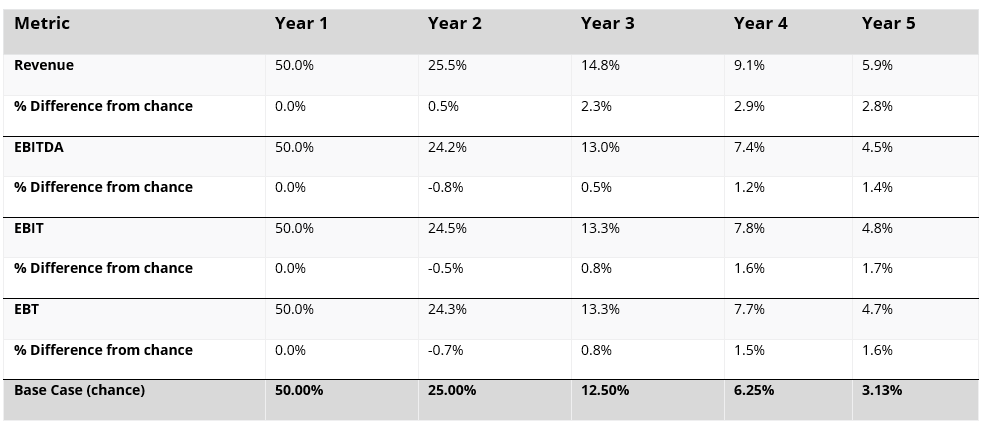
Source: S&P Capital IQ and Verdad research. Past performance is not a guide to the future. The information shown above is for illustrative purposes.

Turning to the Magnificent Seven stocks, one could use singular data and try to predict the exact profits that these companies are going to generate from AI over the next decade (which strikes me as difficult, given the potential for unknowns such as the arrival of challengers like Deepseek), or one could focus on base rate data. For example, one such piece of base rate information is the fact that the ten largest stocks in the S&P500 under perform on average (see chart below). Another fact is that very highly valued stocks also tend to underperform; as the Magnificent Seven stocks are both top ten constituents of the S&P500, and highly valued, probability would suggest that they are likely to underperform the S&P500 in the medium to long term. We cannot say with certainty that this will happen, but investment success comes from trying to tilt the odds of success in your favour; historical evidence simply suggests that the ten largest stocks in the S&P500 are unlikely to beat the wider index over time, especially when starting from such high valuations.

 Chart 2: Top 10 Largest Stocks in the S&P 500 vs S&P 500
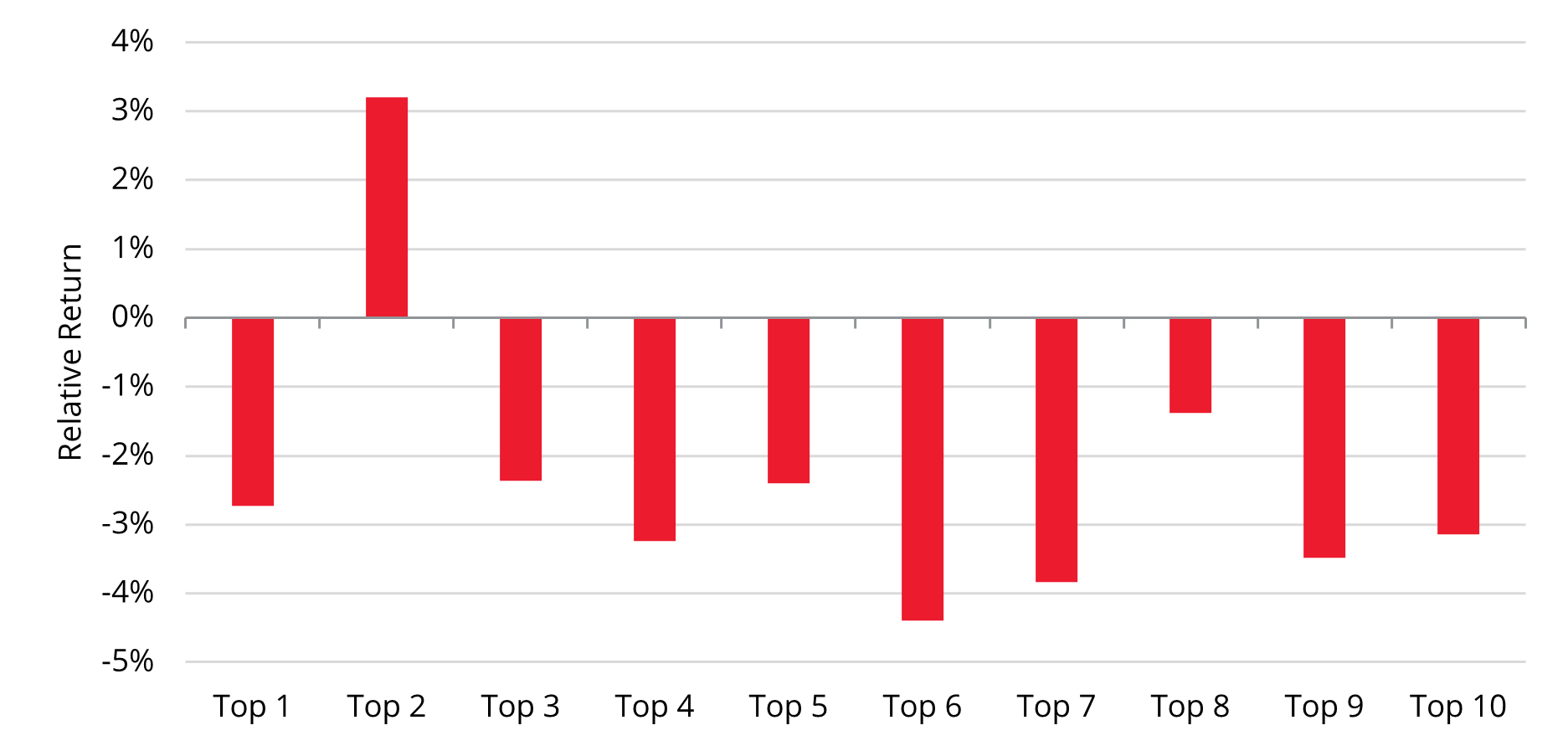
Source: Redwheel, GMO Quarterly Letter, 1Q 2024, data from 1957-2023. Past performance is not a guide to the future. The information shown above is for illustrative purposes.

Overconfidence in the ability to forecast seems to be endemic to our industry, and I suspect it is a function of the type of people the industry attracts (you don’t tend to meet that many shy and retiring fund managers who lack confidence in their own ability). And this is, in fact, good news, because value investing is in part the exploitation of over-optimism and overconfidence in the average investor.  As investors who favour base rates over singular data points this means the following is true of how we approach making predictions:

 – We will not try to forecast the unforecastable, nor produce thousand-line models.

– We will look at long run historical averages and ask whether there is any reason to believe the future will be materially different from the past.

– We will use peer group data – to what extent is this company similar or different to its peers? Is there any reason it should/should not make industry average returns? – to give us a normalised frame of reference.

– We will invest in businesses where low valuations reflect expectations for low or no future profit growth, thus increasing our probability of being rewarded by an outcome that is better than that implied by the share price

But if you are still not convinced that forecasting is very difficult, please enjoy our list of ‘Famously wrong predictions’ below.

Famously wrong predictions

“There may be a recession in stock prices, but not anything in the nature of a crash.” And on 17, 1929: “Stock prices have reached what looks like a permanently high plateau. I do not feel there will be soon if ever a 50 or 60 point break from present levels, such as (bears) have predicted. I expect to see the stock market a good deal higher within a few months.” ― Irving Fisher, leading U.S. economist. The New York Times, Sep 5, 1929

“We will never return to the old boom and bust.” ― Gordon Brown, Budget Statement, 2007

“I think there is a world market for maybe five computers.” ― Thomas J. Watson, 1943, Chairman of the Board of IBM

“This ‘telephone’ has too many shortcomings to be seriously considered as a means of communication. The device is inherently of no value to us.” ― Western Union internal memo, 1876

“640K ought to be enough for anybody.” ― Bill Gates, 1981

“We don’t need you. You haven’t got through college yet.” ―  Hewlett-Packard’s rejection of Steve Jobs, who went on to found Apple Computers

“The chairman of Royal Dutch/Shell, Mark Moody-Stuart, three months ago unveiled a five-year plan that assumed a price of $14 a barrel. He has since publicly mused about oil at $11. Sir John Browne, chief executive of BP-Amoco, is now working on a similar assumption.” ― Economist article ‘Drowning in Oil’ in 1999 predicting the oil price was going to $5 (in the next decade it went to $150)

“All that said, given the fundamental factors in place that should support the demand for housing, we believe the effect of the troubles in the subprime sector on the broader housing market will likely be limited, and we do not expect significant spillovers from the subprime market to the rest of the economy or to the financial system,”        ― Ben Bernanke, May 2007

“It really does now look like President Donald J. Trump, and markets are plunging. When might we expect them to recover?  A first-pass answer is never… So we are very probably looking at a global recession, with no end in sight.” ― Paul Krugman of the New York Times the day after the election.

“By 2005 or so, it will become clear that the Internet’s impact on the economy has been no greater than the fax machines.” ― Paul Krugman, 1998

Key Information

No investment strategy or risk management technique can guarantee returns or eliminate risks in any market environment. Past performance is not a guide to the future. The prices of investments and income from them may fall as well as rise and investors may not get back the full amount invested. Forecasts and estimates are based upon subjective assumptions about circumstances and events that may not yet have taken place and may never do so. The statements and opinions expressed in this article are those of the author as of the date of publication, and do not necessarily represent the view of Redwheel. This article does not constitute investment advice and the information shown is for illustrative purposes only.

Sources:

[1] Bloomberg, July 2025

[2] Bloomberg, July 2025

In case you missed it

Emerging and Frontier Markets
The ‘Fab 4’ become the ‘FOMO 3’

The Redwheel Emerging and Frontier Markets team explores the concentration challenge facing investors today and maps out under‑owned countries, sectors and themes that the team believes offer a richer blend of structural growth and genuine diversification.

27 July, 2026 | 01:48pm
UK Value & income
When it rhymes it pours

Shaul Rosten, Analyst with the Redwheel Value and Income team looks at the striking similarities between today’s market exuberance and the dotcom era, highlighting stretched valuations, record IPO activity and the dominance of the technology sector.

20 July, 2026 | 07:58pm
UK Value & income
Two beautiful games

As England’s World Cup campaign unfolds, the tournament provides a vivid reminder that sensible bets are grounded in probabilities. Supporters know that backing long-shot teams is unlikely to be rewarded, while favouring stronger sides with clear track records is more prudent. In his latest blog, Shaul Rosten of Redwheel's Value & Income team examines how value investing adopts a similar stance, focusing on quality businesses at attractive valuations, rather than richly priced growth narratives with low odds of delivery.

6 July, 2026 | 07:29pm

Disclaimer

Redwheel ® and Ecofin ® are registered trademarks of RWC Partners Limited (“RWC”). The term “Redwheel” may include any one or more Redwheel branded regulated entities including RWC Asset Management LLP, which is authorised and regulated by the UK Financial Conduct Authority and the US Securities and Exchange Commission (“SEC”); RWC Asset Advisors (US) LLC, which is registered with the SEC;  RWC Singapore (Pte) Limited, which is licensed as a Licensed Fund Management Company by the Monetary Authority of Singapore; Redwheel Australia Pty Ltd is an Australian Financial Services Licensee with the Australian Securities and Investment Commission; and Redwheel Europe Fondsmæglerselskab A/S which is regulated by the Danish Financial Supervisory Authority.

Redwheel may act as investment manager or adviser, or otherwise provide services, to more than one product pursuing a similar investment strategy or focus to the product detailed in this document. Redwheel and RWC (together “Redwheel Group”) seeks to minimise any conflicts of interest, and endeavours to act at all times in accordance with its legal and regulatory obligations as well as its own policies and codes of conduct.

This document is directed only at professional, institutional, wholesale or qualified investors. The services provided by Redwheel are available only to such persons. It is not intended for distribution to and should not be relied on by any person who would qualify as a retail or individual investor in any jurisdiction or for distribution to, or use by, any person or entity in any jurisdiction where such distribution or use would be contrary to local law or regulation.

This document has been prepared for general information purposes only and has not been delivered for registration in any jurisdiction nor has its content been reviewed or approved by any regulatory authority in any jurisdiction.

The information contained herein does not constitute: (i) a binding legal agreement; (ii) legal, regulatory, tax, accounting or other advice; (iii) an offer, recommendation or solicitation to buy or sell shares in any fund, security, commodity, financial instrument or derivative linked to, or otherwise included in a portfolio managed or advised by Redwheel; or (iv) an offer to enter into any other transaction whatsoever (each a “Transaction”). Redwheel Group bears no responsibility for your investment research and/or investment decisions and you should consult your own lawyer, accountant, tax adviser or other professional adviser before entering into any Transaction. No representations and/or warranties are made that the information contained herein is either up to date and/or accurate and is not intended to be used or relied upon by any counterparty, investor or any other third party.

Redwheel Group uses information from third party vendors, such as statistical and other data, that it believes to be reliable. However, the accuracy of this data, which may be used to calculate results or otherwise compile data that finds its way over time into Redwheel Group research data stored on its systems, is not guaranteed. If such information is not accurate, some of the conclusions reached or statements made may be adversely affected. Any opinion expressed herein, which may be subjective in nature, may not be shared by all directors, officers, employees, or representatives of Group and may be subject to change without notice. Redwheel Group is not liable for any decisions made or actions or inactions taken by you or others based on the contents of this document and neither Redwheel Group nor any of its directors, officers, employees, or representatives (including affiliates) accepts any liability whatsoever for any errors and/or omissions or for any direct, indirect, special, incidental, or consequential loss, damages, or expenses of any kind howsoever arising from the use of, or reliance on, any information contained herein.

Information contained in this document should not be viewed as indicative of future results. Past performance of any Transaction is not indicative of future results. The value of investments can go down as well as up. Certain assumptions and forward looking statements may have been made either for modelling purposes, to simplify the presentation and/or calculation of any projections or estimates contained herein and Redwheel Group does not represent that that any such assumptions or statements will reflect actual future events or that all assumptions have been considered or stated. There can be no assurance that estimated returns or projections will be realised or that actual returns or performance results will not materially differ from those estimated herein. Some of the information contained in this document may be aggregated data of Transactions executed by Redwheel that has been compiled so as not to identify the underlying Transactions of any particular customer.

No representations or warranties of any kind are intended or should be inferred with respect to the economic return from, or the tax consequences of, an investment in a Redwheel-managed fund.

This document expresses no views as to the suitability or appropriateness of the fund or any other investments described herein to the individual circumstances of any recipient.

The information transmitted is intended only for the person or entity to which it has been given and may contain confidential and/or privileged material. In accepting receipt of the information transmitted you agree that you and/or your affiliates, partners, directors, officers and employees, as applicable, will keep all information strictly confidential. Any review, retransmission, dissemination or other use of, or taking of any action in reliance upon, this information is prohibited. Any distribution or reproduction of this document is not authorised and is prohibited without the express written consent of Redwheel Group.

Funds managed by Redwheel are not, and will not be, registered under the Securities Act of 1933 (the “Securities Act”) and are not available for purchase by US persons (as defined in Regulation S under the Securities Act) except to persons who are “qualified purchasers” (as defined in the Investment Company Act of 1940) and “accredited investors” (as defined in Rule 501(a) under the Securities Act).

This document does not constitute an offer to sell, purchase, subscribe for or otherwise invest in units or shares of any fund managed by Redwheel. Any offering is made only pursuant to the relevant offering document and the relevant subscription application. Prospective investors should review the offering memorandum in its entirety, including the risk factors in the offering memorandum, before making a decision to invest.

AIFMD and Distribution in the European Economic Area (“EEA”)

The Alternative Fund Managers Directive (Directive 2011/61/EU) (“AIFMD”) is a regulatory regime which came into full effect in the EEA on 22 July 2014. RWC Asset Management LLP is an Alternative Investment Fund Manager (an “AIFM”) to certain funds managed by it (each an “AIF”). The AIFM is required to make available to investors certain prescribed information prior to their investment in an AIF. The majority of the prescribed information is contained in the latest Offering Document of the AIF. The remainder of the prescribed information is contained in the relevant AIF’s annual report and accounts. All of the information is provided in accordance with the AIFMD.

In relation to each member state of the EEA (each a “Member State”), this document may only be distributed and shares in a Redwheel fund (“Shares”) may only be offered and placed to the extent that (a) the relevant Redwheel fund is permitted to be marketed to professional investors in accordance with the AIFMD (as implemented into the local law/regulation of the relevant Member State); or (b) this document may otherwise be lawfully distributed and the Shares may lawfully be offered or placed in that Member State (including at the initiative of the investor).

Information Required for Offering in Switzerland of Foreign Collective Investment Schemes to Qualified Investors within the meaning of Article 10 CISA.

This is an advertising document.

The representative and paying agent of the Redwheel-managed funds in Switzerland (the “Representative in Switzerland”) FIRST INDEPENDENT FUND SERVICES LTD, Feldeggstrasse 12, CH-8008 Zurich. Swiss Paying Agent: Helvetische Bank AG, Seefeldstrasse 215, CH-8008 Zurich. In respect of the units of the Redwheel-managed funds offered in Switzerland, the place of performance is at the registered office of the Swiss Representative. The place of jurisdiction is at the registered office of the Swiss Representative or at the registered office or place of residence of the investor.

No investment strategy or risk management technique can guarantee returns or eliminate risks in any market environment.The term “RWC” may include any one or more RWC branded entities including RWC Partners Limited and RWC Asset Management LLP, each of which is authorised and regulated by the UK Financial Conduct Authority and, in the case of RWC Asset Management LLP, the US Securities and Exchange Commission; RWC Asset Advisors (US) LLC, which is registered with the US Securities and Exchange Commission; and RWC Singapore (Pte) Limited, which is licensed as a Licensed Fund Management Company by the Monetary Authority of Singapore.RWC may act as investment manager or adviser, or otherwise provide services, to more than one product pursuing a similar investment strategy or focus to the product detailed in this audio. RWC seeks to minimise any conflicts of interest, and endeavours to act at all times in accordance with its legal and regulatory obligations as well as its own policies and codes of conduct.This audio is directed only at professional, institutional, wholesale or qualified investors. The services provided by RWC are available only to such persons. It is not intended for distribution to and should not be relied on by any person who would qualify as a retail or individual investor in any jurisdiction or for distribution to, or use by, any person or entity in any jurisdiction where such distribution or use would be contrary to local law or regulation.This audio has been prepared for general information purposes only and has not been delivered for registration in any jurisdiction nor has its content been reviewed or approved by any regulatory authority in any jurisdiction. The information contained herein does not constitute: (i) a binding legal agreement; (ii) legal, regulatory, tax, accounting or other advice; (iii) an offer, recommendation or solicitation to buy or sell shares in any fund, security, commodity, financial instrument or derivative linked to, or otherwise included in a portfolio managed or advised by RWC; or(iv) an offer to enter into any other transaction whatsoever (each a “Transaction”). No representations and/or warranties are made that the information contained herein is either up to date and/or accurate and is not intended to be used or relied upon by any counterparty, investor or any other third party.RWC uses information from third party vendors, such as statistical and other data, that it believes to be reliable. However, the accuracy of this data, which may be used to calculate results or otherwise compile data that finds its way over time into RWC research data stored on its systems, is not guaranteed. If such information is not accurate, some of the conclusions reached or statements made may be adversely affected. RWC bears no responsibility for your investment research and/or investment decisions and you should consult your own lawyer, accountant, tax adviser or other professional adviser before entering into any Transaction. Any opinion expressed herein, which may be subjective in nature, may not be shared by all directors, officers, employees, or representatives of RWC and may be subject to change without notice. RWC is not liable for any decisions made or actions or in actions taken by you or others based on the contents of this audio and neither RWC nor any of its directors, officers, employees, or representatives (including affiliates) accepts any liability whatsoever for any errors and/or omissions or for any direct, indirect, special, incidental, or consequential loss, damages, or expenses of any kind howsoever arising from the use of, or reliance on, any information contained herein.Information contained in this audio should not be viewed as indicative of future results. Past performance of any Transaction is not indicative of future results. The value of investments can go down as well as up. Certain assumptions and forward looking statements may have been made either for modelling purposes, to simplify the audio and/or calculation of any projections or estimates contained herein and RWC does not represent that that any such assumptions or statements will reflect actual future events or that all assumptions have been considered or stated. Forward-looking statements are inherently uncertain, and changing factors such as those affecting the markets generally, or those affecting particular industries or issuers, may cause results to differ from those discussed. Accordingly, there can be no assurance that estimated returns or projections will be realised or that actual returns or performance results will not materially differ from those estimated herein. Some of the information contained in this audio may be aggregated data of Transactions executed by RWC that has been compiled so as not to identify the underlying Transactions of any particular customer.The information transmitted is intended only for the person or entity to which it has been given and may contain confidential and/or privileged material. In accepting receipt of the information transmitted you agree that you and/or your affiliates, partners, directors, officers and employees, as applicable, will keep all information strictly confidential. Any review, retransmission, dissemination or other use of, or taking of any action in reliance upon, this information is prohibited. The information contained herein is confidential and is intended for the exclusive use of the intended recipient(s) to which this audio has been provided. Any distribution or reproduction of this audio is not authorised and is prohibited without the express written consent of RWC or any of its affiliates.Changes in rates of exchange may cause the value of such investments to fluctuate. An investor may not be able to get back the amount invested and the loss on realisation may be very high and could result in a substantial or complete loss of the investment. In addition, an investor who realises their investment in a RWC-managed fund after a short period may not realise the amount originally invested as a result of charges made on the issue and/or redemption of such investment. The value of such interests for the purposes of purchases may differ from their value for the purpose of redemptions. No representations or warranties of any kind are intended or should be inferred with respect to the economic return from, or the tax consequences of, an investment in a RWC-managed fund. Current tax levels and reliefs may change. Depending on individual circumstances, this may affect investment returns. Nothing in this document constitutes advice on the merits of buying or selling a particular investment. This audio expresses no views as to the suitability or appropriateness of the fund or any other investments described herein to the individual circumstances of any recipient.AIFMD and Distribution in the European Economic Area (“EEA”)The Alternative Fund Managers Directive (Directive 2011/61/EU)(“AIFMD”) is a regulatory regime which came into full effect in the EEA on 22 July 2014. RWC Asset Management LLP is an Alternative Investment Fund Manager (an “AIFM”) to certain funds managed by it (each an “AIF”). The AIFM is required to make available to investors certain prescribed information prior to their investment in an AIF. The majority of the prescribed information is contained in the latest Offering Document of the AIF. The remainder of the prescribed information is contained in the relevant AIF’s annual report and accounts. All of the information is provided in accordance with the AIFMD.In relation to each member state of the EEA (each a “Member State”),this document may only be distributed and shares in a RWC fund(“Shares”) may only be offered and placed to the extent that (a) the relevant RWC fund is permitted to be marketed to professional investors in accordance with the AIFMD (as implemented into the local law/regulation of the relevant Member State); or (b) this audio may otherwise be lawfully distributed and the Shares may lawfully offered or placed in that Member State (including at the initiative of the investor).Information Required for Distribution of Foreign Collective Investment Schemes to Qualified Investors in SwitzerlandThe representative and paying agent of the RWC-managed funds in Switzerland (the “Representative in Switzerland”) FIRST INDEPENDENT FUND SERVICES LTD, Klausstrasse 33, CH-8008 Zurich. Swiss Paying Agent: Helvetische Bank AG, Seefeldstrasse 215, CH-8008 Zurich. In respect of the units of the RWC-managed funds distributed in Switzerland, the place of performance and jurisdiction is at the registered office of the Representative in Switzerland.