








For much of the past decade, investors could reasonably overlook convertible bonds. Equity markets rose strongly, traditional fixed income offered little income, and the hybrid characteristics of the asset class could appear less compelling than a straightforward allocation to either stocks or bonds.
However, many of those headwinds have reversed. Markets today face a less settled mix of growth, inflation, policy and geopolitical risks, heralding a higher volatility backdrop. A significant new issuance calendar with better structures and sectorial dynamics is widening the available opportunity set.
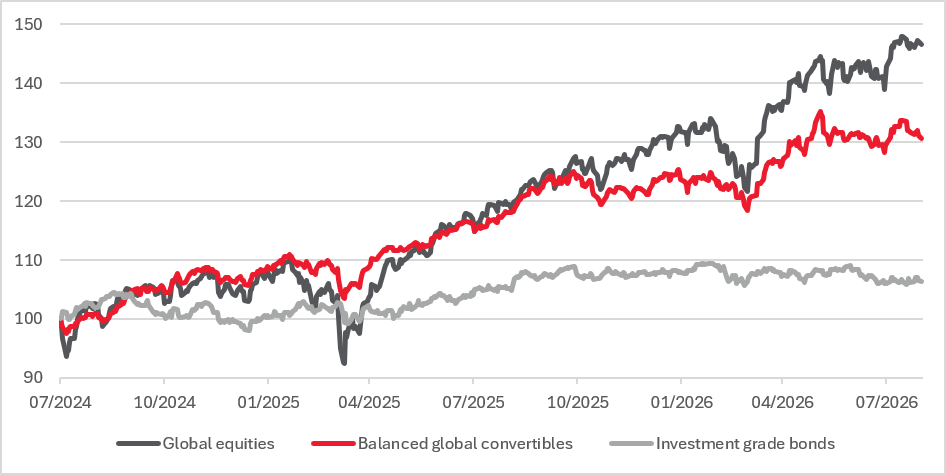
In this environment, we believe convertibles merit renewed attention, and the recent performance of the asset class indicates this as we notice a much higher participation to the equity upside combined with a better capital preservation backdrop.
Chart 1: Balanced global convertibles vs global equities and investment grade bonds – Total return
A more supportive income backdrop
The higher-rate environment has changed the composition of the convertible market. During the era of exceptionally low interest rates, many new issues were structured with minimal coupons and were valued primarily for their equity optionality. More recently, the income component of the asset class has become more meaningful, particularly among balanced convertibles.
That matters because the bond element can provide carry and, subject to issuer creditworthiness, a degree of support when equity markets weaken. At the same time, the embedded option preserves the potential to participate in equity upside. This combination can create a more balanced risk and return profile than an allocation consisting solely of equities or conventional bonds, particularly when considering some of the compelling growth dynamics of some of the issuers.
Convexity has become more relevant
The investment case for convertibles is closely linked to convexity. A balanced convertible bond can participate as the issuer’s share price rises, while its bond characteristics may become more relevant when the share price falls. In simple terms, the objective is not to eliminate losses, but to seek a more favourable balance between upside participation and downside resilience.
This feature can be particularly valuable in a market environment marked by abrupt changes in sentiment. Policy announcements, geopolitical developments, fiscal concerns and elevated equity valuations have all contributed to periods of sharp cross-asset repricing. We would not characterise this as proof of a permanently higher-volatility regime. However, compared with the unusually calm conditions that prevailed for parts of the previous decade, markets appear more vulnerable to episodic shocks.
This increased volatility is generally beneficial for the asset class, from both the increasing value of the convertible but also where a portfolio holds genuinely balanced issues and is actively managed, changing equity sensitivity can create opportunities to rebalance exposure as markets move.
A larger and more diverse primary market
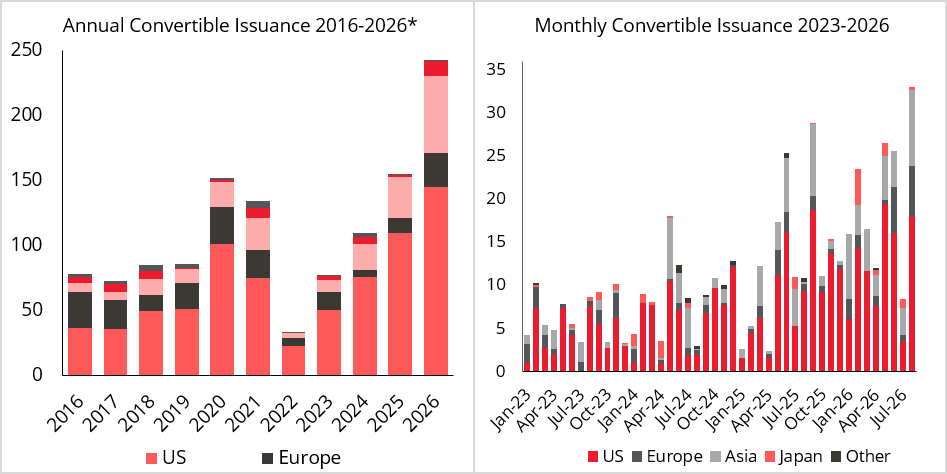
Supply is an important part of the current opportunity. A healthy primary market does more than increase the headline size of the asset class: it refreshes the universe, introduces new issuers and sectors, and gives investors more choice across credit quality, maturity, coupon and equity sensitivity.
Recent issuance has been supported by companies seeking to finance investment, refinance existing debt and preserve flexibility in their capital structures. For issuers, convertibles can lower immediate cash-interest costs relative to straight debt while limiting dilution relative to an immediate equity raise. For investors, new deals can offer access to structures and businesses that may not otherwise be available in the secondary market.
Chart 2 and 3: Convertible issuance (USD bn)
Accessing growth themes with a different risk profile
The expansion of artificial intelligence, cloud infrastructure, data centres and related technology investment is also influencing convertible issuance. Growth-oriented businesses often have substantial funding needs and may favour a convertible structure that combines debt financing with future equity participation.
For investors, this can create a way to gain exposure to long-term growth themes without making a wholly equity-like allocation. Recent issuance from AI-cloud and data-centre-related companies illustrates the role convertibles can play in financing the infrastructure behind these themes. These can offer great ways to access the potential long-term benefits of AI while mitigating the downside given the valuations that some companies may be experiencing could be considered too high particularly if the growth were not to materialise in the expected timeframe.
Beyond a narrow equity market
A further reason to revisit convertibles is their potential role in reducing reliance on a small number of dominant equity-market names. Global equity returns have been heavily influenced by a concentrated group of mega-cap companies. While those businesses remain important, a portfolio tied too closely to a narrow leadership group can become more exposed to valuation risk and changes in market breadth.
The convertible universe provides access to a wider range of companies, including mid-cap growth businesses across technology, healthcare, industrials, consumer and other sectors. This does not mean convertibles will necessarily outperform in every market. A prolonged rally led by the largest equities can favour a conventional equity index. But if leadership broadens, a diversified convertible portfolio may offer exposure to areas of the market that are less well represented in mega-cap benchmarks.
A distinct role in asset allocation
Convertibles should not be regarded merely as a mechanical blend of equities and bonds. Their behaviour changes with the underlying share price, interest rates, credit spreads, volatility and the individual terms of each security. That can make them a useful source of diversification, but it also means they need a clear role within a portfolio, particularly when volatility is elevated.
For some investors, the asset class may sit alongside equity allocations as a way to seek growth with a potentially more balanced profile. For others, it may complement fixed income by adding equity optionality. A dedicated allocation can also be appropriate where investors want to assess the hybrid opportunity set on its own merits.
The right position will depend on an investor’s objectives, risk tolerance, liquidity needs and governance framework. What is increasingly difficult to argue, in our view, is that convertibles can be assessed solely through an equity or bond lens.
A timely moment to reassess
In conclusion, we feel the turning point has been realised after a long period of muted performance. Balanced convertibles are once again delivering meaningful equity participation while outpacing investment grade credit, and providing enhanced reward characteristics driven by several aspects including:
– More meaningful Income component
– Return of Volatility and the value of convexity in an episodic market backdrop
– Broadening equity leadership and the opportunity to diversify concentrated equity exposure
– Expanding primary market
– Risk-managed exposure to secular high-growth themes
Based on this we feel balanced convertibles are once again a relevant and powerful tool for today’s asset allocation challenges.
Key Information
No investment strategy or risk management technique can guarantee returns or eliminate risks in any market environment. Past performance is not a guide to the future. The prices of investments and income from them may fall as well as rise and investors may not get back the full amount invested. Forecasts and estimates are based upon subjective assumptions about circumstances and events that may not yet have taken place and may never do so. The statements and opinions expressed in this article are those of the author as of the date of publication, and do not necessarily represent the view of Redwheel. This article does not constitute investment advice and the information shown is for illustrative purposes only.