









Unusual events in the Redwheel Global Equity Income Strategy may reveal something about today’s equity market: its fixation on a single, dominant theme, and its certainty about the outcome.
The Strategy invests predominantly in large-cap companies: 94% of the Strategy is allocated to stocks classified as large cap, although our disciplines mean we own none of the world’s ten largest companies[1]. One consequence is that our holdings are rarely takeover targets. More often, they are the companies doing the bidding. Before this year, the last bid for a portfolio holding came in July 2020.
Against that history, the events of 2026 so far are striking. Within a matter of months, two portfolio companies agreed to be acquired and a third is the subject of ongoing takeover speculation. What would normally be exceptional has begun to look like a pattern.
In our view, this is evidence that the Strategy holds some global, best-in-class companies at attractive valuations. It also illustrates how the market’s myopic certainty that AI is the only theme that matters is creating opportunities among durable businesses that fall outside the narrative.
An unusual run of interest on our holdings[2]
Beazley Plc.[3], the specialist insurance company, was bid for by Zurich Insurance Group (another holding in the Strategy) in January this year. The final agreed price of £13.35 per share (cash and dividend) was a premium of 63% to the £8.20 per share price prior to the announcement[4].
In April, Intertek, the global testing company, agreed to be acquired by private equity firm EQT. The offer will give shareholders £61.08 per share (cash and dividend), a premium of 62% to the undisturbed price of £37.70 per share (9 April) prior to the announcement.[5]
Meanwhile, insurer Hiscox’s shares rose sharply in May following press reports that Canada’s Intact Financial was exploring a possible approach, although no offer had been made at the time.[6]
These were not obscure micro-cap businesses. Beazley and Intertek each had an equity market value of roughly £5 billion before the respective approaches. Their size, liquidity and established franchises make the concentration of bid activity within the Strategy all the more unusual.
In our view, this unusual sequence is evidence of something broader: attractive valuations are available across many parts of the market, even among large, high-quality businesses. Strategic and financial buyers appear increasingly willing to act on an opportunity that public markets have been overlooking.
The reason lies partly in the market’s narrow fixation on AI. Confidence about the likely winners – and equal certainty about the presumed losers – has directed capital towards a small group of favoured companies. Away from that theme, many sound businesses now trade on valuations rarely seen in their own histories. Such is the market’s certainty of the future, it is not simply rewarding expected beneficiaries of AI; in some cases, it is pricing potential disruption as though decline were close to inevitable.
When disruption is priced as certain decline
Omnicom Group, the leading global advertiser, is currently valued at a market capitalisation of approximately $24bn[7], with net debt estimated at $3bn at the end of 2026. That valuation represents estimates for the full year 2026 of $26bn of revenue, $3bn net income and $3.4bn of free cashflow. That is around 1x revenue, 8x net income and a free cash flow yield of approximately 14%, while generating a dividend yield of 4.5%. By our analysis, the market is implying that Omnicom could well be bust within seven years.[8]
Chart 1: Omnicom Group – Share price performance since downturn vs free cash flow estimates
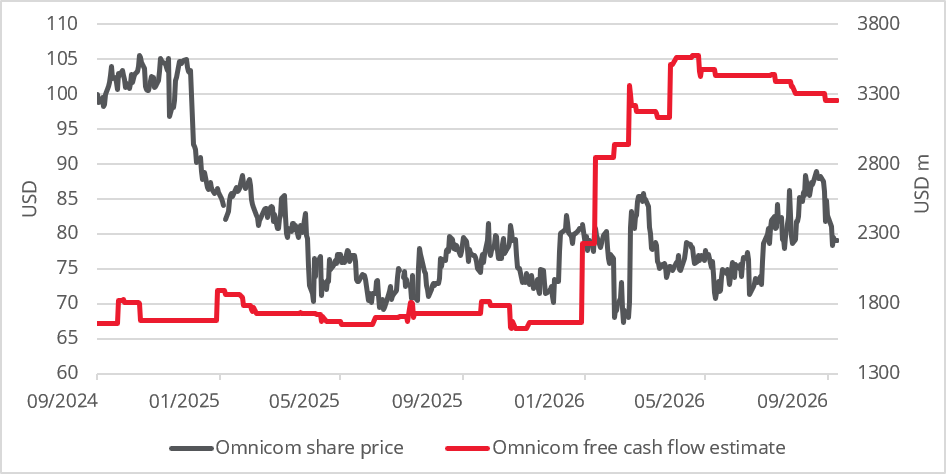
Of course, nothing can be ruled out in a world of rapid technological change, but this is certainly not the only plausible outcome. Chart 1 shows that, while Omnicom’s share price has fallen, analyst expectations for future free cash flow have risen. In addition, Omnicom reported 3.9% organic revenue growth in the first quarter of 2026. Its closest large peer, Publicis Groupe, reported 5.3% organic revenue growth in the first half and a positive outlook.[9]
Accenture Plc., one of the leading global consultancy companies, is currently valued at approximately $116bn[10] with net debt estimated at $1bn in 12 months’ time. That valuation represents estimates for the year to August 2027 of approximately $76bn of revenue, $9bn net income and $11.5bn of free cashflow. That is around 1.5x revenue, 13x net income and a free cash flow yield of approximately 10%, while generating a dividend yield of around 3.8%[11].
Chart 2: Accenture – Share price performance since downturn vs free cash flow estimates
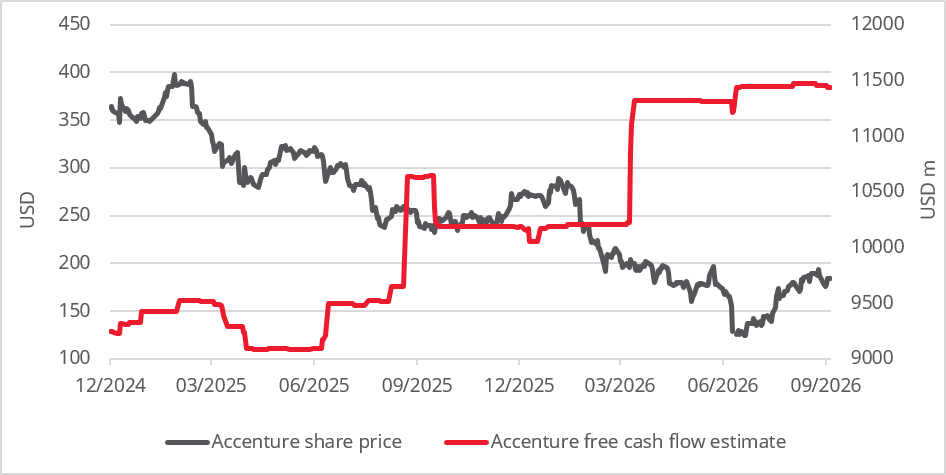
Again, the market is basically implying that Accenture could fail within seven to eight years, yet it continues to grow. For fiscal 2026, it guided to revenue growth of 3–4% while analyst expectations for future free cash flow have increased. Accenture has also said it expects to more than double bookings from partnerships with a broad group of AI and data providers, including OpenAI, NVIDIA, Anthropic, Palantir, Databricks, Snowflake, Google Gemini and Mistral AI.[12]
These revenue growth numbers do not negate the risk that AI changes the economics of consulting, advertising or other knowledge-intensive industries. They do, however, show why we believe the market may be confusing uncertainty with certainty of failure.
Choosing the risk worth taking
All investment entails an assumption of risk. For us, the asymmetry of the risk reward is crucial. We seek to embrace a range of possible outcomes, but only where the valuation of a company’s cash flows means that the balance is skewed in our favour.
Where cash flows are durable and the share price already assumes that much can go wrong, the investment does not depend on an ideal outcome. It may simply require the business to prove more resilient than the market expects for investors to recognise that its cash flows have been undervalued.
The Strategy’s yield discipline is designed to identify such opportunities. Every holding must yield at least 25% more than the MSCI World Index at purchase. This helps us avoid paying too much for confidence and consensus, and directs us towards companies where controversy has lowered expectations.
At the portfolio level, the Strategy’s free cash flow yield is around 6%, compared with approximately 3.8% for MSCI World, while its dividend yield is around 3.2% versus 1.5% for the index. These figures are not forecasts, but they indicate that the Strategy is valued on less demanding assumptions than the market as a whole – and is being paid to wait while those assumptions are tested.
Table 1: Representative portfolio vs MSCI World index – Free cash flow and dividend yields (%)

When uncertainty becomes opportunity
Takeovers are unusual in this Strategy because the portfolio holds large, liquid companies that are more often acquirers than targets. So, when two receive bids at substantial premiums and a third attracts bid speculation, it is a timely reminder that the gap between public-market prices and underlying corporate value can become unusually wide – and perhaps an early sign that the market is beginning to question its assumed inevitability of AI’s winners and losers.
During periods of heightened disruption, investors can crowd into apparent winners and mark down potential losers with little discrimination. We are more comfortable owning companies where the future required to justify the valuation is less heroic, free cash flows and dividends provide tangible support, and investors are paid to wait for the market’s assumptions to be tested.
Sources
[1] Redwheel, July 2026
[2] Portfolio holdings are subject to change at any time without notice. This information should not be construed as a recommendation to purchase or sell any security.
[3] The Strategy held Beazley from February 2024 to August 2026
[4] London Stock Exchange, February 2026
[5] Reuters, M&A Society, May 2026
[6] Reuters, May 2026
[7] Bloomberg, August 2026
[8] Bloomberg consensus estimates, Redwheel analysis, July 2026
[9] Source: Omnicom Group, Q2 2026 results, 28 July 2026; Publicis Groupe, H1 2026 results, 16 July 2026.
[10] Bloomberg, August 2026
[11] Bloomberg consensus estimates, Redwheel analysis, July 2026
[12] Source: Accenture, Q3 fiscal 2026 results and earnings call, 18 June 2026
Key Information
No investment strategy or risk management technique can guarantee returns or eliminate risks in any market environment. Past performance is not a guide to the future. The prices of investments and income from them may fall as well as rise and investors may not get back the full amount invested. Forecasts and estimates are based upon subjective assumptions about circumstances and events that may not yet have taken place and may never do so. The statements and opinions expressed in this article are those of the author as of the date of publication, and do not necessarily represent the view of Redwheel. This article does not constitute investment advice and the information shown is for illustrative purposes only.
*Representative Portfolio
Portfolio characteristics, top ten holdings, sector allocation, country allocation, attribution, volatility, yield, dividend and ESG information are based on a representative portfolio, which is TM Redwheel Global Equity Income Fund. Redwheel believes that precisely this account within the strategy most closely reflects the current portfolio management style for the Redwheel Global Equity Income Strategy. Portfolio holdings are subject to change without notice. The information shown is for illustrative purposes only and is not intended to be, and should not be interpreted as, recommendations or advice.