









Bringing a gun to a fistfight

The Grave Dancer

In late 2007, at the height of the real estate mania gripping the USA, the famed real estate investor Sam Zell struck a deal that is still upheld today a masterclass in timing. In August 2007, about a year before real estate prices began to implode, Zell sparked a bidding war for his commercial property REIT, Equity Office Properties. His eventual buyer was the private equity giant Blackstone, who bought the company in a blockbuster deal valued at $39bn, enabling Zell and his happy shareholders to neatly cash out of the company he had spent 30 years building, in a deal which was, at the time, the largest buyout in history.

Zell was a veteran of US real estate investing, and carried the moniker of ‘Grave Dancer’, which he earned after penning an article outlining his approach to buying cheap, distressed assets, a playbook he employed many times on his road to success. As well as his long record of exceptional real estate investing, Zell was famous for his penchant for communicating his investment philosophy in quirky ways: t-shirts he would distribute to IPO roadshow attendees, music boxes he sent to business partners as gifts, and cartoons which captured key tenets of his investing style[1].

One such cartoon illustrates one of his favourite maxims. It depicts two boxers in a ring, facing off. One is a huge, hulking man with rippling muscles whilst the other is a skinny, bespectacled man about half his size. What the latter does have, however, is a loaded rifle – and a cheeky grin on his face. The caption reads: “Be a risk taker, however define risk by your own terms”.

In our view, this principle resides at the core of disciplined investing, empowering the patient, diligent value seeker to scour the globe for compelling risks to take – and compelling rewards to reap.

Find the (non-smoking) gun

Often, investors identify obvious risk – the prospect of having to fight a seven-foot tall, muscle-bound punching machine – whilst failing to identify the less obvious risk mitigators, like having a fully loaded shotgun hidden in your corner of the ring. Considering one without the other ignores a fundamental element of any basic risk analysis, but is sufficient to drive plenty of irrational investor behaviour we regularly see in the market.

The first such behaviour is the summary rejection of nose-wrinkling corners of the market, where red flags fly and warning lights flash; however, those untrodden corners often create fertile hunting grounds for those willing to look. Take, for example, a recent area in which we have been investing: South Korean banks.

For a multitude of reasons, just uttering the phrase “South Korean banks” can induce for many investors at best gaping yawns, if not spine shudders and cold sweats. The first reason is simply the country of origin: South Korea has long had uninspiring corporate governance – exemplified by the family-controlled Chaebols – as well as strangely frequent periods of political instability, which has led to typically lower valuations for South Korean companies than developed peers.

Chart 1: Price / earnings ratio of major indices, 2015 – 2025
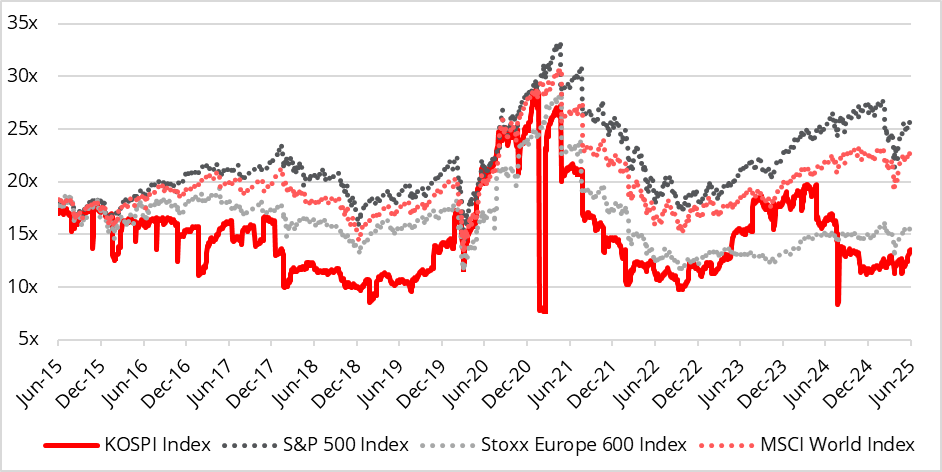
Source: Bloomberg, 1 July 2025. Past performance is not a guide to the future.

In addition, many “quality-first” investors tend to shun banks, viewing them as sprawling, inscrutable machines with timebombs buried deep within their balance sheets, just waiting to go off. In addition, many global investors were burned by South Korean banks during the Asian financial crisis in 1997, which set off a wave of government-induced restructuring and investor losses. Combining these factors has seen valuations for major South Korean financial institutions stumble along at levels far below those of their international peers that are often undervalued themselves. By way of example, below is the price-to-book ratio for a sample of global banks, compared to that of South Korean bank Hana Financial Group.

Chart 2: Price / book ratio of major global banks, 2015 – 2025
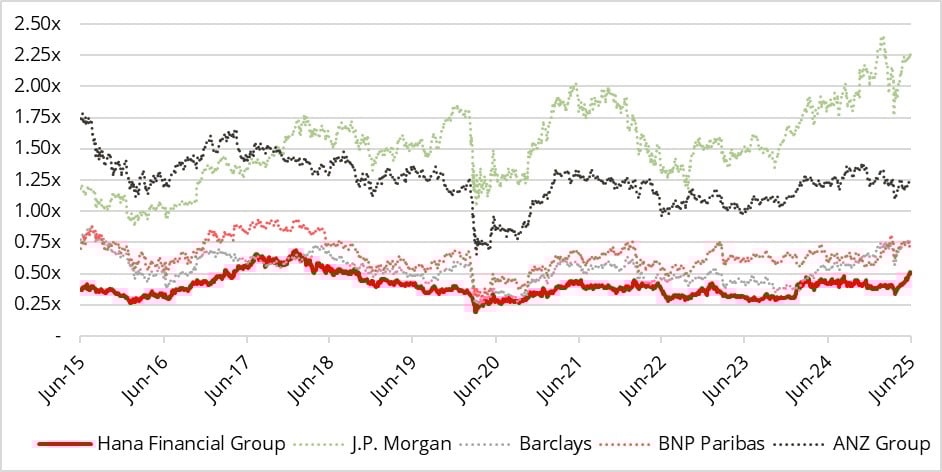
Source: Bloomberg, 1 July 2025. Past performance is not a guide to the future.

However, in our view, this nose-wrinkling is like focusing on the physique of the scrawny boxer in the blue corner – but totally ignoring the automatic weapon at his disposal.

Take, for example, the poor valuation of South Korean companies, and how that has led to weak prices for the major domestic banks. Whilst it is true that share prices have barely budged in the last decade, what this analysis fails to recognise is that the companies behind those share prices have nonetheless delivered consistent growth over time, with assets, net interest income, and per-share earnings all compounding steadily higher [2]. The upshot is that these businesses have been getting cheaper and cheaper over time – and all the while demonstrating, with consistent growth and profitability, that they are worth more than their current meagre valuation. Now, we hear you argue, it is all very well that these companies are getting technically cheaper over time; but if the market price of their shares is not budging, how does that help me? This is a perfectly valid rebuttal – but not when a company allocates its blossoming piles of cash to create their own destiny through meaningful dividends and cheap buybacks. Which, as you may have guessed, is the case today for the South Korean banks.

Inspired by the success of Japan’s attempt to enforce better governance and capital efficiency standards for listed companies, South Korea’s Financial Services Commission launched a “Corporate Value UP” strategy in early 2024. Taking a leaf from Japan’s book, the programme urged Korean corporates to set out plans for increasing shareholder value, with the encouragement of higher dividends and buybacks where appropriate. Indeed, the new South Korean president ran on an explicitly pro-shareholder-interest ticket, and has already pledged a review of Korea’s dividend tax regime to encourage corporations to disburse more cash to shareholders. To the trained ear, the sound of a gun being loaded can be heard.

Indeed, our Korean bank holdings needed no additional encouragement in this arena, with strong cash yields – and the promise of higher payouts over time – as well as the initiation of substantial buybacks at eye-wateringly low prices: think price-to-earnings ratios in the 3x – 4x range (i.e. buying shares at an earnings yield of 25% – 30%) and price-to-book ratios of less than 0.4x3. Repurchasing shares at such low levels, whilst paying rising dividends and growing revenues, points to a strong likelihood of robust shareholder returns – even without any rerating of the share price.

Chart 3: Illustrative return with dividends, buybacks and no rerating
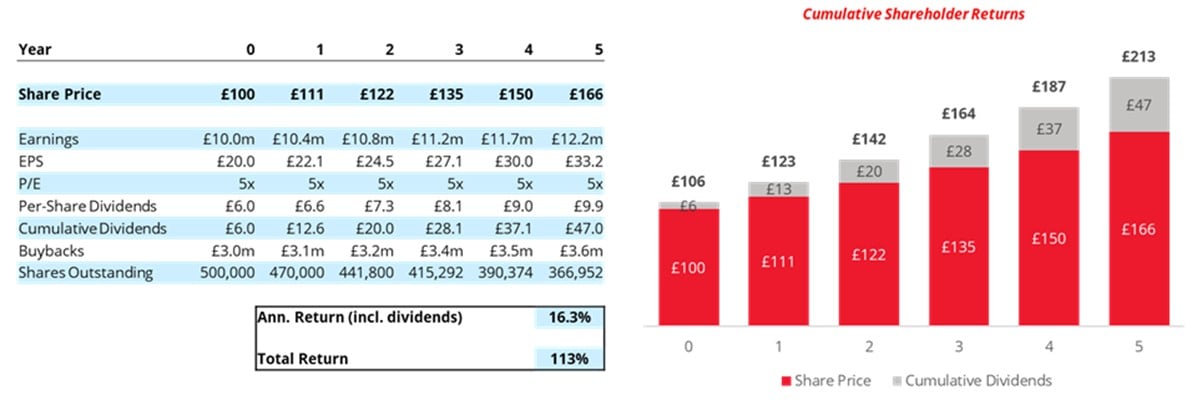
Source: Redwheel. The information shown above is for illustrative purposes. Example shown is with 30% of net income allocated to dividends, 30% to buybacks, and an assumed earnings growth of 4% p.a.

The litany of other initial nose-wrinkle criticisms can also be overcome with further analysis. Yes, South Korea has struggled in the past with corporate governance, but the Value UP program is a clear sign of progress on this issue, as is the fact that the pandemic caused a seismic shift in ownership patterns. Since 2018, the number of South Korean retail investors invested in domestic companies has ballooned from 5.0m to 14.2m [3], meaning that minority shareholder rights and improved returns are now serious voter issues that rank high on the political agenda.

In addition, whilst the 1997 Asian Financial Crisis was painful and left deep scars for foreign investors, it actually worked to make many financial systems more stable and consolidated – and hence more profitable and robust – through the cycle. For example, in South Korea, the government ordered the weakest banks to be absorbed by the strongest, and those banks somewhere in between to merge amongst themselves, creating a consolidated oligopoly that remains healthy, stable, and profitable. As we have also pointed out before to those who systematically shun banks as investments, the long-term bankruptcy record of global banks is, in fact, much better than many other sectors: the cumulative default rate for banks is 5.3% over a ten-year period, compared with 11.6% for healthcare, 24.1% for retail, and 26.2% for durable consumer goods [4].

We will continue to use these observations – simply considering the presence of a loaded gun in the ring – to bet heavily on the skinny guy.

Bet the fight, not the fighter

The same mistake is also made in the opposite direction. Many investors are quick to observe the fantastic economics and market positions of specific companies, thus noting that their boxer is a decorated champion with biceps the size of his head. Often, however, they fail to understand the question being asked of them, as he squares up to a scrawny accountant with an Uzi: it is not who is the better boxer, but who will win the fight. If you buy a premium company, but pay a premium price, your outcomes may not be determined by the strength of your fighter, but by the odds you accepted on him emerging victorious. If your premium company begins to be priced at a more reasonable valuation, then you are going to lose money, almost independent of how good a performance it is able to turn in.

A good recent example of this is the Danish healthcare company Coloplast, which is an undeniably high-quality operation. Returns on invested capital have averaged more than 30% for the past 20 years, and gross margins are routinely north of 60%. Yet, if you paid 55x trailing earnings for their shares in 2021, you would have lost 50% of your money – despite the fact that revenues have grown by over 45% since then, and per-share diluted earnings are up by 14% [5]. But all of that hard corporate effort has been squandered on those investors who ignored the shotgun in the opposite corner, over-egging the odds for their fighter and wildly overpaying for what they assumed was a sure-thing bet that they couldn’t lose. Today, that fine company is valued at 23x trailing earnings, a valuation that still seems to be on the high side of reasonable from where we sit. With such aimless enthusiasm, Coloplast’s investors have enjoyed effectively no total return since 2018 (1.95% in total with dividends reinvested), hard to believe when observing that revenues are 64% higher over that time, and per-share earnings are up 24% [6].

*********

Although we would no doubt enjoy spending our days trying to find prize fighters – companies with the best business models, defensive moats, and undeniable quality – that is not the task with which we are presented. Instead, we must handicap the fight in front of us – buying the most attractive investment opportunities, as measured by both corporate quality and the prospects of substantial quantitative returns – and focus on delivering superior investment performance over time. To that end, we are consistently delighted to find arenas where apparently weaker boxers are assumed to have no hope of surviving – but where spectators seem to have failed to notice the gun at the fistfight. Where the odds are right, we will be lining up to place those bets.

Key Information

No investment strategy or risk management technique can guarantee returns or eliminate risks in any market environment. Past performance is not a guide to the future. The prices of investments and income from them may fall as well as rise and investors may not get back the full amount invested. Forecasts and estimates are based upon subjective assumptions about circumstances and events that may not yet have taken place and may never do so. The statements and opinions expressed in this article are those of the author as of the date of publication, and do not necessarily represent the view of Redwheel. This article does not constitute investment advice and the information shown is for illustrative purposes only.

Sources:

[1] Due to a lack of talented comic artists on staff, our investors should expect no such similar treatment. 

[2] Bloomberg, July 2025

[3] Korea Securities Depository, November 2023

[4] Moody’s Default Trends – Global, February 2024

[5] Bloomberg

[6] Bloomberg, 30 June, 2025
In case you missed it

Emerging and Frontier Markets
The ‘Fab 4’ become the ‘FOMO 3’

The Redwheel Emerging and Frontier Markets team explores the concentration challenge facing investors today and maps out under‑owned countries, sectors and themes that the team believes offer a richer blend of structural growth and genuine diversification.

27 July, 2026 | 01:48pm
UK Value & income
When it rhymes it pours

Shaul Rosten, Analyst with the Redwheel Value and Income team looks at the striking similarities between today’s market exuberance and the dotcom era, highlighting stretched valuations, record IPO activity and the dominance of the technology sector.

20 July, 2026 | 07:58pm
UK Value & income
Two beautiful games

As England’s World Cup campaign unfolds, the tournament provides a vivid reminder that sensible bets are grounded in probabilities. Supporters know that backing long-shot teams is unlikely to be rewarded, while favouring stronger sides with clear track records is more prudent. In his latest blog, Shaul Rosten of Redwheel's Value & Income team examines how value investing adopts a similar stance, focusing on quality businesses at attractive valuations, rather than richly priced growth narratives with low odds of delivery.

6 July, 2026 | 07:29pm

Disclaimer

Redwheel ® and Ecofin ® are registered trademarks of RWC Partners Limited (“RWC”). The term “Redwheel” may include any one or more Redwheel branded regulated entities including RWC Asset Management LLP, which is authorised and regulated by the UK Financial Conduct Authority and the US Securities and Exchange Commission (“SEC”); RWC Asset Advisors (US) LLC, which is registered with the SEC;  RWC Singapore (Pte) Limited, which is licensed as a Licensed Fund Management Company by the Monetary Authority of Singapore; Redwheel Australia Pty Ltd is an Australian Financial Services Licensee with the Australian Securities and Investment Commission; and Redwheel Europe Fondsmæglerselskab A/S which is regulated by the Danish Financial Supervisory Authority.

Redwheel may act as investment manager or adviser, or otherwise provide services, to more than one product pursuing a similar investment strategy or focus to the product detailed in this document. Redwheel and RWC (together “Redwheel Group”) seeks to minimise any conflicts of interest, and endeavours to act at all times in accordance with its legal and regulatory obligations as well as its own policies and codes of conduct.

This document is directed only at professional, institutional, wholesale or qualified investors. The services provided by Redwheel are available only to such persons. It is not intended for distribution to and should not be relied on by any person who would qualify as a retail or individual investor in any jurisdiction or for distribution to, or use by, any person or entity in any jurisdiction where such distribution or use would be contrary to local law or regulation.

This document has been prepared for general information purposes only and has not been delivered for registration in any jurisdiction nor has its content been reviewed or approved by any regulatory authority in any jurisdiction.

The information contained herein does not constitute: (i) a binding legal agreement; (ii) legal, regulatory, tax, accounting or other advice; (iii) an offer, recommendation or solicitation to buy or sell shares in any fund, security, commodity, financial instrument or derivative linked to, or otherwise included in a portfolio managed or advised by Redwheel; or (iv) an offer to enter into any other transaction whatsoever (each a “Transaction”). Redwheel Group bears no responsibility for your investment research and/or investment decisions and you should consult your own lawyer, accountant, tax adviser or other professional adviser before entering into any Transaction. No representations and/or warranties are made that the information contained herein is either up to date and/or accurate and is not intended to be used or relied upon by any counterparty, investor or any other third party.

Redwheel Group uses information from third party vendors, such as statistical and other data, that it believes to be reliable. However, the accuracy of this data, which may be used to calculate results or otherwise compile data that finds its way over time into Redwheel Group research data stored on its systems, is not guaranteed. If such information is not accurate, some of the conclusions reached or statements made may be adversely affected. Any opinion expressed herein, which may be subjective in nature, may not be shared by all directors, officers, employees, or representatives of Group and may be subject to change without notice. Redwheel Group is not liable for any decisions made or actions or inactions taken by you or others based on the contents of this document and neither Redwheel Group nor any of its directors, officers, employees, or representatives (including affiliates) accepts any liability whatsoever for any errors and/or omissions or for any direct, indirect, special, incidental, or consequential loss, damages, or expenses of any kind howsoever arising from the use of, or reliance on, any information contained herein.

Information contained in this document should not be viewed as indicative of future results. Past performance of any Transaction is not indicative of future results. The value of investments can go down as well as up. Certain assumptions and forward looking statements may have been made either for modelling purposes, to simplify the presentation and/or calculation of any projections or estimates contained herein and Redwheel Group does not represent that that any such assumptions or statements will reflect actual future events or that all assumptions have been considered or stated. There can be no assurance that estimated returns or projections will be realised or that actual returns or performance results will not materially differ from those estimated herein. Some of the information contained in this document may be aggregated data of Transactions executed by Redwheel that has been compiled so as not to identify the underlying Transactions of any particular customer.

No representations or warranties of any kind are intended or should be inferred with respect to the economic return from, or the tax consequences of, an investment in a Redwheel-managed fund.

This document expresses no views as to the suitability or appropriateness of the fund or any other investments described herein to the individual circumstances of any recipient.

The information transmitted is intended only for the person or entity to which it has been given and may contain confidential and/or privileged material. In accepting receipt of the information transmitted you agree that you and/or your affiliates, partners, directors, officers and employees, as applicable, will keep all information strictly confidential. Any review, retransmission, dissemination or other use of, or taking of any action in reliance upon, this information is prohibited. Any distribution or reproduction of this document is not authorised and is prohibited without the express written consent of Redwheel Group.

Funds managed by Redwheel are not, and will not be, registered under the Securities Act of 1933 (the “Securities Act”) and are not available for purchase by US persons (as defined in Regulation S under the Securities Act) except to persons who are “qualified purchasers” (as defined in the Investment Company Act of 1940) and “accredited investors” (as defined in Rule 501(a) under the Securities Act).

This document does not constitute an offer to sell, purchase, subscribe for or otherwise invest in units or shares of any fund managed by Redwheel. Any offering is made only pursuant to the relevant offering document and the relevant subscription application. Prospective investors should review the offering memorandum in its entirety, including the risk factors in the offering memorandum, before making a decision to invest.

AIFMD and Distribution in the European Economic Area (“EEA”)

The Alternative Fund Managers Directive (Directive 2011/61/EU) (“AIFMD”) is a regulatory regime which came into full effect in the EEA on 22 July 2014. RWC Asset Management LLP is an Alternative Investment Fund Manager (an “AIFM”) to certain funds managed by it (each an “AIF”). The AIFM is required to make available to investors certain prescribed information prior to their investment in an AIF. The majority of the prescribed information is contained in the latest Offering Document of the AIF. The remainder of the prescribed information is contained in the relevant AIF’s annual report and accounts. All of the information is provided in accordance with the AIFMD.

In relation to each member state of the EEA (each a “Member State”), this document may only be distributed and shares in a Redwheel fund (“Shares”) may only be offered and placed to the extent that (a) the relevant Redwheel fund is permitted to be marketed to professional investors in accordance with the AIFMD (as implemented into the local law/regulation of the relevant Member State); or (b) this document may otherwise be lawfully distributed and the Shares may lawfully be offered or placed in that Member State (including at the initiative of the investor).

Information Required for Offering in Switzerland of Foreign Collective Investment Schemes to Qualified Investors within the meaning of Article 10 CISA.

This is an advertising document.

The representative and paying agent of the Redwheel-managed funds in Switzerland (the “Representative in Switzerland”) FIRST INDEPENDENT FUND SERVICES LTD, Feldeggstrasse 12, CH-8008 Zurich. Swiss Paying Agent: Helvetische Bank AG, Seefeldstrasse 215, CH-8008 Zurich. In respect of the units of the Redwheel-managed funds offered in Switzerland, the place of performance is at the registered office of the Swiss Representative. The place of jurisdiction is at the registered office of the Swiss Representative or at the registered office or place of residence of the investor.

No investment strategy or risk management technique can guarantee returns or eliminate risks in any market environment.The term “RWC” may include any one or more RWC branded entities including RWC Partners Limited and RWC Asset Management LLP, each of which is authorised and regulated by the UK Financial Conduct Authority and, in the case of RWC Asset Management LLP, the US Securities and Exchange Commission; RWC Asset Advisors (US) LLC, which is registered with the US Securities and Exchange Commission; and RWC Singapore (Pte) Limited, which is licensed as a Licensed Fund Management Company by the Monetary Authority of Singapore.RWC may act as investment manager or adviser, or otherwise provide services, to more than one product pursuing a similar investment strategy or focus to the product detailed in this audio. RWC seeks to minimise any conflicts of interest, and endeavours to act at all times in accordance with its legal and regulatory obligations as well as its own policies and codes of conduct.This audio is directed only at professional, institutional, wholesale or qualified investors. The services provided by RWC are available only to such persons. It is not intended for distribution to and should not be relied on by any person who would qualify as a retail or individual investor in any jurisdiction or for distribution to, or use by, any person or entity in any jurisdiction where such distribution or use would be contrary to local law or regulation.This audio has been prepared for general information purposes only and has not been delivered for registration in any jurisdiction nor has its content been reviewed or approved by any regulatory authority in any jurisdiction. The information contained herein does not constitute: (i) a binding legal agreement; (ii) legal, regulatory, tax, accounting or other advice; (iii) an offer, recommendation or solicitation to buy or sell shares in any fund, security, commodity, financial instrument or derivative linked to, or otherwise included in a portfolio managed or advised by RWC; or(iv) an offer to enter into any other transaction whatsoever (each a “Transaction”). No representations and/or warranties are made that the information contained herein is either up to date and/or accurate and is not intended to be used or relied upon by any counterparty, investor or any other third party.RWC uses information from third party vendors, such as statistical and other data, that it believes to be reliable. However, the accuracy of this data, which may be used to calculate results or otherwise compile data that finds its way over time into RWC research data stored on its systems, is not guaranteed. If such information is not accurate, some of the conclusions reached or statements made may be adversely affected. RWC bears no responsibility for your investment research and/or investment decisions and you should consult your own lawyer, accountant, tax adviser or other professional adviser before entering into any Transaction. Any opinion expressed herein, which may be subjective in nature, may not be shared by all directors, officers, employees, or representatives of RWC and may be subject to change without notice. RWC is not liable for any decisions made or actions or in actions taken by you or others based on the contents of this audio and neither RWC nor any of its directors, officers, employees, or representatives (including affiliates) accepts any liability whatsoever for any errors and/or omissions or for any direct, indirect, special, incidental, or consequential loss, damages, or expenses of any kind howsoever arising from the use of, or reliance on, any information contained herein.Information contained in this audio should not be viewed as indicative of future results. Past performance of any Transaction is not indicative of future results. The value of investments can go down as well as up. Certain assumptions and forward looking statements may have been made either for modelling purposes, to simplify the audio and/or calculation of any projections or estimates contained herein and RWC does not represent that that any such assumptions or statements will reflect actual future events or that all assumptions have been considered or stated. Forward-looking statements are inherently uncertain, and changing factors such as those affecting the markets generally, or those affecting particular industries or issuers, may cause results to differ from those discussed. Accordingly, there can be no assurance that estimated returns or projections will be realised or that actual returns or performance results will not materially differ from those estimated herein. Some of the information contained in this audio may be aggregated data of Transactions executed by RWC that has been compiled so as not to identify the underlying Transactions of any particular customer.The information transmitted is intended only for the person or entity to which it has been given and may contain confidential and/or privileged material. In accepting receipt of the information transmitted you agree that you and/or your affiliates, partners, directors, officers and employees, as applicable, will keep all information strictly confidential. Any review, retransmission, dissemination or other use of, or taking of any action in reliance upon, this information is prohibited. The information contained herein is confidential and is intended for the exclusive use of the intended recipient(s) to which this audio has been provided. Any distribution or reproduction of this audio is not authorised and is prohibited without the express written consent of RWC or any of its affiliates.Changes in rates of exchange may cause the value of such investments to fluctuate. An investor may not be able to get back the amount invested and the loss on realisation may be very high and could result in a substantial or complete loss of the investment. In addition, an investor who realises their investment in a RWC-managed fund after a short period may not realise the amount originally invested as a result of charges made on the issue and/or redemption of such investment. The value of such interests for the purposes of purchases may differ from their value for the purpose of redemptions. No representations or warranties of any kind are intended or should be inferred with respect to the economic return from, or the tax consequences of, an investment in a RWC-managed fund. Current tax levels and reliefs may change. Depending on individual circumstances, this may affect investment returns. Nothing in this document constitutes advice on the merits of buying or selling a particular investment. This audio expresses no views as to the suitability or appropriateness of the fund or any other investments described herein to the individual circumstances of any recipient.AIFMD and Distribution in the European Economic Area (“EEA”)The Alternative Fund Managers Directive (Directive 2011/61/EU)(“AIFMD”) is a regulatory regime which came into full effect in the EEA on 22 July 2014. RWC Asset Management LLP is an Alternative Investment Fund Manager (an “AIFM”) to certain funds managed by it (each an “AIF”). The AIFM is required to make available to investors certain prescribed information prior to their investment in an AIF. The majority of the prescribed information is contained in the latest Offering Document of the AIF. The remainder of the prescribed information is contained in the relevant AIF’s annual report and accounts. All of the information is provided in accordance with the AIFMD.In relation to each member state of the EEA (each a “Member State”),this document may only be distributed and shares in a RWC fund(“Shares”) may only be offered and placed to the extent that (a) the relevant RWC fund is permitted to be marketed to professional investors in accordance with the AIFMD (as implemented into the local law/regulation of the relevant Member State); or (b) this audio may otherwise be lawfully distributed and the Shares may lawfully offered or placed in that Member State (including at the initiative of the investor).Information Required for Distribution of Foreign Collective Investment Schemes to Qualified Investors in SwitzerlandThe representative and paying agent of the RWC-managed funds in Switzerland (the “Representative in Switzerland”) FIRST INDEPENDENT FUND SERVICES LTD, Klausstrasse 33, CH-8008 Zurich. Swiss Paying Agent: Helvetische Bank AG, Seefeldstrasse 215, CH-8008 Zurich. In respect of the units of the RWC-managed funds distributed in Switzerland, the place of performance and jurisdiction is at the registered office of the Representative in Switzerland.