









Key takeaways
- Redwheel’s Enhanced Index Focus Convertibles Strategy offers a low-cost, index-oriented way to achieve a balanced exposure to global convertibles.
- In its first year, the Strategy outperformed its benchmark while maintaining low tracking error and high benchmark correlation.
- It aims to maintain close index alignment through constant rebalancing and three implementation levers designed to offset fees and enhance net returns.
Until now, passive implementation of balanced convertible products was not generally available. Investors seeking balanced convertible exposure had to choose fully active mandates, offering manager discretion at typically higher fees.
The Enhanced Index Focus Convertibles Strategy (EIFC) was created to offer a passive approach. Its objective is to deliver the total return performance of the global convertible market — measured against the Refinitiv/FTSE Global Focus Hedged Convertible Bond Index — net of fees, with a low tracking error and a similar risk profile to the index.
The result is a low-cost, index-oriented route to the FTSE Global Focus Convertible Bond Index, designed to give investors transparent exposure to the balanced market segment that they have explicitly chosen. The proposition is fundamentally one of empowerment. Rather than asking investors to select a manager in the hope of achieving the desired convertible profile, the Strategy enables them to choose a balanced exposure directly in a transparent and disciplined format.
A one-year milestone
The Strategy has now completed its first full year, providing an initial live illustration of how its index-oriented implementation has worked in practice.
Chart 1: Redwheel’s EIFC vs FTSE Global Focus Convertible Bond Index – 1-year performance to July 2026
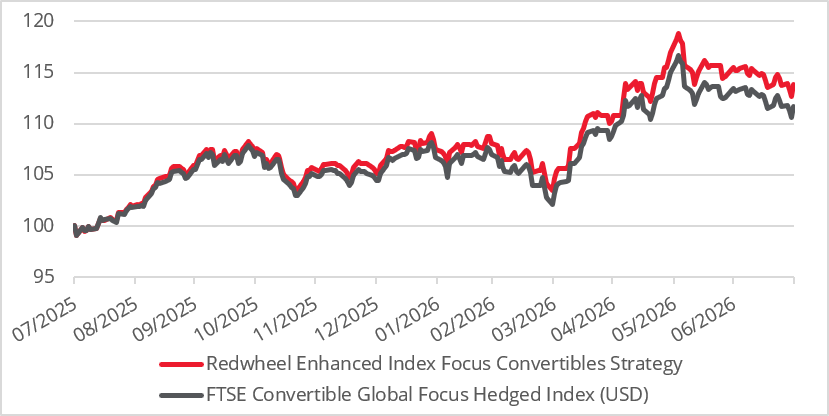
Over its first year, the Strategy delivered 13.83% net of fees versus 11.75% for the FTSE Global Focus Convertible Bond Index – 2.1% net outperformance. Tracking error was approximately 0.62%, benchmark correlation was approximately 0.99, and the information ratio was approximately 2.55.[1]
This outperformance reflects the Strategy’s proprietary implementation process, which comprises three levers of potential alpha. In their simplest forms, these levers focus on optimising for convertibles which are more efficient, incrementally increasing income and extracting alpha from the primary market without taking an economic deviation from the index. In the first year, the levers made a strong contribution to overall performance, and we are encouraged by the efficacy of our proprietary process.
The figures above suggest that the Strategy has delivered broad convertibles exposure with very limited benchmark deviation, while overcoming its costs and generating incremental alpha. The combination of close index alignment and positive net outperformance is particularly notable in an asset class where implementation frictions can be meaningful.
The passive implementation challenge
Delivering this exposure in an index-oriented format is more demanding than it may first appear. The monthly Focus rebalances require significant trading. That means actively managing execution carefully, overcoming bid-offer spreads and controlling transaction costs, all while seeking to minimise deviation from the benchmark.
Those practical challenges help explain why there have been relatively few genuinely low-cost ways to access a convertible exposure passively. In a complex asset class, a passive strategy still needs to be implemented actively and precisely if it is to avoid unnecessary performance leakage.
Cost matters
Cost efficiency is also central to EIFC’s proposition. Convertible strategies have often been more expensive than equivalent offerings in other asset classes, reflecting the complexity of the market. Yet investors seeking index-oriented convertible exposure should not necessarily have to pay fees closer to those associated with active management.
The Strategy is designed as a lower-cost option for investors specifically seeking balanced convertible asset class exposure with controlled benchmark deviation.
Why Focus?
Not all convertible indices provide the same exposure. Unlike conventional approaches, the FTSE Global Focus Convertible Bond Index maintains exposure to the part of the convertible universe with a more balanced equity and bond profile. It does this by rebalancing monthly as the characteristics of individual holdings change and it therefore has a higher turnover.
A balanced convertible profile seeks to capture convexity: the potential to participate more in rising markets while preserving value better as markets decline. This may support a more attractive risk/reward profile over time.
When constructing our process, we chose to apply it to the Focus index first as we feel it to be the most difficult to replicate and the purest expression of the asset class, while also giving us confidence that our approach could be successfully applied to broader indices that are less difficult to replicate.
The alpha is in the asset class
For investors considering convertibles, the appropriate starting point will depend on the exposure they want. The FTSE Global Focus Convertible Bond Index is designed to maintain exposure to the more balanced part of the convertible universe as the equity and bond characteristics of individual securities change.
Where a balanced profile is appropriate, the Strategy seeks to make that exposure more accessible, transparent and cost-efficient.
Key Information
No investment strategy or risk management technique can guarantee returns or eliminate risks in any market environment. Past performance is not a guide to the future. The prices of investments and income from them may fall as well as rise and investors may not get back the full amount invested. Forecasts and estimates are based upon subjective assumptions about circumstances and events that may not yet have taken place and may never do so. The statements and opinions expressed in this article are those of the author as of the date of publication, and do not necessarily represent the view of Redwheel. This article does not constitute investment advice and the information shown is for illustrative purposes only.
Sources:
[1] Bloomberg, Redwheel 30 July 2026