








How datacentres are reshaping power systems – and what it means for investors

Key takeaways
  • Surging datacentre and AI power demand is reshaping electricity markets in North America and Europe.


  • Ageing grids and rapid renewables deployment are driving a structural capex cycle across the power system.


  • Long-dated, premium-priced power contracts are de-risking utility business models and supporting potential re-ratings.


  • We see compelling opportunities across carbon free/low‑carbon baseload generators and grid network companies.

Datacentres are the fastest growing component of electricity demand across North America and Europe. Power demand from AI/Datacentres makes up approximately 4.5% and 3% of total power demand across the US and Europe, respectively, and is forecast to reach at least 9% and 7% by 2030.[1] This implies that datacentre capacity in Europe will nearly triple to reach 31GW by 2030, whereas US datacentre capacity is likely to grow by a factor of four over the same period.[2]

We see AI/datacentre power demand growth boosting infrastructure spending requirements and creating specific, long-term investment opportunities across the electricity system. This relates to the increased need to develop carbon free/low carbon power, accelerate grid investments, and boost flexible generation capacity, amongst others, which we explore in more detail below.

Ageing infrastructure is driving an urgent need for investment across Europe and the US

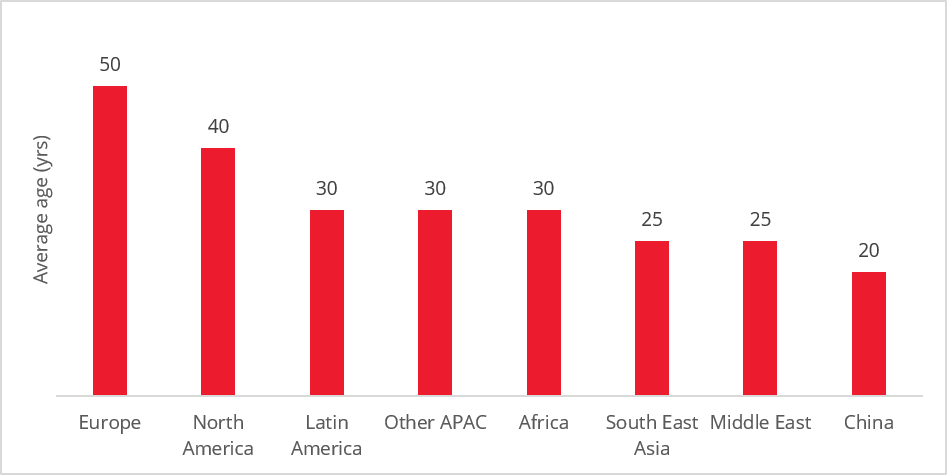
Europe and North America have on average the oldest critical power infrastructure assets globally, as reflected in Chart 1. The majority of critical infrastructure, such as power networks, railways and bridges in these regions, was developed in the 1950s-1970s. In Europe, this corresponds to the post-World War II reconstruction era, where infrastructure capital expenditure (capex) accounted for an elevated proportion of GDP. However, according to the OECD, public investment which includes infrastructure capital expenditure only accounts for around 3.5% of GDP on average today.[3]

Taking the UK as a case study, the energy regulator (OFGEM) recommends a 40–60-year useful life for transmission towers and a 40-50-year useful life for substation plants, overhead lines and cables[4]. This implies that the majority of power infrastructure assets are approaching the end of their useful lives and will likely require further investment for replacement, maintenance or lifetime extensions where possible.

Chart 1: Europe and North America have the oldest critical power infrastructure assets globally on average
Source: Goldman Sachs, September 2025. The information shown above is for illustrative purposes.

Rising renewables penetration is forcing infrastructure networks and systems to adapt

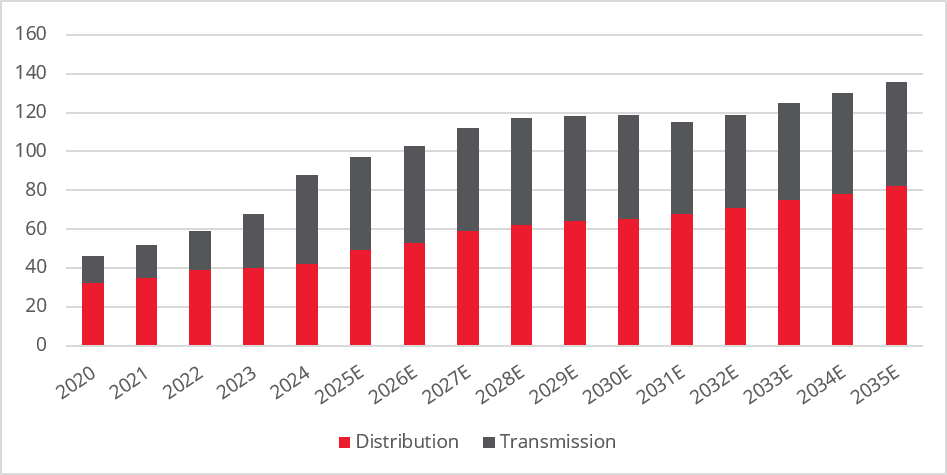
Further to the ageing infrastructure challenge, the energy transition is triggering additional requirements to adapt infrastructure networks and systems. The pace of global renewables deployment has accelerated since 2020 relative to investments in other parts of the electricity system, such as power networks and storage. This drives a costly system imbalance, which further underscores the urgent need for new investments across the electricity system. For example, grid congestion drives renewable output curtailment, which creates balancing costs that drive up electricity bills. UK balancing costs increased 10% year-on-year to £2.7bn in 2024/2025, driven partly by the inability to transmit excess wind output in the north of the country to meet consumption needs in the south[5]. Furthermore, grid connection delays negatively impact renewable capacity growth momentum.

These effects are most acutely felt in markets with older power grids and/or faster renewables penetration. Ultimately, existing global power networks were not designed to support a system with a growing majority of the power mix coming from renewables, and many need to be modernised. This is mainly due to the intermittent supply profile of renewables and oscillation variations, often at very short notice, which threaten grid stability. The April 2025 Iberian blackout offers a stark reminder of the risks of insufficient timely investment in necessary grid infrastructure.

Chart 2: Global grid and storage capex – 2020 to 2035E (EUR, bn)
Source: Goldman Sachs, October 2025. The information shown above is for illustrative purposes. Forecasts and estimates are based upon subjective assumptions.

A major, stillunfunded capex cycle lies ahead

Significant capex will be required to renovate and adapt obsolete infrastructure across OECD economies. Global Infrastructure spending is projected to reach approximately $7trn per annum by 2050, up from $4.4 trillion in 2024, with around 50% of this driven by power and transport infrastructure investments, according to PWC’s Global Infrastructure Outlook[6]. Nearer term, the IEA estimates that global grid investments should increase by 50% to $600bn per annum by 2030, compared to $400bn today[7].

Governments are conscious of the challenge. In the US, the $900bn Inflation Reduction Act, passed in 2022, will direct close to $400bn[8] towards energy and climate change investments. Germany’s €700bn infrastructure plan, approved in 2025, was also a major milestone in that respect. Around 40% of the total budget is likely to be dedicated to power grid investments, with an additional 30% for renewable energy infrastructure. The bulk of the remaining 20% will finance transportation infrastructure.[9]

However, with the vast majority of countries unable to afford such large-scale investment programmes, this raises a major funding gap issue. We think it’s likely that most governments will have to rely on regulators to incentivise capex, which would create more supportive regulatory frameworks for future capex.

Rising demand from datacentres has become the key challenge for electricity systems

Datacentres will likely be a key driver of power demand growth across North America and Europe over the next decade and beyond. According to Satya Nadella, the CEO of Microsoft, “The biggest issue we are now having is not a compute glut, …it’s power”[10]. Similarly, Nvidia CEO, Jensen Huang has noted that “…predictable access to power is becoming just as crucial as securing semiconductors.”[11].  Rising demand from AI and electrification follows two decades of negligible demand growth and coincides with a period a relative scarcity in baseload power generation across electricity systems.

Chart 3: US electricity demand is expected to accelerate (thousand TWh)
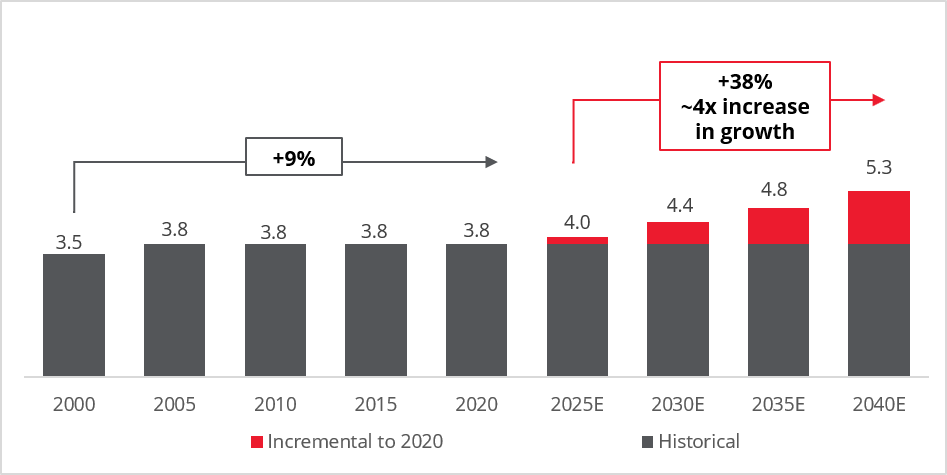
Source: McKinsey, Global Energy Perspective, October 2023; EIA, Annual Energy Outlook, 2023, Redwheel. The information shown above is for illustrative purposes. Forecasts and estimates are based upon subjective assumptions.

Chart 4: Datacentre power demand as % of European power demand is expected to rise
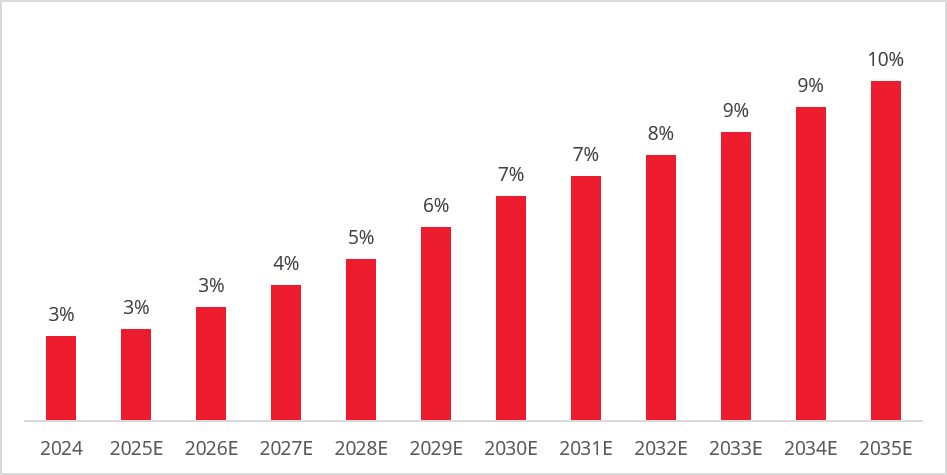
Source: UBS, 23 July 2026. The information shown above is for illustrative purposes. Forecasts and estimates are based upon subjective assumptions.

Datacentres are transforming the world of electricity

Power demand growth is accelerating after years of stagnation

While power demand tracked GDP over the 1945-2000 period, it has stagnated or even declined since then as efficiency gains have allowed for a significant reduction in the power intensity of industrial processes and home uses.[12] Lighting is the most striking illustration of this, with current light bulbs using approximately 80% less electricity than their predecessors. Over the past 20 years, power demand has averaged around 0.5% per annum in the US and 0.6% in Europe.[13] In the UK, we consume roughly 15% less electricity today than in 2000. 

Experts consider that electricity demand will increase by around 30% by 2040 in the US and by as much as 50% by 2035 in Europe.10 Some analysts are even anticipating potential annual growth rates in power demand of 4%.[14] The accelerating trend is driven by a general electrification of the economy, by the rise of electrical vehicles, by new home uses such as heat pumps, and above all by datacentre demand. We estimate the latter is expected to account for at least a third of the next decade’s power consumption increase.

Against this backdrop, companies exposed to the datacentre market with spare low-carbon generation capacity appear well positioned, in our view. The dramatic re-rerating of listed US utilities groups such as Constellation and Vistra[15] over the past couple of years indicates how transformational the evolution is (see Chart 5).

Constellation Energy signed a 20-year PPA with Microsoft to restart its Three Mile Island nuclear plant in September 2024 and signed another 20-year PPA with Meta in June 2025 for its Clinton Clean Energy Centre plant in Illinois.[16] Vistra has similarly signed long-term PPAs with technology companies and recently acquired 5.5GW of dispatchable gas assets through a $4.7bn deal with Cogentrix.[17]

Chart 5: Constellation and Vistra performance – both are well positioned to benefit
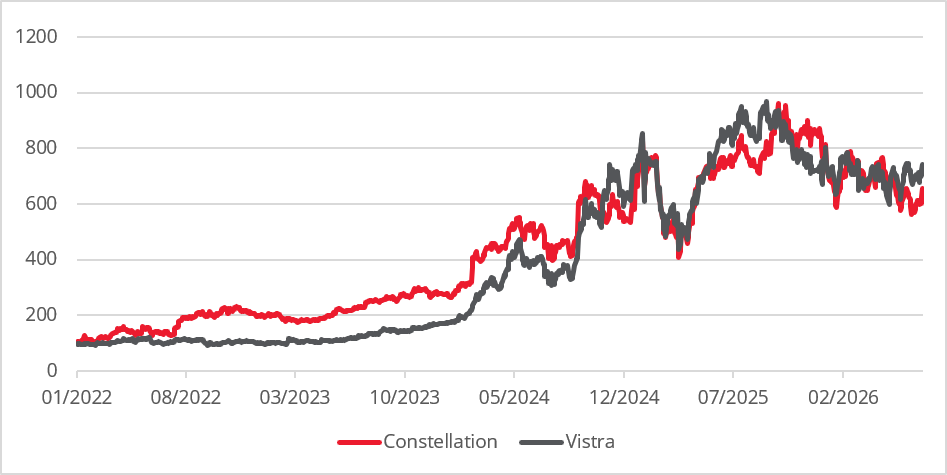
Source: Bloomberg, 20 July, 2026. Normalised to 100. USD. The information shown above is for illustrative purposes. Past performance is not a guide to future results. The prices of investments and income from them may fall as well as rise and an investor’s investment is subject to potential loss, in whole or in part.
Datacentre power demand is structurally de-risking utility business models

Demand from datacentres not only represents a major booster to the growth outlook of the power market, it also contributes to a structural derisking of utility business models. The Power Purchase Agreements (PPAs) between power generators and AI operators are typically signed for periods of 20 years, with clauses to renew them for a similar additional period. Pricing and indexation terms are pre-fixed, giving utilities a high degree of certainty over the future cash flows that the contract will generate, independent of fluctuations in external factors such as commodity prices or inflation.  This represents a major improvement in earnings visibility and security.

The first contract of this type was signed in 2024 between Amazon Web Services and Talen Energy, based on the latter’s Susquehanna nuclear plant in Pennsylvania. The agreement is likely to generate $18bn of revenues over 17 years.[18] Over the past couple of years, US tech companies have signed numerous similar contracts to secure their electricity procurements. We expect the trend to develop further in the US and to reach Europe.          

Most utility majors aim to de-risk their business models by extending the life span of their contracts and insulating themselves from external factors. While the top 10 utility groups in Europe were generating close to 50% of their cash flows from merchant-driven power generation activities 15-20 years ago, this proportion has diminished to around 10% only.[19] Meanwhile, those groups have expanded their exposure to fully regulated or contracted businesses. Datacentre agreements are the latest stage in this trend, as are recent investments in power grids, a source of regular and predictable earnings. Recent examples of this include Engie’s acquisition of UK Power Networks in May 2026 and, in Europe, RWE’s acquisition of an increased stake in Amprion in June 2026. NextEra’s $67bn bid for Dominion announced in May 2026 reflects the same ambition to secure cash flow streams.[20]

Datacentre operators are relatively power price-insensitive

Datacentre PPA contracts are highly sought after by energy developers, not only because of their longer duration nature, but also because of their associated premium price. Behind-the-meter (BTM) datacentre PPAs in Spain are priced at around a 40% premium to regular PPAs. More broadly, in parts of North America, datacentres are paying up to three times the 20-year historical average price of electricity.[21] Several contracts have been signed at electricity prices of $100-120/MWh versus a historical wholesale price of around $35 on average.[22] This phenomenon is reinforced by the scarcity of power generation resources as coal capacity has largely been phased out over the past decade, while investments in carbon-free nuclear capacity have been minimal. At the same time, high demand for power and intense competition among technology companies to maintain leading positions in AI innovation and deployment are pushing prices higher.

Overall, we expect this environment to be a source of enhanced return conditions for incumbent power generators, particularly as company valuations have yet to fully reflect these critical trends, in our view.

Capturing the datacentre power premium

We see a number of solutions that can address the impact of datacentres on electricity systems:.

1. Power generators with spare capacity – we see baseload carbon-free/low carbon power producers as a near-term solution to address rising power demand needs, particularly through BTM solutions as grid connection delays present a challenge for datacentre operators. 

2. Grid investment – grid connection delays are amongst the most significant bottlenecks for renewable capacity growth to address growing datacentre demand. The European Commission estimates that around €580bn of investment is required by 2030 to modernise infrastructure and integrate renewable energy, addressing hundreds of gigawatts of renewable capacity stuck on grid connection queues.[23] Similarly in the US, onshore wind and solar account for most of the capacity stuck on grid connection queues.

3. Flexible generation – we see batteries as a clean energy solution to the problem of curtailment and intermittency. With increasing durations (up to 6 hours in Italy), batteries can complement wind and solar to provide 40-60% of BTM consumption for datacentres.[24] Through hybridisation, batteries can improve renewable project returns by avoiding curtailment and selling stored power during peak-demand hours. Away from generation, we see transmission system operators increasingly using batteries to improve grid stability.

The potential for further re-rating from here

The datacentre build‑out is arriving at a time when many power systems are already stretched by ageing assets, rapid renewables deployment and a growing backlog of projects awaiting grid connections. For investors, this signals a multi‑year period in which access to reliable, low‑carbon electricity becomes a key competitive advantage for both utilities and technology companies.

Listed utilities that can offer that reliability – underpinned by long‑dated, premium‑priced contracts – are, in our view, still in the early stages of a re‑rating. As the capital cycle in grids, baseload generation and flexibility solutions unfolds, we expect the gap between companies that can monetise the datacentre opportunity and those that cannot to widen materially, creating a rich source of potential alpha for active investors.

Sources:

[1] UBS, January 2026; EPRI, January 2026

[2] UBS, January 2026

[3] OECD, May 2026

[4] Ofgem.gov.uk

[5] Neso, June 2025

[6] PWC, April 2026

[7] IEA, 2026

[8] IEA, 2025

[9] Source: Ecofin, BNetzA, AGEB, ENTSOE, Goldman Sachs as at October 2025.

[10] Datacentre Magazine, November 2025

[11] Datacentre Magazine, December 2025  

[12] McKinsey, Global Energy Perspective, October 2023; EIA, Annual Energy Outlook, 2023

[13] McKinsey, Global Energy Perspective, October 2023; EIA, Annual Energy Outlook, 2023, UBS, January 2026

[14] Barclays, December 2025

[15] These securities have been selected to highlight the strategy’s investment methodology and is not representative of the strategy’s performance. Portfolio holdings are subject to change at any time without notice. This information is illustrative and is not a recommendation to purchase or sell any security.

[16] Constellation Energy, September 2024

[17] Vistra, January 2026

[18] Powermag.com, June 2025

[19] Bloomberg, Goldman Sachs, Energy UK, Company data, Redwheel, June 2026

[20] Company releases

[21] Company releases, Redwheel, June 2026

[22] Company releases, Redwheel, June 2026

[23] European Parliament, December 2025

[24] Solaria, November 20

Key Information

No investment strategy or risk management technique can guarantee returns or eliminate risks in any market environment. Past performance is not a guide to the future. The prices of investments and income from them may fall as well as rise and investors may not get back the full amount invested. Forecasts and estimates are based upon subjective assumptions about circumstances and events that may not yet have taken place and may never do so. The statements and opinions expressed in this article are those of the author as of the date of publication, and do not necessarily represent the view of Redwheel. This article does not constitute investment advice and the information shown is for illustrative purposes only.

In case you missed it

UK Value & income
The risk of measuring risk: Why high tracking error may be the prudent choice in a concentrated market

As global equity indices become ever more concentrated, staying close to a benchmark can carry risks investors may not fully appreciate. Filippo Neumaier in Redwheel’s Value & Income team examines why higher tracking error can sometimes be the consequence of maintaining a genuinely diversified portfolio.

2 September, 2026 | 07:02am
Emerging and Frontier Markets
The ‘Fab 4’ become the ‘FOMO 3’

The Redwheel Emerging and Frontier Markets team explores the concentration challenge facing investors today and maps out under‑owned countries, sectors and themes that the team believes offer a richer blend of structural growth and genuine diversification.

27 July, 2026 | 01:48pm
UK Value & income
When it rhymes it pours

Shaul Rosten, Analyst with the Redwheel Value and Income team looks at the striking similarities between today’s market exuberance and the dotcom era, highlighting stretched valuations, record IPO activity and the dominance of the technology sector.

20 July, 2026 | 07:58pm

Disclaimer

Redwheel ® and Ecofin ® are registered trademarks of RWC Partners Limited (“RWC”). The term “Redwheel” may include any one or more Redwheel branded regulated entities including RWC Asset Management LLP, which is authorised and regulated by the UK Financial Conduct Authority and the US Securities and Exchange Commission (“SEC”); RWC Asset Advisors (US) LLC, which is registered with the SEC;  RWC Singapore (Pte) Limited, which is licensed as a Licensed Fund Management Company by the Monetary Authority of Singapore; Redwheel Australia Pty Ltd is an Australian Financial Services Licensee with the Australian Securities and Investment Commission; and Redwheel Europe Fondsmæglerselskab A/S which is regulated by the Danish Financial Supervisory Authority.

Redwheel may act as investment manager or adviser, or otherwise provide services, to more than one product pursuing a similar investment strategy or focus to the product detailed in this document. Redwheel and RWC (together “Redwheel Group”) seeks to minimise any conflicts of interest, and endeavours to act at all times in accordance with its legal and regulatory obligations as well as its own policies and codes of conduct.

This document is directed only at professional, institutional, wholesale or qualified investors. The services provided by Redwheel are available only to such persons. It is not intended for distribution to and should not be relied on by any person who would qualify as a retail or individual investor in any jurisdiction or for distribution to, or use by, any person or entity in any jurisdiction where such distribution or use would be contrary to local law or regulation.

This document has been prepared for general information purposes only and has not been delivered for registration in any jurisdiction nor has its content been reviewed or approved by any regulatory authority in any jurisdiction.

The information contained herein does not constitute: (i) a binding legal agreement; (ii) legal, regulatory, tax, accounting or other advice; (iii) an offer, recommendation or solicitation to buy or sell shares in any fund, security, commodity, financial instrument or derivative linked to, or otherwise included in a portfolio managed or advised by Redwheel; or (iv) an offer to enter into any other transaction whatsoever (each a “Transaction”). Redwheel Group bears no responsibility for your investment research and/or investment decisions and you should consult your own lawyer, accountant, tax adviser or other professional adviser before entering into any Transaction. No representations and/or warranties are made that the information contained herein is either up to date and/or accurate and is not intended to be used or relied upon by any counterparty, investor or any other third party.

Redwheel Group uses information from third party vendors, such as statistical and other data, that it believes to be reliable. However, the accuracy of this data, which may be used to calculate results or otherwise compile data that finds its way over time into Redwheel Group research data stored on its systems, is not guaranteed. If such information is not accurate, some of the conclusions reached or statements made may be adversely affected. Any opinion expressed herein, which may be subjective in nature, may not be shared by all directors, officers, employees, or representatives of Group and may be subject to change without notice. Redwheel Group is not liable for any decisions made or actions or inactions taken by you or others based on the contents of this document and neither Redwheel Group nor any of its directors, officers, employees, or representatives (including affiliates) accepts any liability whatsoever for any errors and/or omissions or for any direct, indirect, special, incidental, or consequential loss, damages, or expenses of any kind howsoever arising from the use of, or reliance on, any information contained herein.

Information contained in this document should not be viewed as indicative of future results. Past performance of any Transaction is not indicative of future results. The value of investments can go down as well as up. Certain assumptions and forward looking statements may have been made either for modelling purposes, to simplify the presentation and/or calculation of any projections or estimates contained herein and Redwheel Group does not represent that that any such assumptions or statements will reflect actual future events or that all assumptions have been considered or stated. There can be no assurance that estimated returns or projections will be realised or that actual returns or performance results will not materially differ from those estimated herein. Some of the information contained in this document may be aggregated data of Transactions executed by Redwheel that has been compiled so as not to identify the underlying Transactions of any particular customer.

No representations or warranties of any kind are intended or should be inferred with respect to the economic return from, or the tax consequences of, an investment in a Redwheel-managed fund.

This document expresses no views as to the suitability or appropriateness of the fund or any other investments described herein to the individual circumstances of any recipient.

The information transmitted is intended only for the person or entity to which it has been given and may contain confidential and/or privileged material. In accepting receipt of the information transmitted you agree that you and/or your affiliates, partners, directors, officers and employees, as applicable, will keep all information strictly confidential. Any review, retransmission, dissemination or other use of, or taking of any action in reliance upon, this information is prohibited. Any distribution or reproduction of this document is not authorised and is prohibited without the express written consent of Redwheel Group.

Funds managed by Redwheel are not, and will not be, registered under the Securities Act of 1933 (the “Securities Act”) and are not available for purchase by US persons (as defined in Regulation S under the Securities Act) except to persons who are “qualified purchasers” (as defined in the Investment Company Act of 1940) and “accredited investors” (as defined in Rule 501(a) under the Securities Act).

This document does not constitute an offer to sell, purchase, subscribe for or otherwise invest in units or shares of any fund managed by Redwheel. Any offering is made only pursuant to the relevant offering document and the relevant subscription application. Prospective investors should review the offering memorandum in its entirety, including the risk factors in the offering memorandum, before making a decision to invest.

AIFMD and Distribution in the European Economic Area (“EEA”)

The Alternative Fund Managers Directive (Directive 2011/61/EU) (“AIFMD”) is a regulatory regime which came into full effect in the EEA on 22 July 2014. RWC Asset Management LLP is an Alternative Investment Fund Manager (an “AIFM”) to certain funds managed by it (each an “AIF”). The AIFM is required to make available to investors certain prescribed information prior to their investment in an AIF. The majority of the prescribed information is contained in the latest Offering Document of the AIF. The remainder of the prescribed information is contained in the relevant AIF’s annual report and accounts. All of the information is provided in accordance with the AIFMD.

In relation to each member state of the EEA (each a “Member State”), this document may only be distributed and shares in a Redwheel fund (“Shares”) may only be offered and placed to the extent that (a) the relevant Redwheel fund is permitted to be marketed to professional investors in accordance with the AIFMD (as implemented into the local law/regulation of the relevant Member State); or (b) this document may otherwise be lawfully distributed and the Shares may lawfully be offered or placed in that Member State (including at the initiative of the investor).

Information Required for Offering in Switzerland of Foreign Collective Investment Schemes to Qualified Investors within the meaning of Article 10 CISA.

This is an advertising document.

The representative and paying agent of the Redwheel-managed funds in Switzerland (the “Representative in Switzerland”) FIRST INDEPENDENT FUND SERVICES LTD, Feldeggstrasse 12, CH-8008 Zurich. Swiss Paying Agent: Helvetische Bank AG, Seefeldstrasse 215, CH-8008 Zurich. In respect of the units of the Redwheel-managed funds offered in Switzerland, the place of performance is at the registered office of the Swiss Representative. The place of jurisdiction is at the registered office of the Swiss Representative or at the registered office or place of residence of the investor.

No investment strategy or risk management technique can guarantee returns or eliminate risks in any market environment.The term “RWC” may include any one or more RWC branded entities including RWC Partners Limited and RWC Asset Management LLP, each of which is authorised and regulated by the UK Financial Conduct Authority and, in the case of RWC Asset Management LLP, the US Securities and Exchange Commission; RWC Asset Advisors (US) LLC, which is registered with the US Securities and Exchange Commission; and RWC Singapore (Pte) Limited, which is licensed as a Licensed Fund Management Company by the Monetary Authority of Singapore.RWC may act as investment manager or adviser, or otherwise provide services, to more than one product pursuing a similar investment strategy or focus to the product detailed in this audio. RWC seeks to minimise any conflicts of interest, and endeavours to act at all times in accordance with its legal and regulatory obligations as well as its own policies and codes of conduct.This audio is directed only at professional, institutional, wholesale or qualified investors. The services provided by RWC are available only to such persons. It is not intended for distribution to and should not be relied on by any person who would qualify as a retail or individual investor in any jurisdiction or for distribution to, or use by, any person or entity in any jurisdiction where such distribution or use would be contrary to local law or regulation.This audio has been prepared for general information purposes only and has not been delivered for registration in any jurisdiction nor has its content been reviewed or approved by any regulatory authority in any jurisdiction. The information contained herein does not constitute: (i) a binding legal agreement; (ii) legal, regulatory, tax, accounting or other advice; (iii) an offer, recommendation or solicitation to buy or sell shares in any fund, security, commodity, financial instrument or derivative linked to, or otherwise included in a portfolio managed or advised by RWC; or(iv) an offer to enter into any other transaction whatsoever (each a “Transaction”). No representations and/or warranties are made that the information contained herein is either up to date and/or accurate and is not intended to be used or relied upon by any counterparty, investor or any other third party.RWC uses information from third party vendors, such as statistical and other data, that it believes to be reliable. However, the accuracy of this data, which may be used to calculate results or otherwise compile data that finds its way over time into RWC research data stored on its systems, is not guaranteed. If such information is not accurate, some of the conclusions reached or statements made may be adversely affected. RWC bears no responsibility for your investment research and/or investment decisions and you should consult your own lawyer, accountant, tax adviser or other professional adviser before entering into any Transaction. Any opinion expressed herein, which may be subjective in nature, may not be shared by all directors, officers, employees, or representatives of RWC and may be subject to change without notice. RWC is not liable for any decisions made or actions or in actions taken by you or others based on the contents of this audio and neither RWC nor any of its directors, officers, employees, or representatives (including affiliates) accepts any liability whatsoever for any errors and/or omissions or for any direct, indirect, special, incidental, or consequential loss, damages, or expenses of any kind howsoever arising from the use of, or reliance on, any information contained herein.Information contained in this audio should not be viewed as indicative of future results. Past performance of any Transaction is not indicative of future results. The value of investments can go down as well as up. Certain assumptions and forward looking statements may have been made either for modelling purposes, to simplify the audio and/or calculation of any projections or estimates contained herein and RWC does not represent that that any such assumptions or statements will reflect actual future events or that all assumptions have been considered or stated. Forward-looking statements are inherently uncertain, and changing factors such as those affecting the markets generally, or those affecting particular industries or issuers, may cause results to differ from those discussed. Accordingly, there can be no assurance that estimated returns or projections will be realised or that actual returns or performance results will not materially differ from those estimated herein. Some of the information contained in this audio may be aggregated data of Transactions executed by RWC that has been compiled so as not to identify the underlying Transactions of any particular customer.The information transmitted is intended only for the person or entity to which it has been given and may contain confidential and/or privileged material. In accepting receipt of the information transmitted you agree that you and/or your affiliates, partners, directors, officers and employees, as applicable, will keep all information strictly confidential. Any review, retransmission, dissemination or other use of, or taking of any action in reliance upon, this information is prohibited. The information contained herein is confidential and is intended for the exclusive use of the intended recipient(s) to which this audio has been provided. Any distribution or reproduction of this audio is not authorised and is prohibited without the express written consent of RWC or any of its affiliates.Changes in rates of exchange may cause the value of such investments to fluctuate. An investor may not be able to get back the amount invested and the loss on realisation may be very high and could result in a substantial or complete loss of the investment. In addition, an investor who realises their investment in a RWC-managed fund after a short period may not realise the amount originally invested as a result of charges made on the issue and/or redemption of such investment. The value of such interests for the purposes of purchases may differ from their value for the purpose of redemptions. No representations or warranties of any kind are intended or should be inferred with respect to the economic return from, or the tax consequences of, an investment in a RWC-managed fund. Current tax levels and reliefs may change. Depending on individual circumstances, this may affect investment returns. Nothing in this document constitutes advice on the merits of buying or selling a particular investment. This audio expresses no views as to the suitability or appropriateness of the fund or any other investments described herein to the individual circumstances of any recipient.AIFMD and Distribution in the European Economic Area (“EEA”)The Alternative Fund Managers Directive (Directive 2011/61/EU)(“AIFMD”) is a regulatory regime which came into full effect in the EEA on 22 July 2014. RWC Asset Management LLP is an Alternative Investment Fund Manager (an “AIFM”) to certain funds managed by it (each an “AIF”). The AIFM is required to make available to investors certain prescribed information prior to their investment in an AIF. The majority of the prescribed information is contained in the latest Offering Document of the AIF. The remainder of the prescribed information is contained in the relevant AIF’s annual report and accounts. All of the information is provided in accordance with the AIFMD.In relation to each member state of the EEA (each a “Member State”),this document may only be distributed and shares in a RWC fund(“Shares”) may only be offered and placed to the extent that (a) the relevant RWC fund is permitted to be marketed to professional investors in accordance with the AIFMD (as implemented into the local law/regulation of the relevant Member State); or (b) this audio may otherwise be lawfully distributed and the Shares may lawfully offered or placed in that Member State (including at the initiative of the investor).Information Required for Distribution of Foreign Collective Investment Schemes to Qualified Investors in SwitzerlandThe representative and paying agent of the RWC-managed funds in Switzerland (the “Representative in Switzerland”) FIRST INDEPENDENT FUND SERVICES LTD, Klausstrasse 33, CH-8008 Zurich. Swiss Paying Agent: Helvetische Bank AG, Seefeldstrasse 215, CH-8008 Zurich. In respect of the units of the RWC-managed funds distributed in Switzerland, the place of performance and jurisdiction is at the registered office of the Representative in Switzerland.