










Just Stop Selling UK Equities!

At the start of 2022, we wrote a paper entitled ‘How to Survive if the US Equity Bubble Pops: Five Reasons to Buy UK Value’ which proved particularly prescient. By the end of the year, the US equity bubble had indeed popped, and the S&P 500 Index had declined by 18% with the technology heavy NASDAQ index down 33%. The UK market was one of the very few places that produced a positive return, returning 4.6%.[1]

How to survive if the US equity bubble pops: five reasons to buy UK Value

In a longer piece, titled Reversion to long-run mean, we again made the case for a reduced allocation to US equities and an increased allocation to UK equities based once more on the extreme divergence in valuations between the two markets but also noting that in our view many of the factors that had driven US outperformance such as low inflation and declining interest rates were in the process of reversing.

Reversion to long-run mean 

The reason that we made that call is not because we are brilliant macro or market forecasters but because we know we are not and hence we always use base rates and probabilities to guide us. In this instance, GMO’s Jeremy Grantham had identified that there had been 300 bubbles in history (defined as a two sigma move away from long run trend) and all 300 had burst.[2] There had been five super bubbles (defined as a three sigma move) and all five had burst with devastating consequences. The US equity market was the sixth super-bubble. One didn’t need to be Stan Druckenmiller to know that having large amounts of money allocated to US equities at that point in time was probably a bad idea. And yet despite the odds of success being massively stacked against investors, in 2021, more money had gone into US equity funds than in the previous nineteen years added together. If 2021 was the year that the crowd marvelled at the emperor’s new clothes, 2022 was the year when the small boy pointed out that he was naked.
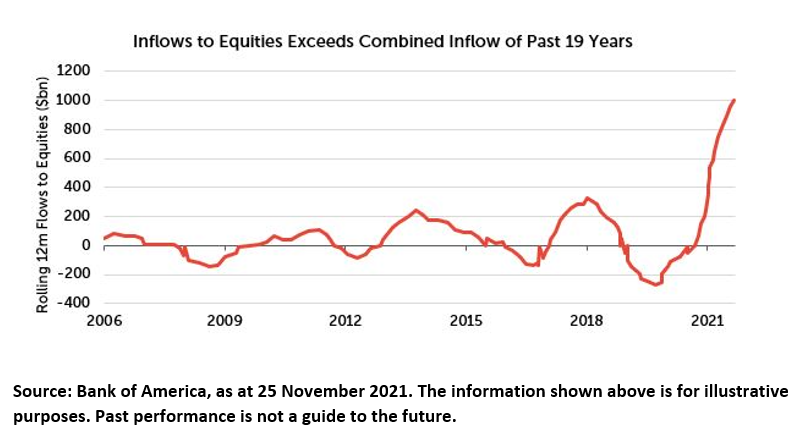
But not only have many investors ignored our advice about the dangers of having a large allocation to US equities, they appear to have completely ignored our advice about the merits of increasing an allocation to UK equities and have done the very opposite of what we were suggesting. The latest data from funds network Calastone[3] shows that investors pulled nearly £870m out of UK focused equity funds in January 2023. That is the 20th consecutive month of outflows and the third worst month on Calastone’s records. Since 2015, investors have sold £7.3billion of UK focused funds and bought £58 billion of funds focusing on anywhere else.

This selling is the continuation of a trend that began about twenty years ago. Back in the mid-nineties when I was a young fund manager at Gartmore looking after the UK part of balanced pension funds (and a young Nick Purves was doing an equivalent job at Schroders), it was standard to have around 55% of the portfolio in UK equities and about another 25% in overseas equities. In addition, because the majority used the CAPS Median as their benchmark, all of the big four pension fund managers (Mercury, Schroders, Gartmore and PDFM) would have a similar weighting across these asset classes which meant that UK pension funds were ridiculously over-exposed to equities in general and UK equities in particular. They subsequently paid for this post-2000 as equities declined and assets within pensions collapsed while falling bond yields meant liabilities increased. This pushed many trustees towards liability matching strategies which usually meant selling equities and buying gilts. These trends can be seen very clearly in the chart below.
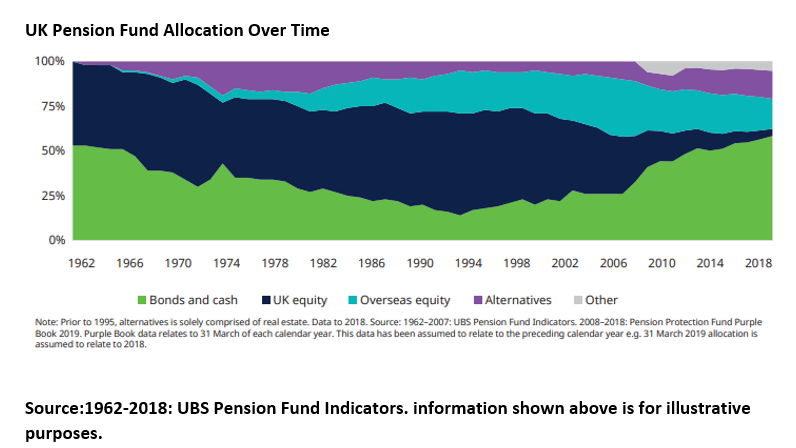
At the same time that the total allocation to equities declined, the balance between UK and overseas also shifted substantially such that the UK approximately represents around 10-15% with overseas making up the balance (see chart below). This reduction of equity exposure combined with a rebalancing from the UK to overseas has created relentless selling pressure on UK equities, which potentially explains why returns have been lacklustre since 2000; even at a new high of 8000, the FTSE 100 Index has only advanced by 15% since its late nineties high whilst the US S&P 500 Index is 183% higher.
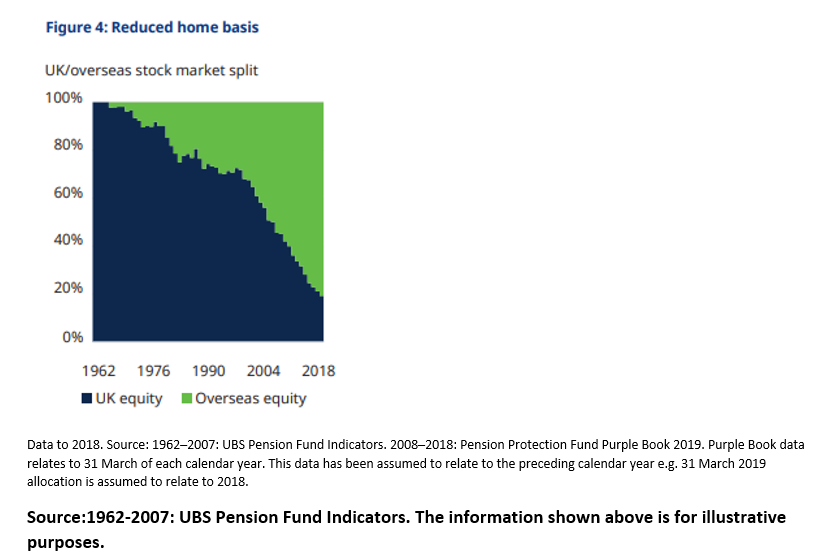
At the Redwheel Investment Summit last year, when I had finished presenting the case for UK equities, a delegate came up to me and said, “the UK market has a smaller market cap than Apple, why do I even need to bother with it?” Whilst a little part of my soul died in that moment, the question did highlight the agency problem in a nutshell; we have created an incentive structure that encourages advisors to hug the index which in practical terms means holding high percentages of investors’ money in large markets rather than cheap markets and in large companies rather than cheap companies. No consideration is given to the fact that these markets or companies may have become large by being very expensive nor to the fact that some of the small ones might be cheap.

I think this is crazy. One of the immutable laws of investing is that valuations and subsequent returns are inversely correlated as the chart below demonstrates so clearly. The implication of this chart is that if you consistently buy expensive assets, you will, over time, get lower returns. As an aside, the yellow dot on the bottom right-hand side of the chart signifies the potential twelve year (negative) returns from the S&P500 at the time that this chart was produced which was December 2022. For those with over two thirds of their client’s equity exposure in the US, you are effectively betting that ‘this time will be different’ or you are playing greater fool and hoping that an expensive asset will get more expensive and provide you with the opportunity to get in and get out. Good luck with that.
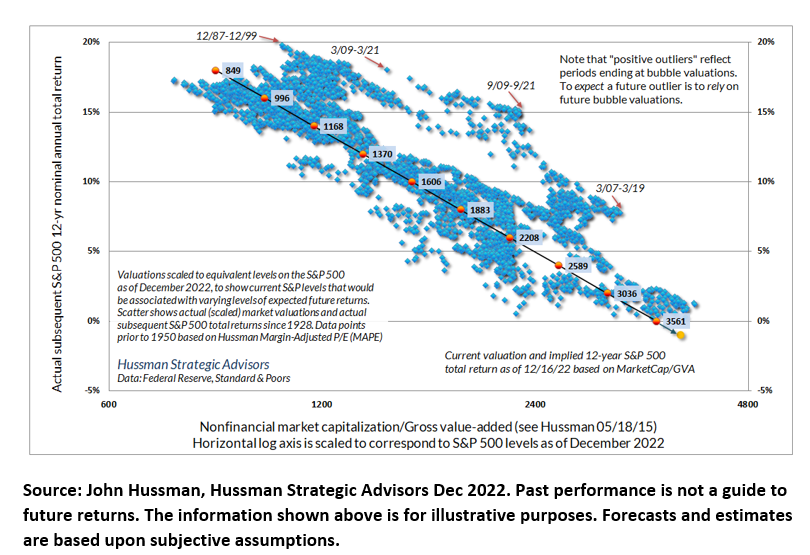
I am constantly surprised how some investment professionals struggle with the concept that starting valuation and subsequent return are inversely correlated. When you buy an equity, you are buying a stream of cash flows and the higher the price you pay for those cash flows, usually the lower your subsequent return. If you pay £32 for £100 a decade from now, your return is 12% (£100/£32)^(1/10)-1=12% whereas if you pay £82 for the same £100 your return is 2% (£100/£82)^(1/10)-1=2%. It really doesn’t matter if you think inflation has peaked and the Fed is going to pivot. When you pay one of the highest valuations that has ever existed for US equities, you are arguably skewing the odds of making a satisfactory return massively against yourself.

So, what explains the extreme levels of negative sentiment towards the UK?

The constant stream of negative headlines probably doesn’t help. Mainstream media feeds us a 24/7 diet of gloom and doom; inflation, rising interest rates, falling real wages, strikes and the looming prospect of higher taxes. ‘Crisis’ has arguably become the most over-used word in the lexicon with the climate crisis, energy crisis and cost of living crisis all competing for air time. I know that it feels like nothing in the country works unless you are fortunate enough to never have to use public transport or the NHS and that barely a day goes by without large swathes of the public sector being on strike. The fact that we have had three Prime Ministers and four Chancellors in eighteen months doesn’t help.

The key point is that none of this matters when it comes to assessing potential long term returns as it is this stream of negative sentiment that has produced the low valuations.

‘It is largely the fluctuations which throw up the bargains and the uncertainty due to the fluctuations which prevents other people from taking advantage of them.’

Also remind yourself that a bearish view on the UK economy has little relevance to the performance of the index where approximately 70% of earnings come from overseas. To give one example, BP has about 2% of its earnings from the UK [5] and hence is not particularly impacted by the performance of the UK economy. Despite this, it attracts a UK discount with the shares trading on 5x earnings versus 10x for Exxon. US investors have woken up to this fact and US buying is cited as one of the reasons that the shares have risen so strongly recently. And let’s remember, those who are selling the UK to go global are selling BP on 5x and then reinvesting the proceeds in Exxon on 10x.[6]

So, if you are someone who cares more about producing good risk adjusted returns for your investors than about benchmark weightings lets re-visit some of the reasons we put forward to own UK equities.

1. The UK is currently one of the cheapest equity markets in the world

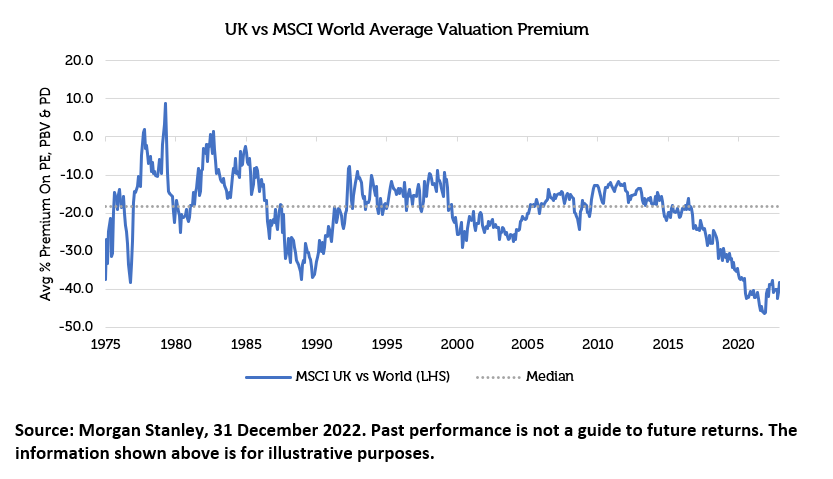
If you accept the earlier premise that starting valuation and subsequent returns are inversely correlated, then the UK should be an attractive place to allocate given that it has one of the lowest valuations relative to World markets for fifty years and is also one of the cheapest developed markets today.
2. Dividend yield

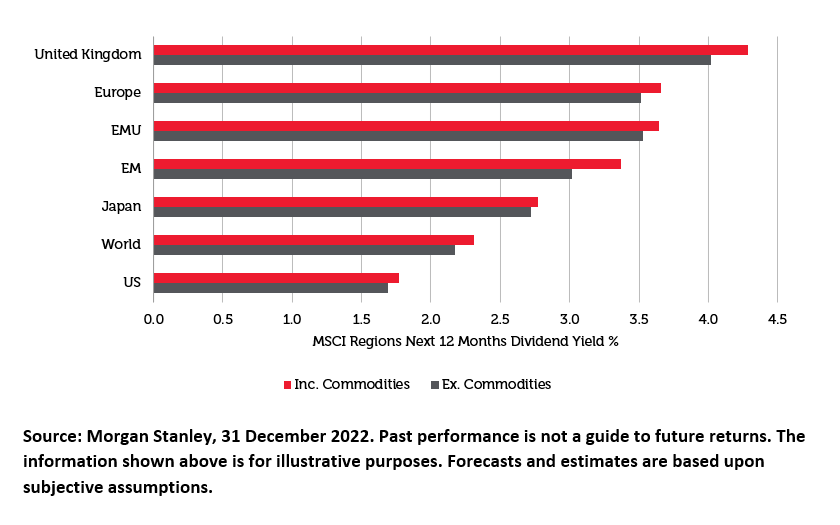
The UK offers one of the highest dividend yields of any market in the world and as readers of the Barclays Gilt Equity study will know, in the long run, dividend yield makes up about half of total returns.
3. Sector composition

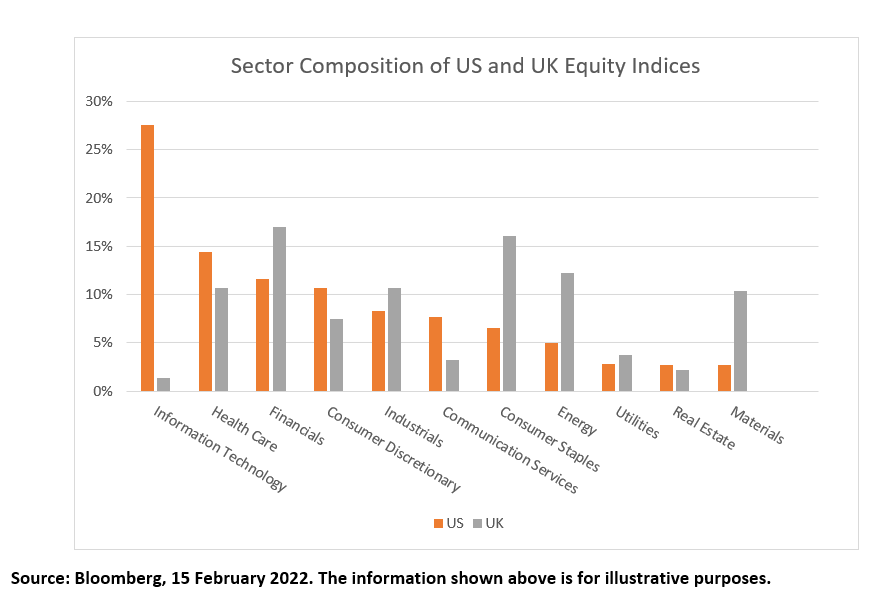
Whilst a low exposure to technology stocks and a high exposure to energy and mining might have been a headwind during the last decade, it is quite possible this becomes a tailwind in the future. Last year, for instance, the energy sector was +30% when NASDAQ was down 30%. Some strategists such as Russell Napier believe that the next decade will see a catch up in investment in productive assets such as gas fields and copper mines and less investment going in to yet another takeaway food delivery app.
Conclusion

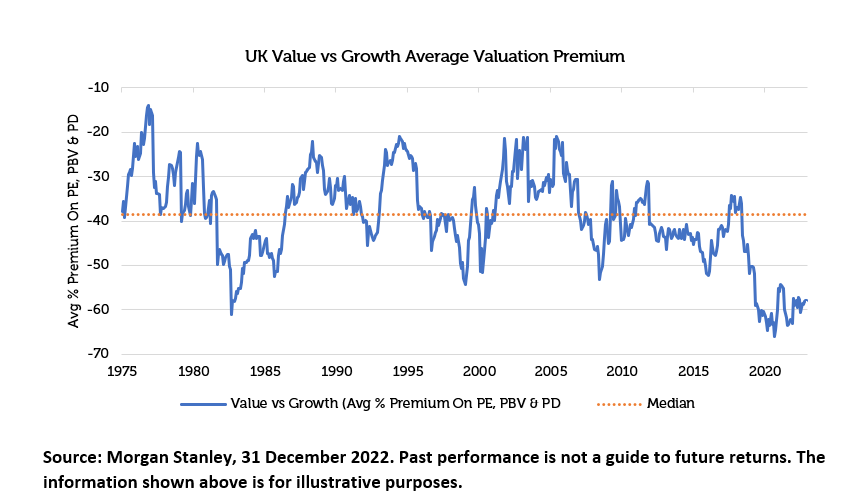
There is a good chance that most of the people reading this note will have no option other than to stick with the asset allocation policy recommended by their Investment Committee of being 1% underweight the US and 1% overweight the UK and hence having 68% of their equity exposure in ‘the sixth super-bubble in financial market history’ and only 5% in one of the cheapest markets in the world. But for those who have the freedom to stray from the benchmark, I would urge you to at least consider a sizeable allocation to the UK. Even better than buying the whole UK market would be buying the cheap part of it since value within the UK is still very cheap relative to growth as the chart below demonstrates. If nothing else, please stop selling UK equities!
Sources:

[1] S&P 500 total return, NASDAQ Index total return, FTSE 100 Index total return, 31 December 2021 to 31 December 2022, Bloomberg

[2] LET THE WILD RUMPUS BEGIN*By Jeremy Grantham, GMO Jan 2022

[3] UK’S AILING IMAGE PROMPTS BIG SWITCH AWAY FROM UK-FOCUSED EQUITY FUNDS WHILE HIGHER YIELDS TEMPT INVESTORS INTO BONDS, Calastone, Fund Flow Index, 6 February 2023

[4] Price change. Bloomberg, 30 December 1999 to 15 February 2023

[5] BP, 31 January 2023

[6] Bloomberg, 15 February 2023

Key Information

No investment strategy or risk management technique can guarantee returns or eliminate risks in any market environment. Past performance is not a guide to future results. The prices of investments and income from them may fall as well as rise and an investor’s investment is subject to potential loss, in whole or in part. Forecasts and estimates are based upon subjective assumptions about circumstances and events that may not yet have taken place and may never do so. The statements and opinions expressed in this article are those of the author as of the date of publication, and do not necessarily represent the view of Redwheel. This article does not constitute investment advice and the information shown is for illustrative purposes only.




In case you missed it

UK Value & income
Finding hidden GEMs beyond Wall Street

There is an old Warren Buffett quote that is often used: “Price is what you pay, value is what you get”. Most investors nod along and then go back to buying whatever US large-cap growth stock everyone else is buying. Large mispricings are more likely to be found in areas where few are looking, however, and this should prompt the bargain hunter to start peering into places far from New York and London...

21 April, 2026 | 01:02am
Infrastructure
Is Hormuz the new Fukushima?

Discover how our Ecofin investment team argues that disruption in the Strait of Hormuz could be an energy shock with echoes of Fukushima, reshaping global power markets and energy security priorities.

21 April, 2026 | 01:02am
Emerging and Frontier Markets
On the road...in Uzbekistan

Watch our latest video as Victor Erch from The Redwheel Emerging and Frontier Markets team shares insights from his recent trip to Uzbekistan and discusses the country's exciting transformation, rich natural resources, population growth, manufacturing development and increase in tourism.

18 November, 2025 | 10:27am

Disclaimer

Redwheel ® and Ecofin ® are registered trademarks of RWC Partners Limited (“RWC”). The term “Redwheel” may include any one or more Redwheel branded regulated entities including RWC Asset Management LLP, which is authorised and regulated by the UK Financial Conduct Authority and the US Securities and Exchange Commission (“SEC”); RWC Asset Advisors (US) LLC, which is registered with the SEC;  RWC Singapore (Pte) Limited, which is licensed as a Licensed Fund Management Company by the Monetary Authority of Singapore; Redwheel Australia Pty Ltd is an Australian Financial Services Licensee with the Australian Securities and Investment Commission; and Redwheel Europe Fondsmæglerselskab A/S which is regulated by the Danish Financial Supervisory Authority.

Redwheel may act as investment manager or adviser, or otherwise provide services, to more than one product pursuing a similar investment strategy or focus to the product detailed in this document. Redwheel and RWC (together “Redwheel Group”) seeks to minimise any conflicts of interest, and endeavours to act at all times in accordance with its legal and regulatory obligations as well as its own policies and codes of conduct.

This document is directed only at professional, institutional, wholesale or qualified investors. The services provided by Redwheel are available only to such persons. It is not intended for distribution to and should not be relied on by any person who would qualify as a retail or individual investor in any jurisdiction or for distribution to, or use by, any person or entity in any jurisdiction where such distribution or use would be contrary to local law or regulation.

This document has been prepared for general information purposes only and has not been delivered for registration in any jurisdiction nor has its content been reviewed or approved by any regulatory authority in any jurisdiction.

The information contained herein does not constitute: (i) a binding legal agreement; (ii) legal, regulatory, tax, accounting or other advice; (iii) an offer, recommendation or solicitation to buy or sell shares in any fund, security, commodity, financial instrument or derivative linked to, or otherwise included in a portfolio managed or advised by Redwheel; or (iv) an offer to enter into any other transaction whatsoever (each a “Transaction”). Redwheel Group bears no responsibility for your investment research and/or investment decisions and you should consult your own lawyer, accountant, tax adviser or other professional adviser before entering into any Transaction. No representations and/or warranties are made that the information contained herein is either up to date and/or accurate and is not intended to be used or relied upon by any counterparty, investor or any other third party.

Redwheel Group uses information from third party vendors, such as statistical and other data, that it believes to be reliable. However, the accuracy of this data, which may be used to calculate results or otherwise compile data that finds its way over time into Redwheel Group research data stored on its systems, is not guaranteed. If such information is not accurate, some of the conclusions reached or statements made may be adversely affected. Any opinion expressed herein, which may be subjective in nature, may not be shared by all directors, officers, employees, or representatives of Group and may be subject to change without notice. Redwheel Group is not liable for any decisions made or actions or inactions taken by you or others based on the contents of this document and neither Redwheel Group nor any of its directors, officers, employees, or representatives (including affiliates) accepts any liability whatsoever for any errors and/or omissions or for any direct, indirect, special, incidental, or consequential loss, damages, or expenses of any kind howsoever arising from the use of, or reliance on, any information contained herein.

Information contained in this document should not be viewed as indicative of future results. Past performance of any Transaction is not indicative of future results. The value of investments can go down as well as up. Certain assumptions and forward looking statements may have been made either for modelling purposes, to simplify the presentation and/or calculation of any projections or estimates contained herein and Redwheel Group does not represent that that any such assumptions or statements will reflect actual future events or that all assumptions have been considered or stated. There can be no assurance that estimated returns or projections will be realised or that actual returns or performance results will not materially differ from those estimated herein. Some of the information contained in this document may be aggregated data of Transactions executed by Redwheel that has been compiled so as not to identify the underlying Transactions of any particular customer.

No representations or warranties of any kind are intended or should be inferred with respect to the economic return from, or the tax consequences of, an investment in a Redwheel-managed fund.

This document expresses no views as to the suitability or appropriateness of the fund or any other investments described herein to the individual circumstances of any recipient.

The information transmitted is intended only for the person or entity to which it has been given and may contain confidential and/or privileged material. In accepting receipt of the information transmitted you agree that you and/or your affiliates, partners, directors, officers and employees, as applicable, will keep all information strictly confidential. Any review, retransmission, dissemination or other use of, or taking of any action in reliance upon, this information is prohibited. Any distribution or reproduction of this document is not authorised and is prohibited without the express written consent of Redwheel Group.

Funds managed by Redwheel are not, and will not be, registered under the Securities Act of 1933 (the “Securities Act”) and are not available for purchase by US persons (as defined in Regulation S under the Securities Act) except to persons who are “qualified purchasers” (as defined in the Investment Company Act of 1940) and “accredited investors” (as defined in Rule 501(a) under the Securities Act).

This document does not constitute an offer to sell, purchase, subscribe for or otherwise invest in units or shares of any fund managed by Redwheel. Any offering is made only pursuant to the relevant offering document and the relevant subscription application. Prospective investors should review the offering memorandum in its entirety, including the risk factors in the offering memorandum, before making a decision to invest.

AIFMD and Distribution in the European Economic Area (“EEA”)

The Alternative Fund Managers Directive (Directive 2011/61/EU) (“AIFMD”) is a regulatory regime which came into full effect in the EEA on 22 July 2014. RWC Asset Management LLP is an Alternative Investment Fund Manager (an “AIFM”) to certain funds managed by it (each an “AIF”). The AIFM is required to make available to investors certain prescribed information prior to their investment in an AIF. The majority of the prescribed information is contained in the latest Offering Document of the AIF. The remainder of the prescribed information is contained in the relevant AIF’s annual report and accounts. All of the information is provided in accordance with the AIFMD.

In relation to each member state of the EEA (each a “Member State”), this document may only be distributed and shares in a Redwheel fund (“Shares”) may only be offered and placed to the extent that (a) the relevant Redwheel fund is permitted to be marketed to professional investors in accordance with the AIFMD (as implemented into the local law/regulation of the relevant Member State); or (b) this document may otherwise be lawfully distributed and the Shares may lawfully be offered or placed in that Member State (including at the initiative of the investor).

Information Required for Offering in Switzerland of Foreign Collective Investment Schemes to Qualified Investors within the meaning of Article 10 CISA.

This is an advertising document.

The representative and paying agent of the Redwheel-managed funds in Switzerland (the “Representative in Switzerland”) FIRST INDEPENDENT FUND SERVICES LTD, Feldeggstrasse 12, CH-8008 Zurich. Swiss Paying Agent: Helvetische Bank AG, Seefeldstrasse 215, CH-8008 Zurich. In respect of the units of the Redwheel-managed funds offered in Switzerland, the place of performance is at the registered office of the Swiss Representative. The place of jurisdiction is at the registered office of the Swiss Representative or at the registered office or place of residence of the investor.

No investment strategy or risk management technique can guarantee returns or eliminate risks in any market environment.The term “RWC” may include any one or more RWC branded entities including RWC Partners Limited and RWC Asset Management LLP, each of which is authorised and regulated by the UK Financial Conduct Authority and, in the case of RWC Asset Management LLP, the US Securities and Exchange Commission; RWC Asset Advisors (US) LLC, which is registered with the US Securities and Exchange Commission; and RWC Singapore (Pte) Limited, which is licensed as a Licensed Fund Management Company by the Monetary Authority of Singapore.RWC may act as investment manager or adviser, or otherwise provide services, to more than one product pursuing a similar investment strategy or focus to the product detailed in this audio. RWC seeks to minimise any conflicts of interest, and endeavours to act at all times in accordance with its legal and regulatory obligations as well as its own policies and codes of conduct.This audio is directed only at professional, institutional, wholesale or qualified investors. The services provided by RWC are available only to such persons. It is not intended for distribution to and should not be relied on by any person who would qualify as a retail or individual investor in any jurisdiction or for distribution to, or use by, any person or entity in any jurisdiction where such distribution or use would be contrary to local law or regulation.This audio has been prepared for general information purposes only and has not been delivered for registration in any jurisdiction nor has its content been reviewed or approved by any regulatory authority in any jurisdiction. The information contained herein does not constitute: (i) a binding legal agreement; (ii) legal, regulatory, tax, accounting or other advice; (iii) an offer, recommendation or solicitation to buy or sell shares in any fund, security, commodity, financial instrument or derivative linked to, or otherwise included in a portfolio managed or advised by RWC; or(iv) an offer to enter into any other transaction whatsoever (each a “Transaction”). No representations and/or warranties are made that the information contained herein is either up to date and/or accurate and is not intended to be used or relied upon by any counterparty, investor or any other third party.RWC uses information from third party vendors, such as statistical and other data, that it believes to be reliable. However, the accuracy of this data, which may be used to calculate results or otherwise compile data that finds its way over time into RWC research data stored on its systems, is not guaranteed. If such information is not accurate, some of the conclusions reached or statements made may be adversely affected. RWC bears no responsibility for your investment research and/or investment decisions and you should consult your own lawyer, accountant, tax adviser or other professional adviser before entering into any Transaction. Any opinion expressed herein, which may be subjective in nature, may not be shared by all directors, officers, employees, or representatives of RWC and may be subject to change without notice. RWC is not liable for any decisions made or actions or in actions taken by you or others based on the contents of this audio and neither RWC nor any of its directors, officers, employees, or representatives (including affiliates) accepts any liability whatsoever for any errors and/or omissions or for any direct, indirect, special, incidental, or consequential loss, damages, or expenses of any kind howsoever arising from the use of, or reliance on, any information contained herein.Information contained in this audio should not be viewed as indicative of future results. Past performance of any Transaction is not indicative of future results. The value of investments can go down as well as up. Certain assumptions and forward looking statements may have been made either for modelling purposes, to simplify the audio and/or calculation of any projections or estimates contained herein and RWC does not represent that that any such assumptions or statements will reflect actual future events or that all assumptions have been considered or stated. Forward-looking statements are inherently uncertain, and changing factors such as those affecting the markets generally, or those affecting particular industries or issuers, may cause results to differ from those discussed. Accordingly, there can be no assurance that estimated returns or projections will be realised or that actual returns or performance results will not materially differ from those estimated herein. Some of the information contained in this audio may be aggregated data of Transactions executed by RWC that has been compiled so as not to identify the underlying Transactions of any particular customer.The information transmitted is intended only for the person or entity to which it has been given and may contain confidential and/or privileged material. In accepting receipt of the information transmitted you agree that you and/or your affiliates, partners, directors, officers and employees, as applicable, will keep all information strictly confidential. Any review, retransmission, dissemination or other use of, or taking of any action in reliance upon, this information is prohibited. The information contained herein is confidential and is intended for the exclusive use of the intended recipient(s) to which this audio has been provided. Any distribution or reproduction of this audio is not authorised and is prohibited without the express written consent of RWC or any of its affiliates.Changes in rates of exchange may cause the value of such investments to fluctuate. An investor may not be able to get back the amount invested and the loss on realisation may be very high and could result in a substantial or complete loss of the investment. In addition, an investor who realises their investment in a RWC-managed fund after a short period may not realise the amount originally invested as a result of charges made on the issue and/or redemption of such investment. The value of such interests for the purposes of purchases may differ from their value for the purpose of redemptions. No representations or warranties of any kind are intended or should be inferred with respect to the economic return from, or the tax consequences of, an investment in a RWC-managed fund. Current tax levels and reliefs may change. Depending on individual circumstances, this may affect investment returns. Nothing in this document constitutes advice on the merits of buying or selling a particular investment. This audio expresses no views as to the suitability or appropriateness of the fund or any other investments described herein to the individual circumstances of any recipient.AIFMD and Distribution in the European Economic Area (“EEA”)The Alternative Fund Managers Directive (Directive 2011/61/EU)(“AIFMD”) is a regulatory regime which came into full effect in the EEA on 22 July 2014. RWC Asset Management LLP is an Alternative Investment Fund Manager (an “AIFM”) to certain funds managed by it (each an “AIF”). The AIFM is required to make available to investors certain prescribed information prior to their investment in an AIF. The majority of the prescribed information is contained in the latest Offering Document of the AIF. The remainder of the prescribed information is contained in the relevant AIF’s annual report and accounts. All of the information is provided in accordance with the AIFMD.In relation to each member state of the EEA (each a “Member State”),this document may only be distributed and shares in a RWC fund(“Shares”) may only be offered and placed to the extent that (a) the relevant RWC fund is permitted to be marketed to professional investors in accordance with the AIFMD (as implemented into the local law/regulation of the relevant Member State); or (b) this audio may otherwise be lawfully distributed and the Shares may lawfully offered or placed in that Member State (including at the initiative of the investor).Information Required for Distribution of Foreign Collective Investment Schemes to Qualified Investors in SwitzerlandThe representative and paying agent of the RWC-managed funds in Switzerland (the “Representative in Switzerland”) FIRST INDEPENDENT FUND SERVICES LTD, Klausstrasse 33, CH-8008 Zurich. Swiss Paying Agent: Helvetische Bank AG, Seefeldstrasse 215, CH-8008 Zurich. In respect of the units of the RWC-managed funds distributed in Switzerland, the place of performance and jurisdiction is at the registered office of the Representative in Switzerland.