









Your annual reminder of what works in investing

You know that you are a bit of an investment geek when you get as excited about the release of the annual Credit Suisse Investment Returns Handbook as others get about the new season of Love Island but nonetheless, it is something I always read and always find illuminating. Now in its fifteenth year, it is a a long-standing collaboration with Professor Paul Marsh and Dr. Mike Staunton of London Business School and Professor Elroy Dimson of Cambridge University and has established itself as one of the the definitive sources for the analysis of the long-term performance of global financial assets.

My favourite section is that on Style Investing which is a very long-term study of what works in investing and each year builds on the same three conclusions about which factors produce excess returns: size, value and momentum.[1]

1. Size

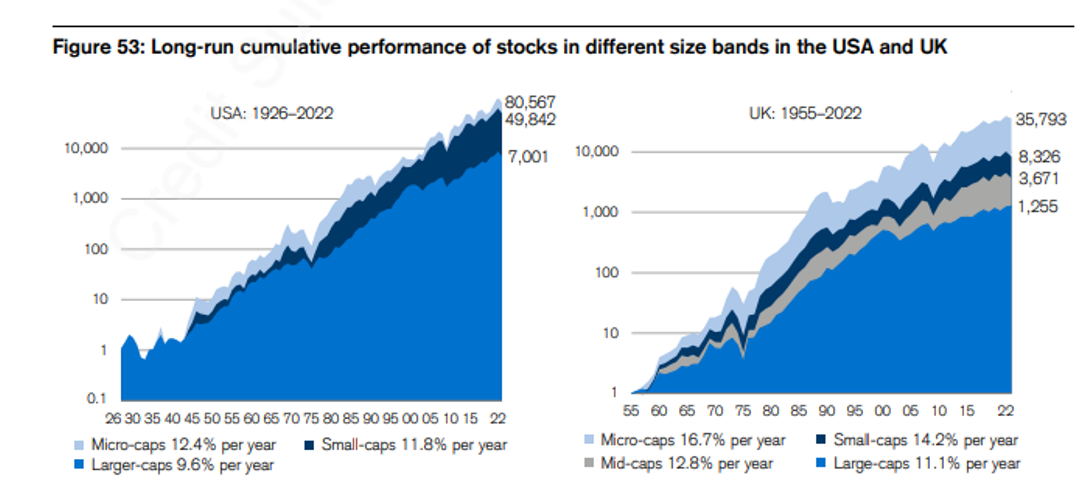
The study shows that in the US stock market between the period 1926 and 2022, the returns on large-cap stocks were an annualised 9.6%, while small and microcap stocks achieved 11.8% and 12.4%, respectively. This meant that a dollar invested in 1926 in larger companies, with dividends reinvested, grew in value to $7,001, a similar investment in small caps gave a terminal value seven times greater at $49,842. Micro-cap stocks did best of all, with an end-2022 value of $80,567.
Source: © Elroy Dimson, Paul Marsh and Mike Staunton; US CRSP capitalization decile returns are from Morningstar. UK Size-based returns are from Evans and Marsh (2023) and are for the Numis Smaller Companies Indexes ex investment companies. Past performance is not a guide to future returns. The information shown above is for illustrative purposes.

The evidence from the UK, although covering a shorter period from 1955 to the present date, reaches a similar conclusion. The chart shows that £1 invested in UK large caps at the start of 1955, with dividends reinvested, would have grown to £1,255 by end-2022, giving an annualised return of 11.1%. The same sum of money invested in the Numis Mid Cap index would have generated £3,671, while the Numis Small Cap Index would have generated £8,326, 6.6 times as much as large caps. However, an investment in micro-caps would have yielded £35,793, over four times as much as from the NSCI, and equivalent to an annualised return of 16.7%.

2. Value (price to book)

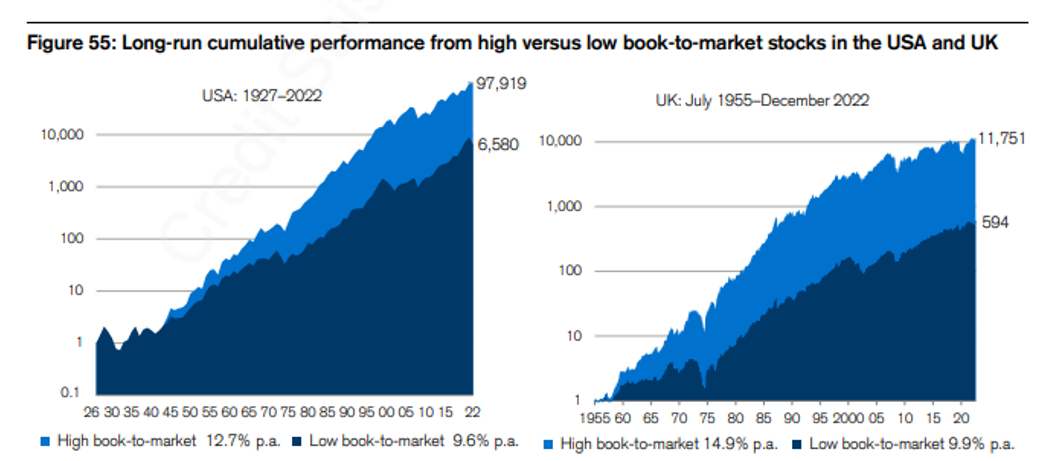
As a value investor, one of the findings I am most encouraged by is that value investing earns a significant premium in the long run. As the charts below show, in the US, $1 invested in the cheapest part of the market in 1926 was worth $97,919 by the end of 2022 whilst $1 invested in the most expensive part of the market was only worth $6,580.
Source: © Elroy Dimson, Paul Marsh and Mike Staunton; US data is from Professor Kenneth French, Tuck School of Business, Dartmouth (website). UK data is from Dimson, Nagel and Quigley, 2003, updated by Elroy Dimson, Paul Marsh and Mike Staunton using the London Share Price Database. Past performance is not a guide to future returns. The information shown above is for illustrative purposes.

Value (High Dividend Yield)

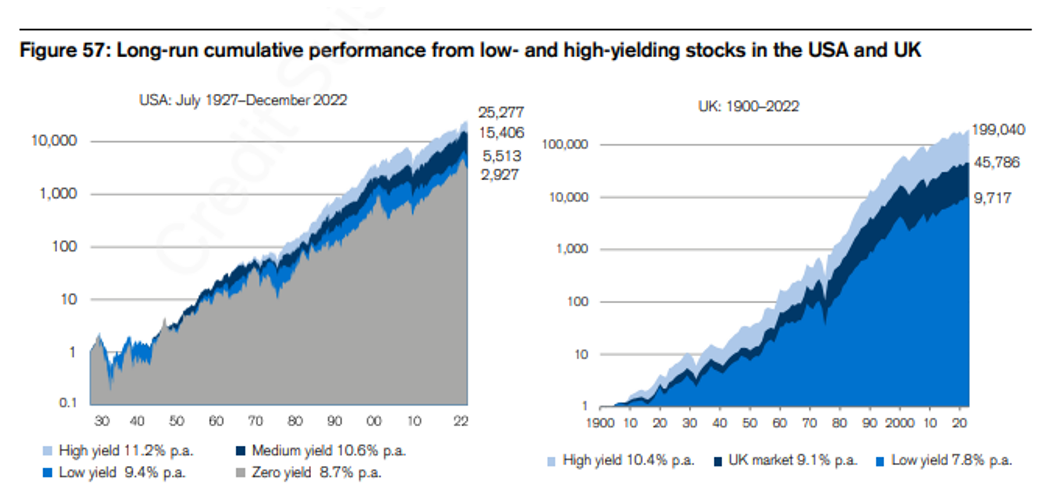
As well as looking at returns using price to book, the authors also use dividend yield as a measure of valuation and derive similar, although less extreme, results with the highest yielding part of the market generating 11.2%p.a. in the US versus 9.4% for the lowest yielding part meaning that $1 becomes $25,277 in the former and only $5,513 in the latter over the period 1927 to 2022. The data for the UK market actually starts from 1900 and the power of compounding means that the results are simply staggering with £1 producing £199,040 in high yielding stocks versus £9,717 in low yielding stocks.
Source: © Elroy Dimson, Paul Marsh and Mike Staunton; US data is from Professor Kenneth French, Tuck School of Business, Dartmouth (website). UK data is from Elroy Dimson, Paul Marsh, and Mike Staunton, London Share Price Database. Past performance is not a guide to future returns. The information shown above is for illustrative purposes.

3. Momentum

One of the factors that surprises me the most is momentum. The idea that every year you could systematically rank last year’s winners, buy them and then be rewarded with an excess return feels like it is so simplistic that it should ultimately be competed away and yet it appears to be enduring. Of all the factors identified, this actually appears to be the one that generates the greatest alpha having generated returns of 17.2% p.a between 1926 and 2022 in the US market and therefore turning $1 in to $4.5m. Even Fama and French have described momentum as the ‘premier anomaly’.
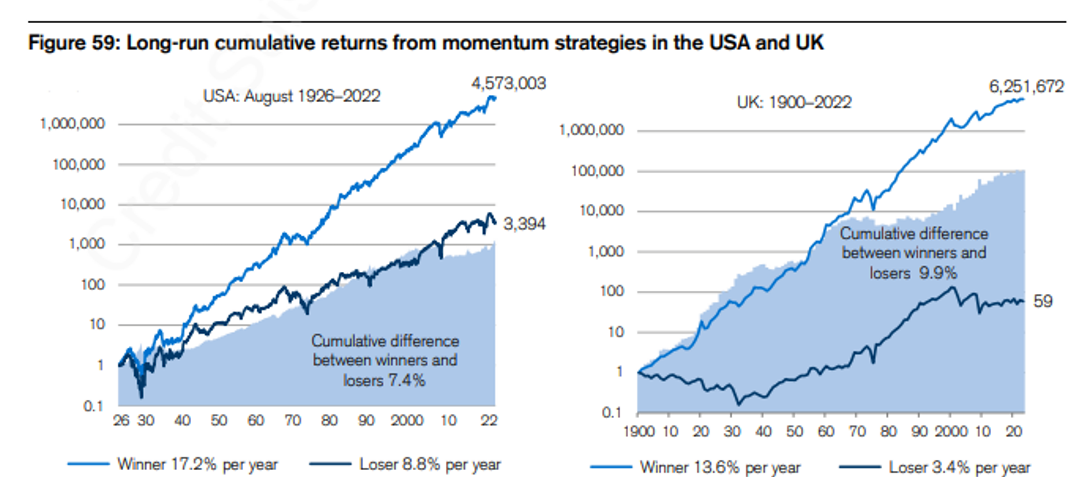
Source: © Elroy Dimson, Paul Marsh and Mike Staunton; US data is from Griffin, Ji and Martin (2003) to end-2000 updated to end -2022 by Elroy Dimson, Paul Marsh and Mike Staunton based on a 6/1/6 strategy; UK data is from Elroy Dimson, Paul Marsh, and Mike Staunton for a 12/1/1 strategy for the Top 100 UK stocks, using the London Share Price Database,Past performance is not a guide to future returns. The information shown above is for illustrative purposes.

Our Conclusions

The research discussed above suggests that there are some factors which produce excess returns and others which produce returns below that of buying a simple index fund. We believe if investors were rational, one might reasonably expect to find the equity portion of portfolios tilted towards those factors which have been shown to produce an excess return (small cap, value and momentum) even if risk management would suggest not being exclusively focused on them. My own experience is that this isn’t generally the case and that it is currently much more common to find investors with a sizeable allocation to large cap and growth (the factors that are shown in the charts above to produce returns less than the market) than small cap and value. Even after these factors produced disappointing returns in 2022, investors seem to have doubled down on them and assets continued to pour into growth firms such as ARK Invest last year. So, what explains this seemingly irrational behaviour?

1. One has to acknowledge that the problem with very long-term data, such as this, is that the devil is in the detail i.e. it doesn’t reveal the concentration risk (is the cheapest part of the market all in one sector?) nor the volatility of returns (small caps in the US performed poorly during The Great Depression and did not catch up with large caps until the early 1940’s and the 1990’s was also a fallow period for small cap stocks).

2. Some of these strategies may also be easier to implement in theory than in practice (for instance a large investment firm would face constraints in implementing a theoretical momentum strategy that was made up of equally weighted small cap stocks).

3. Another explanation is that it is the result of several behavioural traits which influence investors behaviours:

• Recency bias – this is the tendency amongst investors to place a higher weight on more recent data and experience even though a much longer series of data is likely to be more statistically significant. In a paper by Simonsohn et al [2] the authors showed through a series of experiments that direct experience is frequently more heavily weighted than general experience even where the latter is more objective because ‘directly experienced information triggers emotional reactions which vicarious information doesn’t’. As much as we might highlight the fact that value has beaten growth in every decade for the last 110 years bar two (the 1920’s and 2010’s) the lived experience of most of today’s investors is 2010’s and watching the FAANG stocks soar to the skies. Dry academic data has much less impact than the memory of being hauled in front of a board of trustees to explain why their fund is ten percentage points behind the index because of an underweight to growth stocks and it is the latter which is therefore more likely to influence future behaviour.

• Group think or herding – there is evidence from neuroscience to suggest that real pain and social pain are felt in the same parts of the brain thus investors are hard wired to herd.[3] If other investors are all chasing high flying growth stocks, it is emotionally extremely difficult not to do the same particularly when those investments are doing well. There is also a self-preservation element to this; missing out on a growth bubble is likely to lead firstly to a loss of assets and finally to a loss of one’s job. There is therefore sometimes a career incentive to follow the same strategies as your peers, safe in the knowledge that if it pops, you can use the excuse that ‘everyone was doing it and hence no-one could have foreseen the end’.

• The two most common biases are over optimism and over-confidence. For instance, when teachers ask a class who will finish in the top half, on average around 80% of the class think they will. But not only are people generally overly optimistic but they are sometimes over-confident as well and people are surprised more often than they expect to be. When asked to give a forecast and provide estimates of 98% confidence interval, the true answer only lies within the limits around 60-70% of the time. In investment terms, these traits lead many investors to mistakenly believe they can spot ‘next Amazon’ in the face of overwhelming evidence that very few companies can grow at an above average rate on a sustainable basis and that few investors are able to spot them ex ante. Another form of over confidence is in macro forecasting. When explaining a big overweight to growth stocks, a common explanation is that the investors ‘know’ that the Fed is about to pivot and that this will be good for technology stocks. The reason why they have this informational advantage over all other investors is usually less clear.

It never ceases to amaze me how difficult many people make investing. Using strategies that employ factors which have historically been shown to be successful is a way of tilting the odds of success in your favour. Betting on factors that have a long history of producing poor returns but have worked recently is like watching someone drive 300 yards from the tee with a putter and then deciding to copy those tactics for the next eighteen holes – not a strategy likely to be successful in the long run.

We would like to thank Professors Dimson and Marsh and Dr. Staunton for allowing us to reproduce the charts from their study here.

Sources:

[1] The study also finds a low volatility anomaly although the data for this typically coincides with the forty year period in which inflation and interest rates declined and this may have had a positive influence on bond proxy type stocks. We would want to see this factor work in an entirely different environment before concluding that it was a sustainable source of alpha.

[2] ‘The Tree of Experience in the Forest of Information’ by Simonsohn, Karlsson, Loewenstein and Ariely (2004)

[3] ‘Why Rejection Hurts: a Common Neural Alarm System for Physical and Social Pain’ by Eisenberger and Lieberman (2004)

Key Information
No investment strategy or risk management technique can guarantee returns or eliminate risks in any market environment. Past performance is not a guide to future results. The prices of investments and income from them may fall as well as rise and an investor’s investment is subject to potential loss, in whole or in part. Forecasts and estimates are based upon subjective assumptions about circumstances and events that may not yet have taken place and may never do so. The statements and opinions expressed in this article are those of the author as of the date of publication, and do not necessarily represent the view of Redwheel. This article does not constitute investment advice and the information shown is for illustrative purposes only.
In case you missed it

Emerging and Frontier Markets
The ‘Fab 4’ become the ‘FOMO 3’

The Redwheel Emerging and Frontier Markets team explores the concentration challenge facing investors today and maps out under‑owned countries, sectors and themes that the team believes offer a richer blend of structural growth and genuine diversification.

27 July, 2026 | 01:48pm
UK Value & income
When it rhymes it pours

Shaul Rosten, Analyst with the Redwheel Value and Income team looks at the striking similarities between today’s market exuberance and the dotcom era, highlighting stretched valuations, record IPO activity and the dominance of the technology sector.

20 July, 2026 | 07:58pm
UK Value & income
Two beautiful games

As England’s World Cup campaign unfolds, the tournament provides a vivid reminder that sensible bets are grounded in probabilities. Supporters know that backing long-shot teams is unlikely to be rewarded, while favouring stronger sides with clear track records is more prudent. In his latest blog, Shaul Rosten of Redwheel's Value & Income team examines how value investing adopts a similar stance, focusing on quality businesses at attractive valuations, rather than richly priced growth narratives with low odds of delivery.

6 July, 2026 | 07:29pm

Disclaimer

Redwheel ® and Ecofin ® are registered trademarks of RWC Partners Limited (“RWC”). The term “Redwheel” may include any one or more Redwheel branded regulated entities including RWC Asset Management LLP, which is authorised and regulated by the UK Financial Conduct Authority and the US Securities and Exchange Commission (“SEC”); RWC Asset Advisors (US) LLC, which is registered with the SEC;  RWC Singapore (Pte) Limited, which is licensed as a Licensed Fund Management Company by the Monetary Authority of Singapore; Redwheel Australia Pty Ltd is an Australian Financial Services Licensee with the Australian Securities and Investment Commission; and Redwheel Europe Fondsmæglerselskab A/S which is regulated by the Danish Financial Supervisory Authority.

Redwheel may act as investment manager or adviser, or otherwise provide services, to more than one product pursuing a similar investment strategy or focus to the product detailed in this document. Redwheel and RWC (together “Redwheel Group”) seeks to minimise any conflicts of interest, and endeavours to act at all times in accordance with its legal and regulatory obligations as well as its own policies and codes of conduct.

This document is directed only at professional, institutional, wholesale or qualified investors. The services provided by Redwheel are available only to such persons. It is not intended for distribution to and should not be relied on by any person who would qualify as a retail or individual investor in any jurisdiction or for distribution to, or use by, any person or entity in any jurisdiction where such distribution or use would be contrary to local law or regulation.

This document has been prepared for general information purposes only and has not been delivered for registration in any jurisdiction nor has its content been reviewed or approved by any regulatory authority in any jurisdiction.

The information contained herein does not constitute: (i) a binding legal agreement; (ii) legal, regulatory, tax, accounting or other advice; (iii) an offer, recommendation or solicitation to buy or sell shares in any fund, security, commodity, financial instrument or derivative linked to, or otherwise included in a portfolio managed or advised by Redwheel; or (iv) an offer to enter into any other transaction whatsoever (each a “Transaction”). Redwheel Group bears no responsibility for your investment research and/or investment decisions and you should consult your own lawyer, accountant, tax adviser or other professional adviser before entering into any Transaction. No representations and/or warranties are made that the information contained herein is either up to date and/or accurate and is not intended to be used or relied upon by any counterparty, investor or any other third party.

Redwheel Group uses information from third party vendors, such as statistical and other data, that it believes to be reliable. However, the accuracy of this data, which may be used to calculate results or otherwise compile data that finds its way over time into Redwheel Group research data stored on its systems, is not guaranteed. If such information is not accurate, some of the conclusions reached or statements made may be adversely affected. Any opinion expressed herein, which may be subjective in nature, may not be shared by all directors, officers, employees, or representatives of Group and may be subject to change without notice. Redwheel Group is not liable for any decisions made or actions or inactions taken by you or others based on the contents of this document and neither Redwheel Group nor any of its directors, officers, employees, or representatives (including affiliates) accepts any liability whatsoever for any errors and/or omissions or for any direct, indirect, special, incidental, or consequential loss, damages, or expenses of any kind howsoever arising from the use of, or reliance on, any information contained herein.

Information contained in this document should not be viewed as indicative of future results. Past performance of any Transaction is not indicative of future results. The value of investments can go down as well as up. Certain assumptions and forward looking statements may have been made either for modelling purposes, to simplify the presentation and/or calculation of any projections or estimates contained herein and Redwheel Group does not represent that that any such assumptions or statements will reflect actual future events or that all assumptions have been considered or stated. There can be no assurance that estimated returns or projections will be realised or that actual returns or performance results will not materially differ from those estimated herein. Some of the information contained in this document may be aggregated data of Transactions executed by Redwheel that has been compiled so as not to identify the underlying Transactions of any particular customer.

No representations or warranties of any kind are intended or should be inferred with respect to the economic return from, or the tax consequences of, an investment in a Redwheel-managed fund.

This document expresses no views as to the suitability or appropriateness of the fund or any other investments described herein to the individual circumstances of any recipient.

The information transmitted is intended only for the person or entity to which it has been given and may contain confidential and/or privileged material. In accepting receipt of the information transmitted you agree that you and/or your affiliates, partners, directors, officers and employees, as applicable, will keep all information strictly confidential. Any review, retransmission, dissemination or other use of, or taking of any action in reliance upon, this information is prohibited. Any distribution or reproduction of this document is not authorised and is prohibited without the express written consent of Redwheel Group.

Funds managed by Redwheel are not, and will not be, registered under the Securities Act of 1933 (the “Securities Act”) and are not available for purchase by US persons (as defined in Regulation S under the Securities Act) except to persons who are “qualified purchasers” (as defined in the Investment Company Act of 1940) and “accredited investors” (as defined in Rule 501(a) under the Securities Act).

This document does not constitute an offer to sell, purchase, subscribe for or otherwise invest in units or shares of any fund managed by Redwheel. Any offering is made only pursuant to the relevant offering document and the relevant subscription application. Prospective investors should review the offering memorandum in its entirety, including the risk factors in the offering memorandum, before making a decision to invest.

AIFMD and Distribution in the European Economic Area (“EEA”)

The Alternative Fund Managers Directive (Directive 2011/61/EU) (“AIFMD”) is a regulatory regime which came into full effect in the EEA on 22 July 2014. RWC Asset Management LLP is an Alternative Investment Fund Manager (an “AIFM”) to certain funds managed by it (each an “AIF”). The AIFM is required to make available to investors certain prescribed information prior to their investment in an AIF. The majority of the prescribed information is contained in the latest Offering Document of the AIF. The remainder of the prescribed information is contained in the relevant AIF’s annual report and accounts. All of the information is provided in accordance with the AIFMD.

In relation to each member state of the EEA (each a “Member State”), this document may only be distributed and shares in a Redwheel fund (“Shares”) may only be offered and placed to the extent that (a) the relevant Redwheel fund is permitted to be marketed to professional investors in accordance with the AIFMD (as implemented into the local law/regulation of the relevant Member State); or (b) this document may otherwise be lawfully distributed and the Shares may lawfully be offered or placed in that Member State (including at the initiative of the investor).

Information Required for Offering in Switzerland of Foreign Collective Investment Schemes to Qualified Investors within the meaning of Article 10 CISA.

This is an advertising document.

The representative and paying agent of the Redwheel-managed funds in Switzerland (the “Representative in Switzerland”) FIRST INDEPENDENT FUND SERVICES LTD, Feldeggstrasse 12, CH-8008 Zurich. Swiss Paying Agent: Helvetische Bank AG, Seefeldstrasse 215, CH-8008 Zurich. In respect of the units of the Redwheel-managed funds offered in Switzerland, the place of performance is at the registered office of the Swiss Representative. The place of jurisdiction is at the registered office of the Swiss Representative or at the registered office or place of residence of the investor.

No investment strategy or risk management technique can guarantee returns or eliminate risks in any market environment.The term “RWC” may include any one or more RWC branded entities including RWC Partners Limited and RWC Asset Management LLP, each of which is authorised and regulated by the UK Financial Conduct Authority and, in the case of RWC Asset Management LLP, the US Securities and Exchange Commission; RWC Asset Advisors (US) LLC, which is registered with the US Securities and Exchange Commission; and RWC Singapore (Pte) Limited, which is licensed as a Licensed Fund Management Company by the Monetary Authority of Singapore.RWC may act as investment manager or adviser, or otherwise provide services, to more than one product pursuing a similar investment strategy or focus to the product detailed in this audio. RWC seeks to minimise any conflicts of interest, and endeavours to act at all times in accordance with its legal and regulatory obligations as well as its own policies and codes of conduct.This audio is directed only at professional, institutional, wholesale or qualified investors. The services provided by RWC are available only to such persons. It is not intended for distribution to and should not be relied on by any person who would qualify as a retail or individual investor in any jurisdiction or for distribution to, or use by, any person or entity in any jurisdiction where such distribution or use would be contrary to local law or regulation.This audio has been prepared for general information purposes only and has not been delivered for registration in any jurisdiction nor has its content been reviewed or approved by any regulatory authority in any jurisdiction. The information contained herein does not constitute: (i) a binding legal agreement; (ii) legal, regulatory, tax, accounting or other advice; (iii) an offer, recommendation or solicitation to buy or sell shares in any fund, security, commodity, financial instrument or derivative linked to, or otherwise included in a portfolio managed or advised by RWC; or(iv) an offer to enter into any other transaction whatsoever (each a “Transaction”). No representations and/or warranties are made that the information contained herein is either up to date and/or accurate and is not intended to be used or relied upon by any counterparty, investor or any other third party.RWC uses information from third party vendors, such as statistical and other data, that it believes to be reliable. However, the accuracy of this data, which may be used to calculate results or otherwise compile data that finds its way over time into RWC research data stored on its systems, is not guaranteed. If such information is not accurate, some of the conclusions reached or statements made may be adversely affected. RWC bears no responsibility for your investment research and/or investment decisions and you should consult your own lawyer, accountant, tax adviser or other professional adviser before entering into any Transaction. Any opinion expressed herein, which may be subjective in nature, may not be shared by all directors, officers, employees, or representatives of RWC and may be subject to change without notice. RWC is not liable for any decisions made or actions or in actions taken by you or others based on the contents of this audio and neither RWC nor any of its directors, officers, employees, or representatives (including affiliates) accepts any liability whatsoever for any errors and/or omissions or for any direct, indirect, special, incidental, or consequential loss, damages, or expenses of any kind howsoever arising from the use of, or reliance on, any information contained herein.Information contained in this audio should not be viewed as indicative of future results. Past performance of any Transaction is not indicative of future results. The value of investments can go down as well as up. Certain assumptions and forward looking statements may have been made either for modelling purposes, to simplify the audio and/or calculation of any projections or estimates contained herein and RWC does not represent that that any such assumptions or statements will reflect actual future events or that all assumptions have been considered or stated. Forward-looking statements are inherently uncertain, and changing factors such as those affecting the markets generally, or those affecting particular industries or issuers, may cause results to differ from those discussed. Accordingly, there can be no assurance that estimated returns or projections will be realised or that actual returns or performance results will not materially differ from those estimated herein. Some of the information contained in this audio may be aggregated data of Transactions executed by RWC that has been compiled so as not to identify the underlying Transactions of any particular customer.The information transmitted is intended only for the person or entity to which it has been given and may contain confidential and/or privileged material. In accepting receipt of the information transmitted you agree that you and/or your affiliates, partners, directors, officers and employees, as applicable, will keep all information strictly confidential. Any review, retransmission, dissemination or other use of, or taking of any action in reliance upon, this information is prohibited. The information contained herein is confidential and is intended for the exclusive use of the intended recipient(s) to which this audio has been provided. Any distribution or reproduction of this audio is not authorised and is prohibited without the express written consent of RWC or any of its affiliates.Changes in rates of exchange may cause the value of such investments to fluctuate. An investor may not be able to get back the amount invested and the loss on realisation may be very high and could result in a substantial or complete loss of the investment. In addition, an investor who realises their investment in a RWC-managed fund after a short period may not realise the amount originally invested as a result of charges made on the issue and/or redemption of such investment. The value of such interests for the purposes of purchases may differ from their value for the purpose of redemptions. No representations or warranties of any kind are intended or should be inferred with respect to the economic return from, or the tax consequences of, an investment in a RWC-managed fund. Current tax levels and reliefs may change. Depending on individual circumstances, this may affect investment returns. Nothing in this document constitutes advice on the merits of buying or selling a particular investment. This audio expresses no views as to the suitability or appropriateness of the fund or any other investments described herein to the individual circumstances of any recipient.AIFMD and Distribution in the European Economic Area (“EEA”)The Alternative Fund Managers Directive (Directive 2011/61/EU)(“AIFMD”) is a regulatory regime which came into full effect in the EEA on 22 July 2014. RWC Asset Management LLP is an Alternative Investment Fund Manager (an “AIFM”) to certain funds managed by it (each an “AIF”). The AIFM is required to make available to investors certain prescribed information prior to their investment in an AIF. The majority of the prescribed information is contained in the latest Offering Document of the AIF. The remainder of the prescribed information is contained in the relevant AIF’s annual report and accounts. All of the information is provided in accordance with the AIFMD.In relation to each member state of the EEA (each a “Member State”),this document may only be distributed and shares in a RWC fund(“Shares”) may only be offered and placed to the extent that (a) the relevant RWC fund is permitted to be marketed to professional investors in accordance with the AIFMD (as implemented into the local law/regulation of the relevant Member State); or (b) this audio may otherwise be lawfully distributed and the Shares may lawfully offered or placed in that Member State (including at the initiative of the investor).Information Required for Distribution of Foreign Collective Investment Schemes to Qualified Investors in SwitzerlandThe representative and paying agent of the RWC-managed funds in Switzerland (the “Representative in Switzerland”) FIRST INDEPENDENT FUND SERVICES LTD, Klausstrasse 33, CH-8008 Zurich. Swiss Paying Agent: Helvetische Bank AG, Seefeldstrasse 215, CH-8008 Zurich. In respect of the units of the RWC-managed funds distributed in Switzerland, the place of performance and jurisdiction is at the registered office of the Representative in Switzerland.