









Speed chess and skinning cats: Multiple ways to lose money

For anyone who enjoyed the Olympics this summer, I’d like you to take a moment and spare a thought for Ali Farag. The Egyptian is the highest ranked men’s squash player in the world, according to the Professional Squash Association, and was the winner of the 2019, 2021, and 2023 World Championships. Alas, unlike skateboarders, Farag did not grace your screen at the 2024 Paris Olympics, as squash is still not part of the games, despite it being played by an estimated 20 million people around the world in over 185 countries. Squash is one of the most contentious of the sports not included in the Olympics, among a litany of others including cricket, bowling, netball, darts – and chess.

Chess, unlike other ‘sports’, is regularly dismissed not because of its lack of popularity, but because it lacks the “physical exertion” that the International Olympic Committee demands. Despite the Olympic snub, watching competitive chess online and in person is popular – particularly in the short-form ‘Blitz’ (3-minute) or ‘Bullet’ (1-minute) formats – with international celebrity players commanding audiences of over 600,000 viewers[1]. Chief amongst these celebrities is Norwegian Grandmaster Magnus Carlsen. Regarded by many as the greatest chess player of all time, 33-year-old Carlsen is a five-time World Chess Champion, five-time World Rapid Chess Champion (1-hour games), and seven-time World Blitz Chess Champion. A particularly enjoyable and widely replayed game was a rare defeat that Carlsen suffered in a live-stream he played online; here, Carlsen was playing a Blitz game, and was beaten in 18 moves ending in a highly unusual checkmate.

Blitz chess – apart from being enjoyable to play and watch – is an excellent framework for thinking about investment skill. In Blitz chess, you are not only required to make intelligent moves: you need to also avoid running out of time. It is no good being excellent at identifying the best move if it takes you twenty minutes to do so; you may not lose on skill, but you will lose on time. Having only one of those abilities is insufficient to assure success – and the same is true in investing.

Keep your eyes on the price

As we have noted in the past, investing is a practice that requires, in reasonably equal measure, the ability to (i) understand and quantify the economics of a business over time, and (ii) to fairly assess the value of that business today, what we term the “intrinsic value” of the company. It is only if you are confident in both the earnings stream of a business, and that the price today represents a material discount to the true intrinsic value of the business, that an investment is merited; having only one of those critical elements is insufficient.

In our view, the main mistake being made by many investors today is not about the quality of the business, but the appropriateness of the price.”

Yet, over the past decade, many investors have enjoyed the fruits of a benign economic environment, supported by accommodatingly low rates that made access to capital extremely cheap. This allowed some investors to focus only on the predictability of earnings – part of the assessed quality of the business – while forgetting the importance of considering what the company is worth. Whilst for many years this mistake was swept under the rug of ever-expanding valuation multiples, the landscape today is changing fast, and recent abrupt declines in value of some of the world’s companies shine a spotlight on this error.

Across industries, geographies, and sectors, many justifiably admired companies have seen their valuations collapse, often leaving investors with zero total returns over substantial timeframes (five years or more). Companies that are widely considered to be global leaders have lost shareholders substantial value in the past year, and many have done so to such a degree as to leave investors with flat or negative total returns over a full five-year period. This is not sector specific, but is a phenomenon found across high-quality industry-leading giants.
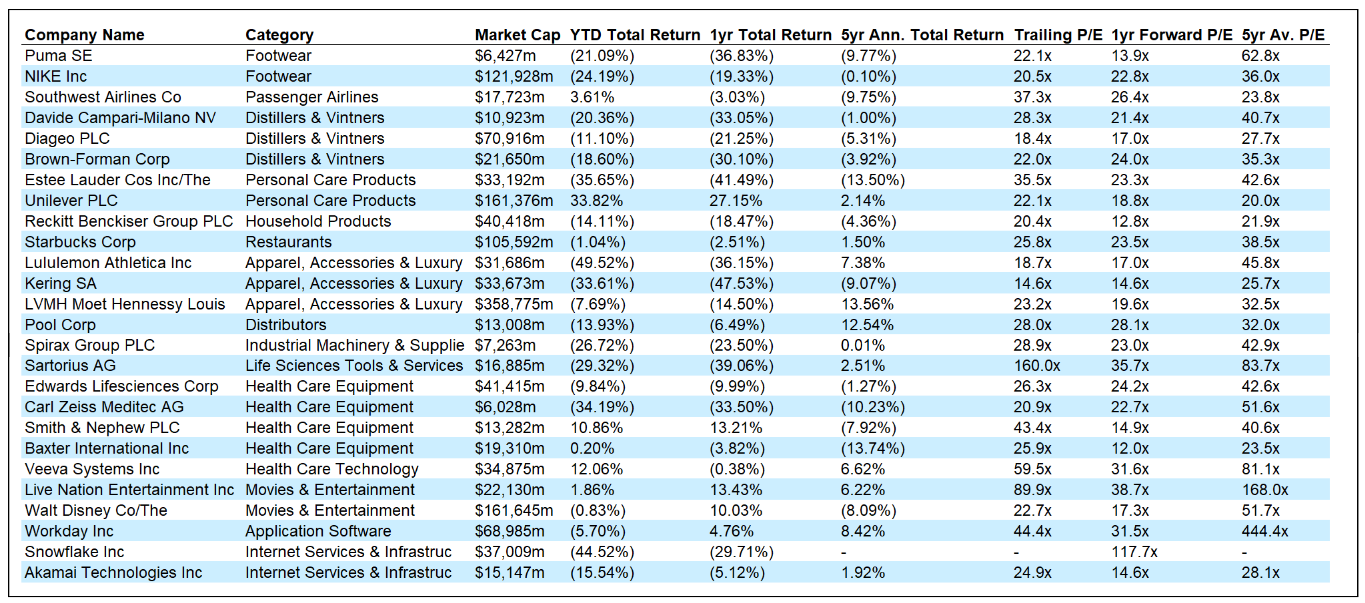
Source: Bloomberg as of August 26th 2024 Performance in brackets denotes negative total return. Past performance is not a guide to the future. Stocks selected are for illustrative purposes only and have been identified by the investment team to provide examples of large well-known names that have delivered either negative or below market returns over 1- or 5-year periods.

The question that should arise, of course, is how it is possible that so many truly great companies – great as defined by the quality of their products, the strength of their market position, and the depth of their talent pools – have delivered such poor outcomes to investors? This question is amplified by the relative performance of global markets, which have been comparably strong, and by the simultaneous, very impressive performance of other public companies; again, across industries and geographies, there have been plenty of companies, even those of lower inherent quality, that have delivered fabulous returns to shareholders over the same period. What, then, is the problem?

Quality growth vs value

As with Blitz chess, the answer comes down to the inescapable fact that to win – beating either your opponent, or the market – investors need to be able to balance two skills at the same time. With the above companies, and others, the issue was unlikely to be the quality of the business: rather, it was going to be the quality of the business relative to the price paid, and relative to the expectations baked into those prices. Notably, the connection between the companies in the table above is not the line of business they are in, nor the country in which they operate: it is that they were all highly priced.

For example, spirits manufacturer Davide Campari has delivered no net returns to investors over the past five years. This is largely because its valuation – expressed in shorthand by the multiple of its earnings paid by investors – has plummeted from over 50x in 2021 to 28x today, still by no means inexpensive (if you disagree, I have several banks to sell you). This valuation has also fallen in the context of growing earnings, and continued expectations – despite the share price fall – of future earnings growth. If buying a great business with growing earnings was the sole requirement for investment success, then Campari and the other companies above would have delivered much better outcomes for investors.

As interest rates rise and as highly priced quality companies fail to deliver, we would encourage investors to remember: valuation matters.”

Instead, what has happened appears to be a growing dismissal of the importance of not overpaying, with many market participants having chosen to ignore valuation as irrelevant, relying on the market to constantly pay high multiples. Whilst this approach is all very well whilst the music is playing, it is hard to understand how it can deliver a favourable outcome when the party goes quiet. If you bought Campari at 50x earnings, and earnings grew 15% but the multiple fell to 28x, you would have lost 35.6% – even in the face of impressive fundamental performance. But we would press the question further: who can say that 28x will be the worst price you will get? Why wouldn’t it be 20x (losing you 54%), 15x (losing you 66%) or 12x (losing you 72%)? There are plenty of comparably good businesses that are on similar multiples or lower – usually in unpopular industries – that are available for those prices, and it is very possible that your high-quality but higher valued business will join them.

By way of example, look at the below chart, which compares annualised ten-year revenue growth with the enterprise value to operating earnings ratio, a useful shorthand for valuation. Here, it is evident that there are companies (which we own) holding their own against the adored quality growth crowd in terms of long-term revenue growth, but which carry far lower valuations, simply due to the distaste the market currently has for their industry.
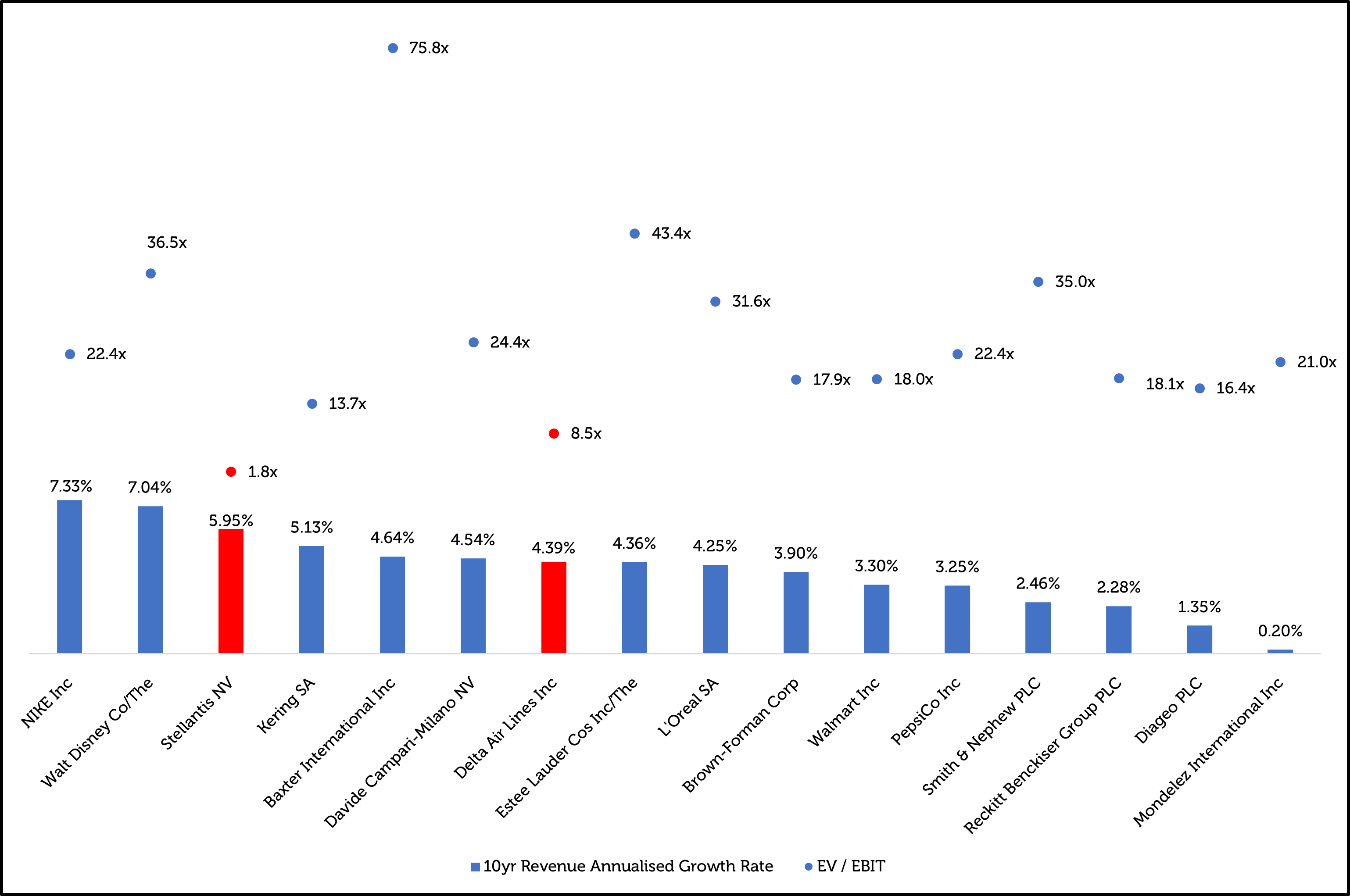
Source: Bloomberg, Redwheel as of August 26th 2024. Past performance is not a guide to the future. Companies highlighted in red are securities that the Redwheel Value & Income team currently holds.

If your investment case relies not on fundamental corporate performance – which is in the control of the company – but on a lofty sale price, then the force of economic gravity will do its best to help you lose. In our view, the main mistake being made by many investors today is not about the quality of the business, but the appropriateness of the price.

Avoiding the double punch

That is not to say, of course, that investors haven’t also made mistakes in assessing the quality of a business; there are several companies – some in the list above – that have been lauded for years as perpetual growth machines, only to have recently stumbled, forced to issue profit warnings and temper the lofty expectations of their investor base. Take cosmetics giant Estée Lauder. Despite being priced for prime growth over the past five years – with an average price earnings multiple of 41.2x – the company has had to issue repeated profit warnings over the course of 2023 and 2024, with revenues for the full year 2024 expected to be only 4% higher than those delivered in 2019; net income, what truly matters to shareholders at the end of the day, is forecast to be less than half of that earned five years ago. Not only did investors overpay – they also misread the quality of the enterprise.

This underscores the risk of paying high prices: you are not only relying on the market maintaining its willingness to keep paying up for quality, but you are also running the risk that you are fundamentally wrong about the quality of the business. By stark contrast, when you pay an unjustifiably low price for a company, you are investing on the basis that the core earnings stream of the company is being underestimated, and that things will evolve into a rosier, more normalised picture than is being priced in. If you are wrong, the chances of you losing money is lower; if the company is worse than you expected, it is still in line with what the market expected, and so the market price – right all along – is less likely to change. Buying into a darling company, where everyone expects greatness, can deliver a double punch should there be disappointment with the fundamental performance: not only are earnings lower than you and the market thought, but now the market is less willing to put a high price on those earnings. It has proven for many investors so far this year to be a bruising 1-2 combination.

Valuation matters

Like skinning a cat, there is more than one way to lose money as an investor. It is undoubtedly true that one of these ways is to buy poor quality businesses, whose operation and balance sheet deteriorates, permanently impairing your capital. However, post the Great Financial Crisis – a crisis in which this sort of risk did indeed materialise – investors have perhaps focussed too closely on that risk, forgetting, like the studious chess player who doesn’t check the clock, that there is something else that they need to consider. Today, as interest rates rise and as highly priced quality companies fail to deliver, we would encourage investors to remember: valuation matters.

Source:

[1] https://kommunikasjon.ntb.no/announcement/1062?publisherId=16823864&lang=en

Key Information
No investment strategy or risk management technique can guarantee returns or eliminate risks in any market environment. Past performance is not a guide to future results. The prices of investments and income from them may fall as well as rise and an investor’s investment is subject to potential loss, in whole or in part. Forecasts and estimates are based upon subjective assumptions about circumstances and events that may not yet have taken place and may never do so. The statements and opinions expressed in this article are those of the author as of the date of publication, and do not necessarily represent the view of Redwheel. This article does not constitute investment advice and the information shown is for illustrative purposes only.

 

In case you missed it

Emerging and Frontier Markets
The ‘Fab 4’ become the ‘FOMO 3’

The Redwheel Emerging and Frontier Markets team explores the concentration challenge facing investors today and maps out under‑owned countries, sectors and themes that the team believes offer a richer blend of structural growth and genuine diversification.

27 July, 2026 | 01:48pm
UK Value & income
When it rhymes it pours

Shaul Rosten, Analyst with the Redwheel Value and Income team looks at the striking similarities between today’s market exuberance and the dotcom era, highlighting stretched valuations, record IPO activity and the dominance of the technology sector.

20 July, 2026 | 07:58pm
UK Value & income
Two beautiful games

As England’s World Cup campaign unfolds, the tournament provides a vivid reminder that sensible bets are grounded in probabilities. Supporters know that backing long-shot teams is unlikely to be rewarded, while favouring stronger sides with clear track records is more prudent. In his latest blog, Shaul Rosten of Redwheel's Value & Income team examines how value investing adopts a similar stance, focusing on quality businesses at attractive valuations, rather than richly priced growth narratives with low odds of delivery.

6 July, 2026 | 07:29pm

Disclaimer

Redwheel ® and Ecofin ® are registered trademarks of RWC Partners Limited (“RWC”). The term “Redwheel” may include any one or more Redwheel branded regulated entities including RWC Asset Management LLP, which is authorised and regulated by the UK Financial Conduct Authority and the US Securities and Exchange Commission (“SEC”); RWC Asset Advisors (US) LLC, which is registered with the SEC;  RWC Singapore (Pte) Limited, which is licensed as a Licensed Fund Management Company by the Monetary Authority of Singapore; Redwheel Australia Pty Ltd is an Australian Financial Services Licensee with the Australian Securities and Investment Commission; and Redwheel Europe Fondsmæglerselskab A/S which is regulated by the Danish Financial Supervisory Authority.

Redwheel may act as investment manager or adviser, or otherwise provide services, to more than one product pursuing a similar investment strategy or focus to the product detailed in this document. Redwheel and RWC (together “Redwheel Group”) seeks to minimise any conflicts of interest, and endeavours to act at all times in accordance with its legal and regulatory obligations as well as its own policies and codes of conduct.

This document is directed only at professional, institutional, wholesale or qualified investors. The services provided by Redwheel are available only to such persons. It is not intended for distribution to and should not be relied on by any person who would qualify as a retail or individual investor in any jurisdiction or for distribution to, or use by, any person or entity in any jurisdiction where such distribution or use would be contrary to local law or regulation.

This document has been prepared for general information purposes only and has not been delivered for registration in any jurisdiction nor has its content been reviewed or approved by any regulatory authority in any jurisdiction.

The information contained herein does not constitute: (i) a binding legal agreement; (ii) legal, regulatory, tax, accounting or other advice; (iii) an offer, recommendation or solicitation to buy or sell shares in any fund, security, commodity, financial instrument or derivative linked to, or otherwise included in a portfolio managed or advised by Redwheel; or (iv) an offer to enter into any other transaction whatsoever (each a “Transaction”). Redwheel Group bears no responsibility for your investment research and/or investment decisions and you should consult your own lawyer, accountant, tax adviser or other professional adviser before entering into any Transaction. No representations and/or warranties are made that the information contained herein is either up to date and/or accurate and is not intended to be used or relied upon by any counterparty, investor or any other third party.

Redwheel Group uses information from third party vendors, such as statistical and other data, that it believes to be reliable. However, the accuracy of this data, which may be used to calculate results or otherwise compile data that finds its way over time into Redwheel Group research data stored on its systems, is not guaranteed. If such information is not accurate, some of the conclusions reached or statements made may be adversely affected. Any opinion expressed herein, which may be subjective in nature, may not be shared by all directors, officers, employees, or representatives of Group and may be subject to change without notice. Redwheel Group is not liable for any decisions made or actions or inactions taken by you or others based on the contents of this document and neither Redwheel Group nor any of its directors, officers, employees, or representatives (including affiliates) accepts any liability whatsoever for any errors and/or omissions or for any direct, indirect, special, incidental, or consequential loss, damages, or expenses of any kind howsoever arising from the use of, or reliance on, any information contained herein.

Information contained in this document should not be viewed as indicative of future results. Past performance of any Transaction is not indicative of future results. The value of investments can go down as well as up. Certain assumptions and forward looking statements may have been made either for modelling purposes, to simplify the presentation and/or calculation of any projections or estimates contained herein and Redwheel Group does not represent that that any such assumptions or statements will reflect actual future events or that all assumptions have been considered or stated. There can be no assurance that estimated returns or projections will be realised or that actual returns or performance results will not materially differ from those estimated herein. Some of the information contained in this document may be aggregated data of Transactions executed by Redwheel that has been compiled so as not to identify the underlying Transactions of any particular customer.

No representations or warranties of any kind are intended or should be inferred with respect to the economic return from, or the tax consequences of, an investment in a Redwheel-managed fund.

This document expresses no views as to the suitability or appropriateness of the fund or any other investments described herein to the individual circumstances of any recipient.

The information transmitted is intended only for the person or entity to which it has been given and may contain confidential and/or privileged material. In accepting receipt of the information transmitted you agree that you and/or your affiliates, partners, directors, officers and employees, as applicable, will keep all information strictly confidential. Any review, retransmission, dissemination or other use of, or taking of any action in reliance upon, this information is prohibited. Any distribution or reproduction of this document is not authorised and is prohibited without the express written consent of Redwheel Group.

Funds managed by Redwheel are not, and will not be, registered under the Securities Act of 1933 (the “Securities Act”) and are not available for purchase by US persons (as defined in Regulation S under the Securities Act) except to persons who are “qualified purchasers” (as defined in the Investment Company Act of 1940) and “accredited investors” (as defined in Rule 501(a) under the Securities Act).

This document does not constitute an offer to sell, purchase, subscribe for or otherwise invest in units or shares of any fund managed by Redwheel. Any offering is made only pursuant to the relevant offering document and the relevant subscription application. Prospective investors should review the offering memorandum in its entirety, including the risk factors in the offering memorandum, before making a decision to invest.

AIFMD and Distribution in the European Economic Area (“EEA”)

The Alternative Fund Managers Directive (Directive 2011/61/EU) (“AIFMD”) is a regulatory regime which came into full effect in the EEA on 22 July 2014. RWC Asset Management LLP is an Alternative Investment Fund Manager (an “AIFM”) to certain funds managed by it (each an “AIF”). The AIFM is required to make available to investors certain prescribed information prior to their investment in an AIF. The majority of the prescribed information is contained in the latest Offering Document of the AIF. The remainder of the prescribed information is contained in the relevant AIF’s annual report and accounts. All of the information is provided in accordance with the AIFMD.

In relation to each member state of the EEA (each a “Member State”), this document may only be distributed and shares in a Redwheel fund (“Shares”) may only be offered and placed to the extent that (a) the relevant Redwheel fund is permitted to be marketed to professional investors in accordance with the AIFMD (as implemented into the local law/regulation of the relevant Member State); or (b) this document may otherwise be lawfully distributed and the Shares may lawfully be offered or placed in that Member State (including at the initiative of the investor).

Information Required for Offering in Switzerland of Foreign Collective Investment Schemes to Qualified Investors within the meaning of Article 10 CISA.

This is an advertising document.

The representative and paying agent of the Redwheel-managed funds in Switzerland (the “Representative in Switzerland”) FIRST INDEPENDENT FUND SERVICES LTD, Feldeggstrasse 12, CH-8008 Zurich. Swiss Paying Agent: Helvetische Bank AG, Seefeldstrasse 215, CH-8008 Zurich. In respect of the units of the Redwheel-managed funds offered in Switzerland, the place of performance is at the registered office of the Swiss Representative. The place of jurisdiction is at the registered office of the Swiss Representative or at the registered office or place of residence of the investor.

No investment strategy or risk management technique can guarantee returns or eliminate risks in any market environment.The term “RWC” may include any one or more RWC branded entities including RWC Partners Limited and RWC Asset Management LLP, each of which is authorised and regulated by the UK Financial Conduct Authority and, in the case of RWC Asset Management LLP, the US Securities and Exchange Commission; RWC Asset Advisors (US) LLC, which is registered with the US Securities and Exchange Commission; and RWC Singapore (Pte) Limited, which is licensed as a Licensed Fund Management Company by the Monetary Authority of Singapore.RWC may act as investment manager or adviser, or otherwise provide services, to more than one product pursuing a similar investment strategy or focus to the product detailed in this audio. RWC seeks to minimise any conflicts of interest, and endeavours to act at all times in accordance with its legal and regulatory obligations as well as its own policies and codes of conduct.This audio is directed only at professional, institutional, wholesale or qualified investors. The services provided by RWC are available only to such persons. It is not intended for distribution to and should not be relied on by any person who would qualify as a retail or individual investor in any jurisdiction or for distribution to, or use by, any person or entity in any jurisdiction where such distribution or use would be contrary to local law or regulation.This audio has been prepared for general information purposes only and has not been delivered for registration in any jurisdiction nor has its content been reviewed or approved by any regulatory authority in any jurisdiction. The information contained herein does not constitute: (i) a binding legal agreement; (ii) legal, regulatory, tax, accounting or other advice; (iii) an offer, recommendation or solicitation to buy or sell shares in any fund, security, commodity, financial instrument or derivative linked to, or otherwise included in a portfolio managed or advised by RWC; or(iv) an offer to enter into any other transaction whatsoever (each a “Transaction”). No representations and/or warranties are made that the information contained herein is either up to date and/or accurate and is not intended to be used or relied upon by any counterparty, investor or any other third party.RWC uses information from third party vendors, such as statistical and other data, that it believes to be reliable. However, the accuracy of this data, which may be used to calculate results or otherwise compile data that finds its way over time into RWC research data stored on its systems, is not guaranteed. If such information is not accurate, some of the conclusions reached or statements made may be adversely affected. RWC bears no responsibility for your investment research and/or investment decisions and you should consult your own lawyer, accountant, tax adviser or other professional adviser before entering into any Transaction. Any opinion expressed herein, which may be subjective in nature, may not be shared by all directors, officers, employees, or representatives of RWC and may be subject to change without notice. RWC is not liable for any decisions made or actions or in actions taken by you or others based on the contents of this audio and neither RWC nor any of its directors, officers, employees, or representatives (including affiliates) accepts any liability whatsoever for any errors and/or omissions or for any direct, indirect, special, incidental, or consequential loss, damages, or expenses of any kind howsoever arising from the use of, or reliance on, any information contained herein.Information contained in this audio should not be viewed as indicative of future results. Past performance of any Transaction is not indicative of future results. The value of investments can go down as well as up. Certain assumptions and forward looking statements may have been made either for modelling purposes, to simplify the audio and/or calculation of any projections or estimates contained herein and RWC does not represent that that any such assumptions or statements will reflect actual future events or that all assumptions have been considered or stated. Forward-looking statements are inherently uncertain, and changing factors such as those affecting the markets generally, or those affecting particular industries or issuers, may cause results to differ from those discussed. Accordingly, there can be no assurance that estimated returns or projections will be realised or that actual returns or performance results will not materially differ from those estimated herein. Some of the information contained in this audio may be aggregated data of Transactions executed by RWC that has been compiled so as not to identify the underlying Transactions of any particular customer.The information transmitted is intended only for the person or entity to which it has been given and may contain confidential and/or privileged material. In accepting receipt of the information transmitted you agree that you and/or your affiliates, partners, directors, officers and employees, as applicable, will keep all information strictly confidential. Any review, retransmission, dissemination or other use of, or taking of any action in reliance upon, this information is prohibited. The information contained herein is confidential and is intended for the exclusive use of the intended recipient(s) to which this audio has been provided. Any distribution or reproduction of this audio is not authorised and is prohibited without the express written consent of RWC or any of its affiliates.Changes in rates of exchange may cause the value of such investments to fluctuate. An investor may not be able to get back the amount invested and the loss on realisation may be very high and could result in a substantial or complete loss of the investment. In addition, an investor who realises their investment in a RWC-managed fund after a short period may not realise the amount originally invested as a result of charges made on the issue and/or redemption of such investment. The value of such interests for the purposes of purchases may differ from their value for the purpose of redemptions. No representations or warranties of any kind are intended or should be inferred with respect to the economic return from, or the tax consequences of, an investment in a RWC-managed fund. Current tax levels and reliefs may change. Depending on individual circumstances, this may affect investment returns. Nothing in this document constitutes advice on the merits of buying or selling a particular investment. This audio expresses no views as to the suitability or appropriateness of the fund or any other investments described herein to the individual circumstances of any recipient.AIFMD and Distribution in the European Economic Area (“EEA”)The Alternative Fund Managers Directive (Directive 2011/61/EU)(“AIFMD”) is a regulatory regime which came into full effect in the EEA on 22 July 2014. RWC Asset Management LLP is an Alternative Investment Fund Manager (an “AIFM”) to certain funds managed by it (each an “AIF”). The AIFM is required to make available to investors certain prescribed information prior to their investment in an AIF. The majority of the prescribed information is contained in the latest Offering Document of the AIF. The remainder of the prescribed information is contained in the relevant AIF’s annual report and accounts. All of the information is provided in accordance with the AIFMD.In relation to each member state of the EEA (each a “Member State”),this document may only be distributed and shares in a RWC fund(“Shares”) may only be offered and placed to the extent that (a) the relevant RWC fund is permitted to be marketed to professional investors in accordance with the AIFMD (as implemented into the local law/regulation of the relevant Member State); or (b) this audio may otherwise be lawfully distributed and the Shares may lawfully offered or placed in that Member State (including at the initiative of the investor).Information Required for Distribution of Foreign Collective Investment Schemes to Qualified Investors in SwitzerlandThe representative and paying agent of the RWC-managed funds in Switzerland (the “Representative in Switzerland”) FIRST INDEPENDENT FUND SERVICES LTD, Klausstrasse 33, CH-8008 Zurich. Swiss Paying Agent: Helvetische Bank AG, Seefeldstrasse 215, CH-8008 Zurich. In respect of the units of the RWC-managed funds distributed in Switzerland, the place of performance and jurisdiction is at the registered office of the Representative in Switzerland.