










Monopoly money: Playing games and investing wisely

Sometimes, it is better to be lucky than smart. This adage was exemplified in the heat of the Second World War by the British Secret Service’s MI9 division, who were looking for innovative ways to smuggle escape kits to British prisoners of war (“POWs”) held captive across enemy lines.

They had two particularly thorny problems to solve, among others. First was the delivery of said escape kits to POWs: they needed to be provided with tools to cut bars and wires, compasses, and maps of the local terrain. The second problem was the map itself. Paper maps were a poor option, as paper tears easily, dissolves in water, is heavy to pack, conceal, and carry, and rustles noisily when being used. Instead, MI9 aimed to revive an old military tactic by printing maps on silk; silk is quiet, lightweight, and water-resistant. The only problem: virtually no one in wartime Britain had the know-how to print on silk.

Eventually, MI9 tracked down the one man who could do the job, a Mr. John Waddington of Leeds. By sheer dumb luck, Waddington not only provided them with the silk printing facilities they so desperately needed, but he solved their first problem too, giving them a way to covertly deliver entire escape packages to POWs. For Waddington, in addition to being a silk printer, just happened to be the UK distributor of the game Monopoly – a game which MI9 could send to POWs via fake humanitarian organisations, and which had varied enough contents to disguise the many items needed to escape. Compasses and files were passed off as playing pieces, the fake monopoly money had real European banknotes stored in amongst it, and the silk map itself was hidden inside the game’s famous board.

Overall, it is estimated that thousands of British POWs were able to escape Nazi prison camps by using the ingenious Monopoly board escape kits – secretly marked by an extra red dot, printed as if by accident on the Free Parking space. And all because the one person who could solve their printing problem also just happened to have the perfect escape kit disguise at hand.

Passing go: Monopoly’s lessons for equity investors

Monopoly, apart from its less-well known history as a wartime escape kit[1], is the globally recognised board game that brings out the inner entrepreneur in us all – haggling over rents and trying to complete a colour group are no doubt fond holiday memories for many families. For those unfamiliar, the object of the game is:

To become the wealthiest player through buying, renting and selling property[2]

This aim obviously aligns closely with the object of investors, who seek to grow their wealth through buying, renting (being paid a regular cash return on invested capital) and selling companies. What is curious, however, is how the behaviour of players differs when playing a board game for fake, paper money, and when investing their own hard-earned money into the very real shares of very real companies.

Take, for example, the purchase and sale of properties in Monopoly: the price for each is initially set by the board, and thereafter negotiated between players. Typically, these prices will be closely determined by the ability of those properties to produce cashflow for the owner. Someone with two properties in the orange group[3] will pay more for the third than it is worth to someone without those matching assets, as they can complete a set, build houses and hotels, and earn higher rental yields from their investments:
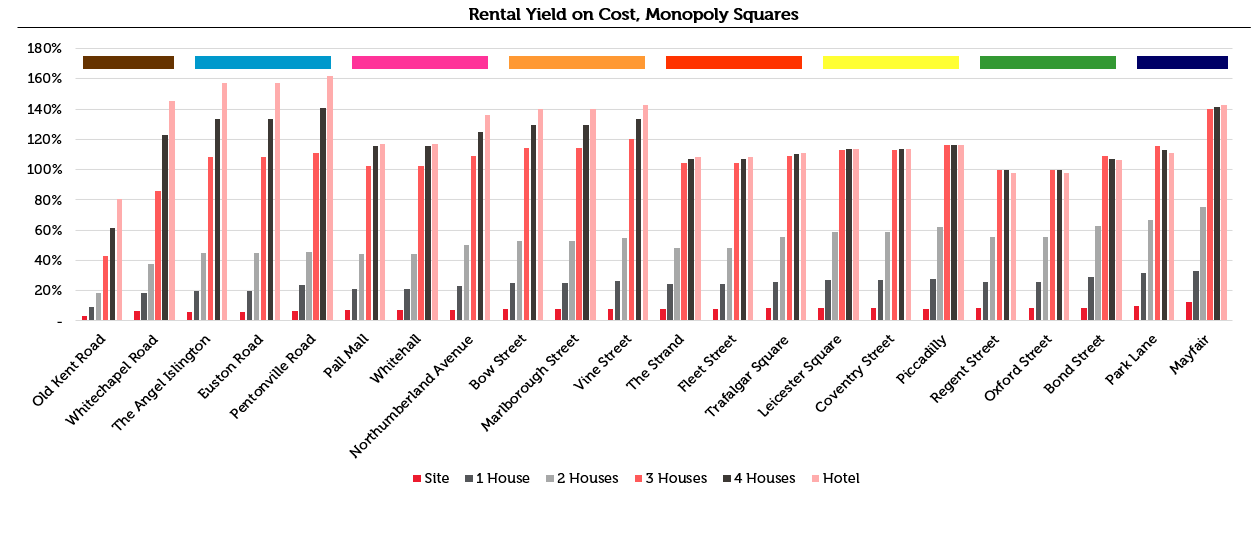
Source: Redwheel, 24 October 2024. The information shown above is for illustrative purposes.

What doesn’t often happen in Monopoly, however, is wild overvaluation. If someone offers you £20,000 for Whitechapel Road (Baltic Avenue for our American readers) – which is 44x the maximum rent you can earn from the property – you should sell it to them, before watching them go quickly bankrupt whilst you use your money to build cashflow-generating houses and hotels, pay your bills, and remain solvent until victory. Even if someone immediately bought the property off your rash opponent for £50,000, that would not reflect good judgement on the part of the first buyer, or poor judgement on yours: two illogical transactions do not justify one. This fundamental understanding of value as a function of earnings potential, however, seems completely lost on many equity investors.

Not just monopoly pieces

When buying shares listed on public markets, investors seem to instead behave as if they are gambling on the future movements of random lines on a chart – or, in the words of Warren Buffet, like “tokens in a game, like the thimble and flatiron in Monopoly[4]  – represented by abstract ticker symbols vaguely related to some facet of the economy. They forget that, like properties in Monopoly, the shares they are purchasing represent a small but very real interest in a set of cashflows, and that the price of those shares must, over time, be a function of those cashflows. Instead, the price movements of shares – and, by extension, of companies – seems to us to quite often fluctuate to a large extent on short-term directional shifts, such as changes in business momentum or reported earnings.

Any businessperson with a degree of experience will recognise the irrationality of such an approach. Viewed logically, the true value of a company is a simple calculation that evaluates all the likely cashflow a company can produce and when it can produce it, before putting a present value (i.e. what all future cashflows are worth today) on those figures. This, what we term ‘intrinsic value’, should be the north star to a businessperson in the position of a private owner. Although it is always the case that things might be getting better or worse for the business in any given week, the general pathway of cashflows over long periods of time – ten years or more – is unlikely to have changed materially as a result of short-term news flow. If a private buyer wanted to negotiate the purchase of a company, and drastically altered their purchase price on a minute-by-minute basis based on the headlines in that day’s newspaper, they would probably find themselves politely escorted out of the boardroom. If regular business owners can manage quite rationally without paying attention to minute changes in real-time news flow, then perhaps so can we.   

The term ‘intrinsic value’ should be the north star to a private owner.

The recent events playing out in the UK corporate market, which we view as among the cheapest in the world, support this point. As valuations are ground lower and lower by what is, in our opinion, a prevalence of short-term pessimism, calmer and more rational actors with a longer-term view – corporate buyers – have stepped in to take advantage. In the first half of 2024, the UK saw £68bn worth of M&A deals[5], a whopping 66% increase over the £41bn in the same period in 2023. Globally, the increase was only 5% year on year: the UK far outstripped global corporate activity, which we suspect is the unsurprising result of its low valuation. This has been reflected in our portfolio, where several of our holdings – Curry’s, Direct Line Group, and Anglo American – have fended off substantial bids from strategic buyers.

Of course, anyone who has ever played Monopoly will intuitively understand what we are describing. Imagine playing with an opponent – let’s call him ‘Mr. Market’ – who takes enthusiasm for the game to a whole new level. As you are playing, he is analysing the wear and tear of the dice, the weight of the game pieces and the direction of the wind in the room, all in the name of trying to discern who will do what next. In so doing, he gets extremely excited about certain squares, and hugely pessimistic about others, offering to transact on those properties at absurd prices – both high and low. It may be true that one player rolling a 5, and skipping happily past Mr. Market’s hotel on Regent Street (Pacific Avenue), is a marginally bad outcome for Regent Street. But over time, the cashflows that an owner can expect to receive from that property will not have changed much. If Mr. Market turns sour on his hotel on Regent Street because of that single roll, and offers it for sale for a mere £600 (just under half its rent), you should snap it up [6]. Similarly, if he sees you cashing in £2,000 of rent from your hotel on Mayfair (Boardwalk), and – marvelling at the high quality of that location and hotel – offers you £100,000 for it, you should sell it to him as fast as you can.

The benefits of irrationality

Intuitively, playing with this kind of opponent is a boon. You get to take advantage of irrational behaviour, which extrapolates recent trends out of all proportion and ignores the future cashflows that each of the properties can be expected to generate.

Despite this, what seems obvious in board games often goes unheeded on the stock exchange. Traders furiously transact on titbits of news, share price momentum and narratives that dominate the headlines. Meanwhile, these same companies continue to plod along, generating cash, investing for growth, and building businesses that measure their results in quarters, years and decades. For those investors who are able to think about returns over similar periods of time – years or decades – the existence of ultra-short-term focussed opponents can be viewed, as in Monopoly, as a benefit.

Another outcome of this fixation with incremental developments is how they impact share prices when news is released. Instead of rationally considering how a company’s announcement may impact the sum of future cashflows discounted to present value, share prices seem to react sharply, jumping or collapsing on good or bad news, respectively.

Investors forget that, like properties in Monopoly, the shares they are purchasing represent a small but very real interest in a set of cashflows.

However, such movements in prices rarely seem to consider the starting point of the company valuation. To return to our Monopoly analogy, it is akin to increasing an irrationally high valuation of Mayfair from £100,000 to £125,000 just because someone landed on your hotel, and you earned a £2,000 payday. Sure, more cashflow is great, but what expectation of total rent did a price of £100,000 assume? Aren’t those large rent cheques already being accounted for in the price? If you’re expecting a surprise, then it isn’t a surprise. And granted, losing a £1,275 rent payday to someone skipping past Regent Street is irritating, but should that push the value of that square from £600 to £400 simply because the event was negative? After all, how many rental payments do you have to collect to earn a handsome return from a £600 purchase price? In our view, these reactions are symptomatic of the prevalence of short-term thinking in the marketplace – a symptom which can provide longer-term investors with attractive opportunities.

All things being equal, we prefer to invest in a market where people sometimes sell us decent quantities of sound businesses at incredibly low prices. The challenge to which we must constantly rise, therefore, is in remembering what we have set out to do, and thinking always about the north star: buying companies for less – ideally, substantially less – than what we think they are truly worth. As in Monopoly, so in investing.

[1] And its less well-known intended function as an advertisement for Georgism

[2] Monopoly instructions

[3]There are eight colour groups, each consisting of four properties.

[4] Chairman’s Letter to Shareholders, Berkshire Hathaway Annual Report, 1987

[5] PWC Global M&A Industry Trends Report, July 2024

[6] You should only snap it up if you expect at least 20 more plays of the board.

Key Information
No investment strategy or risk management technique can guarantee returns or eliminate risks in any market environment. Past performance is not a guide to future results. The prices of investments and income from them may fall as well as rise and an investor’s investment is subject to potential loss, in whole or in part. Forecasts and estimates are based upon subjective assumptions about circumstances and events that may not yet have taken place and may never do so. The statements and opinions expressed in this article are those of the author as of the date of publication, and do not necessarily represent the view of Redwheel. This article does not constitute investment advice and the information shown is for illustrative purposes only.

In case you missed it

Emerging and Frontier Markets
The ‘Fab 4’ become the ‘FOMO 3’

The Redwheel Emerging and Frontier Markets team explores the concentration challenge facing investors today and maps out under‑owned countries, sectors and themes that the team believes offer a richer blend of structural growth and genuine diversification.

27 July, 2026 | 01:48pm
UK Value & income
When it rhymes it pours

Shaul Rosten, Analyst with the Redwheel Value and Income team looks at the striking similarities between today’s market exuberance and the dotcom era, highlighting stretched valuations, record IPO activity and the dominance of the technology sector.

20 July, 2026 | 07:58pm
UK Value & income
Two beautiful games

As England’s World Cup campaign unfolds, the tournament provides a vivid reminder that sensible bets are grounded in probabilities. Supporters know that backing long-shot teams is unlikely to be rewarded, while favouring stronger sides with clear track records is more prudent. In his latest blog, Shaul Rosten of Redwheel's Value & Income team examines how value investing adopts a similar stance, focusing on quality businesses at attractive valuations, rather than richly priced growth narratives with low odds of delivery.

6 July, 2026 | 07:29pm

Disclaimer

Redwheel ® and Ecofin ® are registered trademarks of RWC Partners Limited (“RWC”). The term “Redwheel” may include any one or more Redwheel branded regulated entities including RWC Asset Management LLP, which is authorised and regulated by the UK Financial Conduct Authority and the US Securities and Exchange Commission (“SEC”); RWC Asset Advisors (US) LLC, which is registered with the SEC;  RWC Singapore (Pte) Limited, which is licensed as a Licensed Fund Management Company by the Monetary Authority of Singapore; Redwheel Australia Pty Ltd is an Australian Financial Services Licensee with the Australian Securities and Investment Commission; and Redwheel Europe Fondsmæglerselskab A/S which is regulated by the Danish Financial Supervisory Authority.

Redwheel may act as investment manager or adviser, or otherwise provide services, to more than one product pursuing a similar investment strategy or focus to the product detailed in this document. Redwheel and RWC (together “Redwheel Group”) seeks to minimise any conflicts of interest, and endeavours to act at all times in accordance with its legal and regulatory obligations as well as its own policies and codes of conduct.

This document is directed only at professional, institutional, wholesale or qualified investors. The services provided by Redwheel are available only to such persons. It is not intended for distribution to and should not be relied on by any person who would qualify as a retail or individual investor in any jurisdiction or for distribution to, or use by, any person or entity in any jurisdiction where such distribution or use would be contrary to local law or regulation.

This document has been prepared for general information purposes only and has not been delivered for registration in any jurisdiction nor has its content been reviewed or approved by any regulatory authority in any jurisdiction.

The information contained herein does not constitute: (i) a binding legal agreement; (ii) legal, regulatory, tax, accounting or other advice; (iii) an offer, recommendation or solicitation to buy or sell shares in any fund, security, commodity, financial instrument or derivative linked to, or otherwise included in a portfolio managed or advised by Redwheel; or (iv) an offer to enter into any other transaction whatsoever (each a “Transaction”). Redwheel Group bears no responsibility for your investment research and/or investment decisions and you should consult your own lawyer, accountant, tax adviser or other professional adviser before entering into any Transaction. No representations and/or warranties are made that the information contained herein is either up to date and/or accurate and is not intended to be used or relied upon by any counterparty, investor or any other third party.

Redwheel Group uses information from third party vendors, such as statistical and other data, that it believes to be reliable. However, the accuracy of this data, which may be used to calculate results or otherwise compile data that finds its way over time into Redwheel Group research data stored on its systems, is not guaranteed. If such information is not accurate, some of the conclusions reached or statements made may be adversely affected. Any opinion expressed herein, which may be subjective in nature, may not be shared by all directors, officers, employees, or representatives of Group and may be subject to change without notice. Redwheel Group is not liable for any decisions made or actions or inactions taken by you or others based on the contents of this document and neither Redwheel Group nor any of its directors, officers, employees, or representatives (including affiliates) accepts any liability whatsoever for any errors and/or omissions or for any direct, indirect, special, incidental, or consequential loss, damages, or expenses of any kind howsoever arising from the use of, or reliance on, any information contained herein.

Information contained in this document should not be viewed as indicative of future results. Past performance of any Transaction is not indicative of future results. The value of investments can go down as well as up. Certain assumptions and forward looking statements may have been made either for modelling purposes, to simplify the presentation and/or calculation of any projections or estimates contained herein and Redwheel Group does not represent that that any such assumptions or statements will reflect actual future events or that all assumptions have been considered or stated. There can be no assurance that estimated returns or projections will be realised or that actual returns or performance results will not materially differ from those estimated herein. Some of the information contained in this document may be aggregated data of Transactions executed by Redwheel that has been compiled so as not to identify the underlying Transactions of any particular customer.

No representations or warranties of any kind are intended or should be inferred with respect to the economic return from, or the tax consequences of, an investment in a Redwheel-managed fund.

This document expresses no views as to the suitability or appropriateness of the fund or any other investments described herein to the individual circumstances of any recipient.

The information transmitted is intended only for the person or entity to which it has been given and may contain confidential and/or privileged material. In accepting receipt of the information transmitted you agree that you and/or your affiliates, partners, directors, officers and employees, as applicable, will keep all information strictly confidential. Any review, retransmission, dissemination or other use of, or taking of any action in reliance upon, this information is prohibited. Any distribution or reproduction of this document is not authorised and is prohibited without the express written consent of Redwheel Group.

Funds managed by Redwheel are not, and will not be, registered under the Securities Act of 1933 (the “Securities Act”) and are not available for purchase by US persons (as defined in Regulation S under the Securities Act) except to persons who are “qualified purchasers” (as defined in the Investment Company Act of 1940) and “accredited investors” (as defined in Rule 501(a) under the Securities Act).

This document does not constitute an offer to sell, purchase, subscribe for or otherwise invest in units or shares of any fund managed by Redwheel. Any offering is made only pursuant to the relevant offering document and the relevant subscription application. Prospective investors should review the offering memorandum in its entirety, including the risk factors in the offering memorandum, before making a decision to invest.

AIFMD and Distribution in the European Economic Area (“EEA”)

The Alternative Fund Managers Directive (Directive 2011/61/EU) (“AIFMD”) is a regulatory regime which came into full effect in the EEA on 22 July 2014. RWC Asset Management LLP is an Alternative Investment Fund Manager (an “AIFM”) to certain funds managed by it (each an “AIF”). The AIFM is required to make available to investors certain prescribed information prior to their investment in an AIF. The majority of the prescribed information is contained in the latest Offering Document of the AIF. The remainder of the prescribed information is contained in the relevant AIF’s annual report and accounts. All of the information is provided in accordance with the AIFMD.

In relation to each member state of the EEA (each a “Member State”), this document may only be distributed and shares in a Redwheel fund (“Shares”) may only be offered and placed to the extent that (a) the relevant Redwheel fund is permitted to be marketed to professional investors in accordance with the AIFMD (as implemented into the local law/regulation of the relevant Member State); or (b) this document may otherwise be lawfully distributed and the Shares may lawfully be offered or placed in that Member State (including at the initiative of the investor).

Information Required for Offering in Switzerland of Foreign Collective Investment Schemes to Qualified Investors within the meaning of Article 10 CISA.

This is an advertising document.

The representative and paying agent of the Redwheel-managed funds in Switzerland (the “Representative in Switzerland”) FIRST INDEPENDENT FUND SERVICES LTD, Feldeggstrasse 12, CH-8008 Zurich. Swiss Paying Agent: Helvetische Bank AG, Seefeldstrasse 215, CH-8008 Zurich. In respect of the units of the Redwheel-managed funds offered in Switzerland, the place of performance is at the registered office of the Swiss Representative. The place of jurisdiction is at the registered office of the Swiss Representative or at the registered office or place of residence of the investor.

No investment strategy or risk management technique can guarantee returns or eliminate risks in any market environment.The term “RWC” may include any one or more RWC branded entities including RWC Partners Limited and RWC Asset Management LLP, each of which is authorised and regulated by the UK Financial Conduct Authority and, in the case of RWC Asset Management LLP, the US Securities and Exchange Commission; RWC Asset Advisors (US) LLC, which is registered with the US Securities and Exchange Commission; and RWC Singapore (Pte) Limited, which is licensed as a Licensed Fund Management Company by the Monetary Authority of Singapore.RWC may act as investment manager or adviser, or otherwise provide services, to more than one product pursuing a similar investment strategy or focus to the product detailed in this audio. RWC seeks to minimise any conflicts of interest, and endeavours to act at all times in accordance with its legal and regulatory obligations as well as its own policies and codes of conduct.This audio is directed only at professional, institutional, wholesale or qualified investors. The services provided by RWC are available only to such persons. It is not intended for distribution to and should not be relied on by any person who would qualify as a retail or individual investor in any jurisdiction or for distribution to, or use by, any person or entity in any jurisdiction where such distribution or use would be contrary to local law or regulation.This audio has been prepared for general information purposes only and has not been delivered for registration in any jurisdiction nor has its content been reviewed or approved by any regulatory authority in any jurisdiction. The information contained herein does not constitute: (i) a binding legal agreement; (ii) legal, regulatory, tax, accounting or other advice; (iii) an offer, recommendation or solicitation to buy or sell shares in any fund, security, commodity, financial instrument or derivative linked to, or otherwise included in a portfolio managed or advised by RWC; or(iv) an offer to enter into any other transaction whatsoever (each a “Transaction”). No representations and/or warranties are made that the information contained herein is either up to date and/or accurate and is not intended to be used or relied upon by any counterparty, investor or any other third party.RWC uses information from third party vendors, such as statistical and other data, that it believes to be reliable. However, the accuracy of this data, which may be used to calculate results or otherwise compile data that finds its way over time into RWC research data stored on its systems, is not guaranteed. If such information is not accurate, some of the conclusions reached or statements made may be adversely affected. RWC bears no responsibility for your investment research and/or investment decisions and you should consult your own lawyer, accountant, tax adviser or other professional adviser before entering into any Transaction. Any opinion expressed herein, which may be subjective in nature, may not be shared by all directors, officers, employees, or representatives of RWC and may be subject to change without notice. RWC is not liable for any decisions made or actions or in actions taken by you or others based on the contents of this audio and neither RWC nor any of its directors, officers, employees, or representatives (including affiliates) accepts any liability whatsoever for any errors and/or omissions or for any direct, indirect, special, incidental, or consequential loss, damages, or expenses of any kind howsoever arising from the use of, or reliance on, any information contained herein.Information contained in this audio should not be viewed as indicative of future results. Past performance of any Transaction is not indicative of future results. The value of investments can go down as well as up. Certain assumptions and forward looking statements may have been made either for modelling purposes, to simplify the audio and/or calculation of any projections or estimates contained herein and RWC does not represent that that any such assumptions or statements will reflect actual future events or that all assumptions have been considered or stated. Forward-looking statements are inherently uncertain, and changing factors such as those affecting the markets generally, or those affecting particular industries or issuers, may cause results to differ from those discussed. Accordingly, there can be no assurance that estimated returns or projections will be realised or that actual returns or performance results will not materially differ from those estimated herein. Some of the information contained in this audio may be aggregated data of Transactions executed by RWC that has been compiled so as not to identify the underlying Transactions of any particular customer.The information transmitted is intended only for the person or entity to which it has been given and may contain confidential and/or privileged material. In accepting receipt of the information transmitted you agree that you and/or your affiliates, partners, directors, officers and employees, as applicable, will keep all information strictly confidential. Any review, retransmission, dissemination or other use of, or taking of any action in reliance upon, this information is prohibited. The information contained herein is confidential and is intended for the exclusive use of the intended recipient(s) to which this audio has been provided. Any distribution or reproduction of this audio is not authorised and is prohibited without the express written consent of RWC or any of its affiliates.Changes in rates of exchange may cause the value of such investments to fluctuate. An investor may not be able to get back the amount invested and the loss on realisation may be very high and could result in a substantial or complete loss of the investment. In addition, an investor who realises their investment in a RWC-managed fund after a short period may not realise the amount originally invested as a result of charges made on the issue and/or redemption of such investment. The value of such interests for the purposes of purchases may differ from their value for the purpose of redemptions. No representations or warranties of any kind are intended or should be inferred with respect to the economic return from, or the tax consequences of, an investment in a RWC-managed fund. Current tax levels and reliefs may change. Depending on individual circumstances, this may affect investment returns. Nothing in this document constitutes advice on the merits of buying or selling a particular investment. This audio expresses no views as to the suitability or appropriateness of the fund or any other investments described herein to the individual circumstances of any recipient.AIFMD and Distribution in the European Economic Area (“EEA”)The Alternative Fund Managers Directive (Directive 2011/61/EU)(“AIFMD”) is a regulatory regime which came into full effect in the EEA on 22 July 2014. RWC Asset Management LLP is an Alternative Investment Fund Manager (an “AIFM”) to certain funds managed by it (each an “AIF”). The AIFM is required to make available to investors certain prescribed information prior to their investment in an AIF. The majority of the prescribed information is contained in the latest Offering Document of the AIF. The remainder of the prescribed information is contained in the relevant AIF’s annual report and accounts. All of the information is provided in accordance with the AIFMD.In relation to each member state of the EEA (each a “Member State”),this document may only be distributed and shares in a RWC fund(“Shares”) may only be offered and placed to the extent that (a) the relevant RWC fund is permitted to be marketed to professional investors in accordance with the AIFMD (as implemented into the local law/regulation of the relevant Member State); or (b) this audio may otherwise be lawfully distributed and the Shares may lawfully offered or placed in that Member State (including at the initiative of the investor).Information Required for Distribution of Foreign Collective Investment Schemes to Qualified Investors in SwitzerlandThe representative and paying agent of the RWC-managed funds in Switzerland (the “Representative in Switzerland”) FIRST INDEPENDENT FUND SERVICES LTD, Klausstrasse 33, CH-8008 Zurich. Swiss Paying Agent: Helvetische Bank AG, Seefeldstrasse 215, CH-8008 Zurich. In respect of the units of the RWC-managed funds distributed in Switzerland, the place of performance and jurisdiction is at the registered office of the Representative in Switzerland.