









Is Hormuz the new Fukushima?

Key takeaways

  • The Hormuz blockade is exposing oil and LNG as structural security liabilities just as electrification and renewables have become economically competitive.

  • Fossil‑fuel price shocks are accelerating the shift from direct fuel use to electricity, particularly in power generation and road transport.

  • Countries with strong domestic renewable resources and robust grids are already demonstrating what ‘electricity‑first’ energy systems can look like.

  • We believe asset allocators need to reweight energy allocations towards businesses positioned to benefit directly from rising electricity demand.


The world is reeling from what the IEA calls the worst energy shock on record [1] – a blockade through Hormuz that has choked off a quarter of global oil supply and significant volumes of liquefied natural gas (LNG).[2] Explosive price volatility, fuel rationing and demand-based restrictions evoke the systemic vulnerability felt after Fukushima, but this crisis is different in one critical respect. This time the world is ready to pivot at scale away from fossil fuels towards electrification more broadly, renewables and more secure, local power systems.

As these shockwaves spread, they are not just disrupting economic activity; they are accelerating a structural energy transition that was already underway. For investors, the implications of the seismic shifts that could follow a major energy disruption like this are critical – requiring a decisive reweighting of energy allocations towards electricity-focused assets.

Oil shocks in an electrification era

Fukushima dramatically changed how Japan and, by extension, parts of Europe thought about nuclear power and their mix of electricity supply options; today, the Hormuz crisis is prompting a similar reaction away from oil and LNG at the margin, and illustrating the extreme vulnerability of large-scale fossil fuel installations in that region.

The war in Ukraine was the first major warning for economies heavily dependent on imported Russian gas, exposing the vulnerability of supply‑concentrated systems. Policy responses at the time focused largely on diversifying gas suppliers and filling storage rather than structurally reshaping energy systems. A second large fossil‑fuel supply shock in four years now makes that incremental approach insufficient: reducing exposure to imported fuels and accelerating investment in renewables, storage and grids has become a policy necessity rather than a choice.

Chart 1 shows how widely exposed the world is: around three‑quarters of the global population live in countries that are net fossil‑fuel importers, with Asia and Europe among the most vulnerable.[3] Outside the United States – which has domestic oil and gas resources but remains exposed to higher global prices – most economies are now confronting the reality that shallow strategic reserves are insufficient and future energy shocks are a growing concern.

Chart 1 – Fossil fuel import dependency is widespread
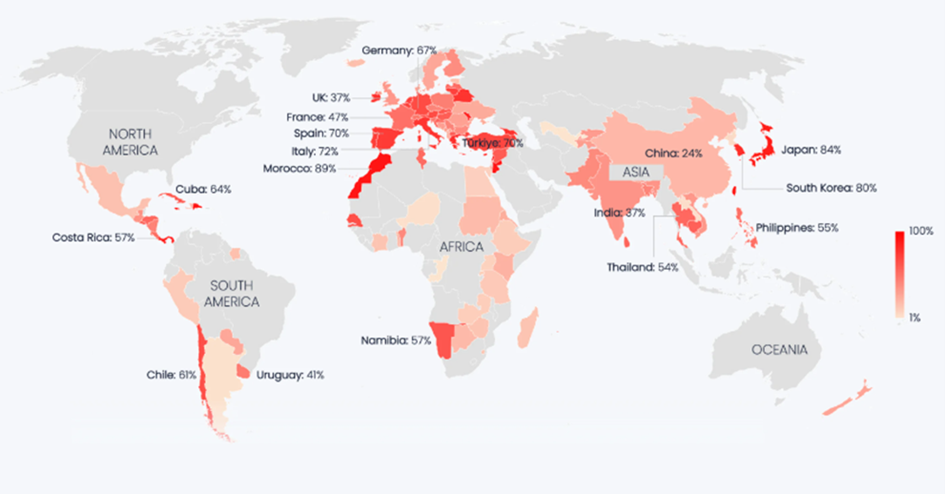
Source: IEA WEB, Ember analysis, 2023. Fossil fuel imports as a share of primary energy demand. The information shown above is for illustrative purposes.

What makes this shock different from the oil crises of the 1970s is that it is landing on a system that is now technologically ready to substitute. In power, new renewables are now competitive or cheaper than new fossil capacity in most markets (Chart 2); in transport, electric vehicles (EVs) are approaching or have already reached cost parity with internal combustion engine (ICE) vehicles.[4] The security case to consume less oil and gas therefore now reinforces, rather than contradicts, the economic case.

Against that backdrop, we believe that many countries are likely to make reducing reliance on imported fossil fuels an explicit goal of energy policy – using higher strategic reserves, demand‑side measures and, above all, increased domestic investment in renewables, storage and grids.

The economics already flipped

Global levelised‑cost data show that the cost of electricity from new onshore wind and utility‑scale solar has fallen dramatically over the last decade and now typically sits below that of new coal and gas‑fired generation on a per‑kilowatt‑hour basis – see Chart 2. Higher and more volatile fossil‑fuel prices since the 2021–23 global energy crisis [5] have amplified this advantage, raising the effective hurdle rate for new fossil investment and making renewables look even more attractive than they already did on a pure cost basis. In effect, hydrocarbons now face a “two‑factor” risk: the usual price cycle plus the growing risk of physical disruption and security‑driven policy responses.

Chart 2 – Levelised cost of new wind/solar vs fossil fuels (USD)
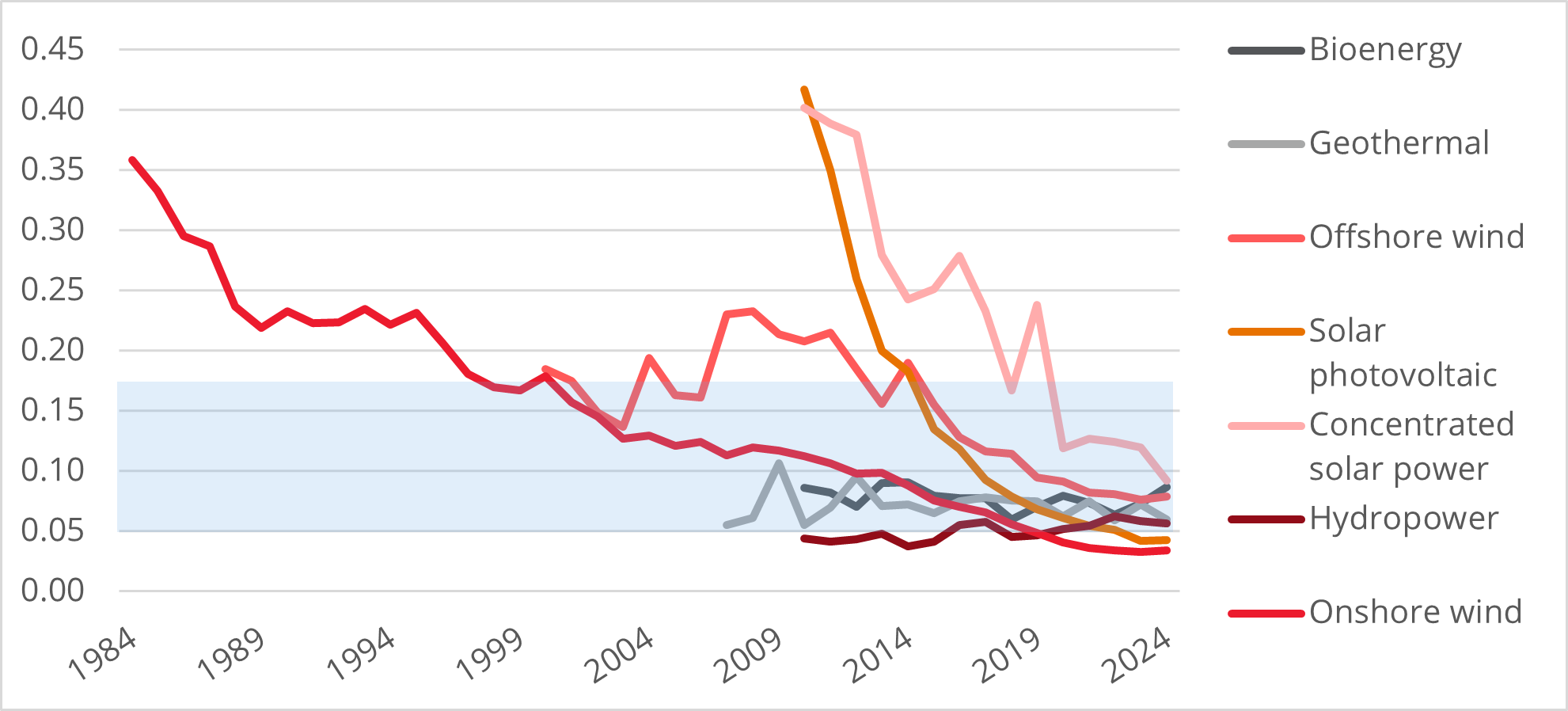
Source: IRENA, 2024, 2025. Costs are expressed in constant 2024 US$ per kilowatt-hour. Light blue area denotes fossil fuel price range. The information shown above is for illustrative purposes.

Sector data from the IEA show that road transport remains the single largest source of final oil demand globally, followed by petrochemicals, aviation and shipping. That concentration means that accelerating EV adoption and improving efficiency in vehicles could have a disproportionate impact on long-term oil consumption, even if other uses of oil prove harder to displace.

Chart 3: Global oil consumption by sector (%)
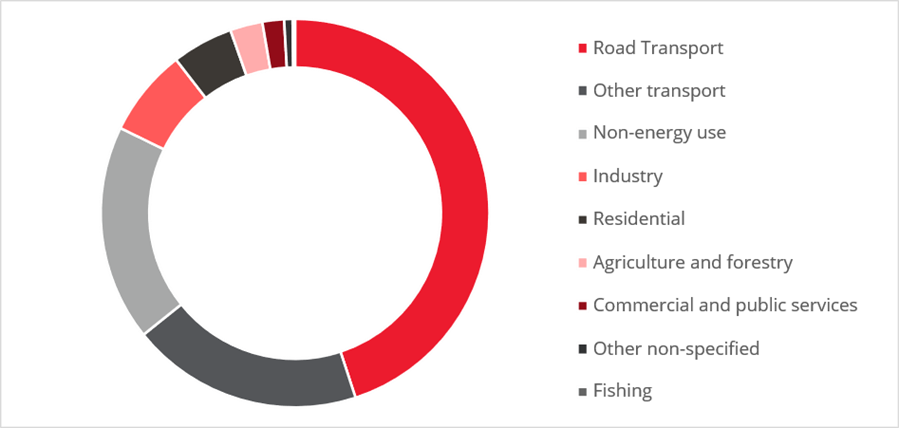
Source: IEA, 2023. In order of consumption. The information shown above is for illustrative purposes.

EV market share of new car sales has risen sharply over the past few years, with many markets in Europe and China already seeing double‑digit penetration and rapid growth in Asia and Latin America from a lower base.[6] As battery prices have fallen and driving ranges per charge increased, the total cost of ownership for EVs has converged with ICE vehicles in a growing number of segments, especially where fuel is taxed or imported.[7] That makes higher oil prices – and the risk that they remain elevated – an additional tailwind for EV adoption.

Chart 4 – EV share of new car sales (%)
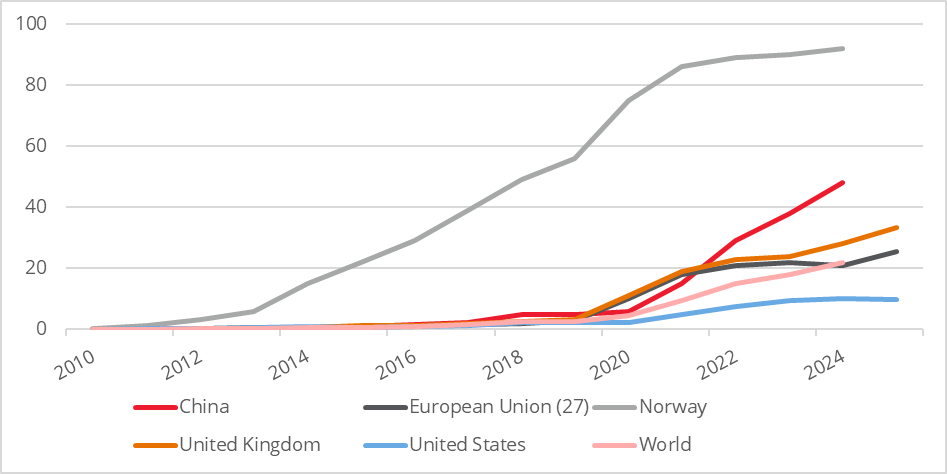
Source: IEA, 2023. In order of consumption. The information shown above is for illustrative purposes.

Concerns that shifting from Middle Eastern fuels to Asian‑manufactured solar modules, batteries or Danish wind components simply swaps one form of dependence for another are understandable but often overstated. Once built, solar and wind assets are powered by local resources; they do not depend on continuous fuel deliveries that can be interrupted or repriced overnight. Hardware typically accounts for a minority of lifetime project costs, with the bulk tied up in financing, labour, land and grid connections; and the equipment itself is geographically diversified. Many parts of the world are also decentralizing manufacturing and assembly of renewable systems, so we expect further diversification of these concerns. Indeed, Tesla has announced plans to develop as much as 100GW of solar manufacturing capacity in the US recently.[8]

Natural gas: A transition resource for power systems

Oil has been phased out of most electricity supply systems globally, but LNG has grown rapidly as an alternative to both oil and coal. Gas still plays an important role in electricity supply systems. However, the rapid advancement of battery storage – both in technical terms, as well as a rapid decline in cost of electricity (LCOE) – means the need for firm or baseload power supply provided by LNG is actually starting to decline, and could decline by more than 90%, in our view. This reality is so new that many market experts openly deny this possibility. AI‑driven data‑centre demand in the US complicates this picture, but we believe this will not change the basic direction of travel for fossil fuel demand.

Different paths to electrification: Asia, China and Europe

Electrification is not unfolding in the same way everywhere. Asia ex‑China is experiencing the Hormuz shock most acutely because of its high import dependence and shallow reserves; here, the immediate policy levers include accelerating EV uptake to cut oil demand, ramping renewables to reduce LNG or piped gas needs, and reinforcing grids to absorb more variable generation. China, by contrast, enters this crisis with a huge installed base of coal and increasing nuclear and renewable capacity that limits exposure to seaborne imports of fossil fuels.

In Europe, the picture is different again. Spain, in particular, offers a striking example of what an electricity‑first system can look like in a developed market. Over the past decade it has delivered rapid growth in wind and solar, while bringing down the share of fossil‑fired generation and weakening the link between gas prices and power prices. Crucially, this has been driven largely by the economic merit of renewables – supported by hydro and interconnection – rather than by policy: even as political sentiment has oscillated, renewables have remained the cheapest way to add capacity.[9]

Chart 5 – Wind and solar share of electricity generation, EU and UK, H1 2019–H1 2025
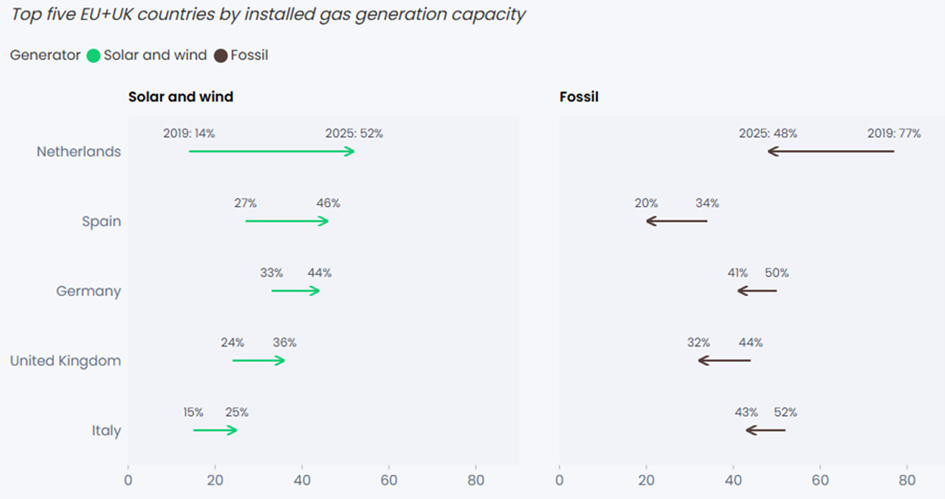
Sources: Ember, October 2025. The information shown above is for illustrative purposes.

Taken together, these regional stories reinforce a common message: the transition away from fuel and towards power is already under way globally, but it is expressing itself differently depending on resource endowments, policy priorities and starting points.

Where does capital need to go?

EVs, batteries, grids and firm low‑carbon generation are the enabling assets that turn higher electricity share into energy security, by shifting demand away from imported fuel and anchoring it in domestic, 24/7 power. IEA analysis shows that, under both the conservative Current Policies Scenario (CPS) and the Stated Policies Scenario (STEPS), global energy investment – including grids – needs to rise materially over the coming decades, with grid and storage investment playing a central role.

Chart 6 – Projected global energy and grid investment, CPS vs STEPS scenarios
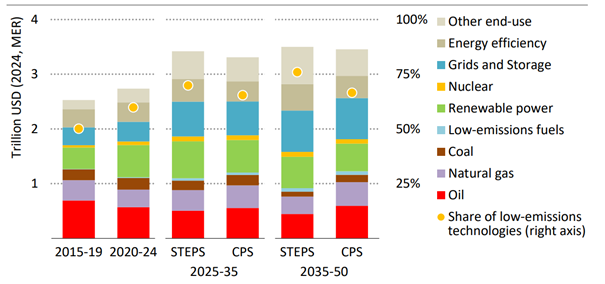
Source: IEA, World energy outlook 2025. The information shown above is for illustrative purposes. Forecasts and estimates are based upon subjective assumptions.

For investors, the key building blocks of an electricity‑first energy system include:

  • Local and domestic power generation: Renewables and, in some markets, nuclear are the technologies that convert domestic resources into electricity, reducing exposure to imported fuels while benefiting from improving economics.

  • EVs as the visible edge of electrification: EVs translate high‑level system change into tangible consumer behaviour, directly displacing oil demand in transport and boosting electricity demand in a way that can be planned for.

  • Batteries and flexibility: Storage and demand‑side response turn variable renewables into firm capacity by shifting energy across time, allowing grids to meet peak demand without relying on expensive fossil peakers.[10]

  • Nuclear as firm low‑carbon capacity: Where social licence and regulatory frameworks permit, life extensions of existing nuclear fleets and, potentially, small modular reactors provide non‑fossil, on-demand power that reduces reliance on gas and oil in the broader power mix.

Much of this investment will be executed by listed renewables platforms, integrated utilities and regulated network operators, many of which currently trade at valuations that reflect their rate sensitivity more than their structural role in the new energy order. That creates a disconnect between fundamentals and market pricing that long‑term investors can exploit.

Rethinking energy exposures

Many asset allocators with energy exposure are still primarily exposed to oil and gas exploration and production, with little or no explicit allocation to electricity infrastructure. That may have made sense in a world where energy security meant securing fossil fuel flows. In a world that is being driven, by both economics and geopolitics, from fossil fuel direct use to power systems, investors risk becoming structurally underweight the very assets that stand to benefit from the new regime.

We believe ‘electricity companies’ – integrated utilities, renewables platforms, regulated grids and selected storage and flexibility assets – should increasingly sit at the core of an energy allocation. These are the businesses that build, own and operate the assets that generate, move and store power, that will gain share as fuel loses it, and that stand to benefit from a structurally higher security premium on fossil fuels. In our view, that makes today an attractive entry point to tilt existing energy allocations towards market share-winning electricity.

After Hormuz, there’s no going back

The Hormuz crisis has exposed oil and LNG as structural security liabilities just as electrification has become economically compelling. In much the same way that Fukushima locked in a multi‑decade reshaping of gas and power markets in Japan and Australia, today’s crisis is likely to lock in a protracted investment cycle in electricity infrastructure.

For policymakers, that means building electricity‑first systems – renewables, grids, storage and firm low‑carbon generation – that can shelter their economies from oil and gas disruption. For investors, it means ensuring that energy allocations are anchored in the parts of the system where security, economics and the transition all now point in the same direction – and where, in our view, the next decade of energy returns are most likely to be made.

Key Information

No investment strategy or risk management technique can guarantee returns or eliminate risks in any market environment. Past performance is not a guide to the future. The prices of investments and income from them may fall as well as rise and investors may not get back the full amount invested. Forecasts and estimates are based upon subjective assumptions about circumstances and events that may not yet have taken place and may never do so. The statements and opinions expressed in this article are those of the author as of the date of publication, and do not necessarily represent the view of Redwheel. This article does not constitute investment advice and the information shown is for illustrative purposes only.

References

[1] Oilprice.com

[2] UNCTAD

[3] Ember Energy, March 2026

[4] IEA.org

[5] IEA.org

[6] Ember Energy, The EV leapfrog – how emerging markets are driving a global EV boom, December 2025

[7] IEA.org

[8] Bloomberg, March 2026

[9] IRENA.org – 91% of New Renewable Projects Now Cheaper Than Fossil Fuels Alternatives

In case you missed it

Emerging and Frontier Markets
The ‘Fab 4’ become the ‘FOMO 3’

The Redwheel Emerging and Frontier Markets team explores the concentration challenge facing investors today and maps out under‑owned countries, sectors and themes that the team believes offer a richer blend of structural growth and genuine diversification.

27 July, 2026 | 01:48pm
UK Value & income
When it rhymes it pours

Shaul Rosten, Analyst with the Redwheel Value and Income team looks at the striking similarities between today’s market exuberance and the dotcom era, highlighting stretched valuations, record IPO activity and the dominance of the technology sector.

20 July, 2026 | 07:58pm
UK Value & income
Two beautiful games

As England’s World Cup campaign unfolds, the tournament provides a vivid reminder that sensible bets are grounded in probabilities. Supporters know that backing long-shot teams is unlikely to be rewarded, while favouring stronger sides with clear track records is more prudent. In his latest blog, Shaul Rosten of Redwheel's Value & Income team examines how value investing adopts a similar stance, focusing on quality businesses at attractive valuations, rather than richly priced growth narratives with low odds of delivery.

6 July, 2026 | 07:29pm

Disclaimer

Redwheel ® and Ecofin ® are registered trademarks of RWC Partners Limited (“RWC”). The term “Redwheel” may include any one or more Redwheel branded regulated entities including RWC Asset Management LLP, which is authorised and regulated by the UK Financial Conduct Authority and the US Securities and Exchange Commission (“SEC”); RWC Asset Advisors (US) LLC, which is registered with the SEC;  RWC Singapore (Pte) Limited, which is licensed as a Licensed Fund Management Company by the Monetary Authority of Singapore; Redwheel Australia Pty Ltd is an Australian Financial Services Licensee with the Australian Securities and Investment Commission; and Redwheel Europe Fondsmæglerselskab A/S which is regulated by the Danish Financial Supervisory Authority.

Redwheel may act as investment manager or adviser, or otherwise provide services, to more than one product pursuing a similar investment strategy or focus to the product detailed in this document. Redwheel and RWC (together “Redwheel Group”) seeks to minimise any conflicts of interest, and endeavours to act at all times in accordance with its legal and regulatory obligations as well as its own policies and codes of conduct.

This document is directed only at professional, institutional, wholesale or qualified investors. The services provided by Redwheel are available only to such persons. It is not intended for distribution to and should not be relied on by any person who would qualify as a retail or individual investor in any jurisdiction or for distribution to, or use by, any person or entity in any jurisdiction where such distribution or use would be contrary to local law or regulation.

This document has been prepared for general information purposes only and has not been delivered for registration in any jurisdiction nor has its content been reviewed or approved by any regulatory authority in any jurisdiction.

The information contained herein does not constitute: (i) a binding legal agreement; (ii) legal, regulatory, tax, accounting or other advice; (iii) an offer, recommendation or solicitation to buy or sell shares in any fund, security, commodity, financial instrument or derivative linked to, or otherwise included in a portfolio managed or advised by Redwheel; or (iv) an offer to enter into any other transaction whatsoever (each a “Transaction”). Redwheel Group bears no responsibility for your investment research and/or investment decisions and you should consult your own lawyer, accountant, tax adviser or other professional adviser before entering into any Transaction. No representations and/or warranties are made that the information contained herein is either up to date and/or accurate and is not intended to be used or relied upon by any counterparty, investor or any other third party.

Redwheel Group uses information from third party vendors, such as statistical and other data, that it believes to be reliable. However, the accuracy of this data, which may be used to calculate results or otherwise compile data that finds its way over time into Redwheel Group research data stored on its systems, is not guaranteed. If such information is not accurate, some of the conclusions reached or statements made may be adversely affected. Any opinion expressed herein, which may be subjective in nature, may not be shared by all directors, officers, employees, or representatives of Group and may be subject to change without notice. Redwheel Group is not liable for any decisions made or actions or inactions taken by you or others based on the contents of this document and neither Redwheel Group nor any of its directors, officers, employees, or representatives (including affiliates) accepts any liability whatsoever for any errors and/or omissions or for any direct, indirect, special, incidental, or consequential loss, damages, or expenses of any kind howsoever arising from the use of, or reliance on, any information contained herein.

Information contained in this document should not be viewed as indicative of future results. Past performance of any Transaction is not indicative of future results. The value of investments can go down as well as up. Certain assumptions and forward looking statements may have been made either for modelling purposes, to simplify the presentation and/or calculation of any projections or estimates contained herein and Redwheel Group does not represent that that any such assumptions or statements will reflect actual future events or that all assumptions have been considered or stated. There can be no assurance that estimated returns or projections will be realised or that actual returns or performance results will not materially differ from those estimated herein. Some of the information contained in this document may be aggregated data of Transactions executed by Redwheel that has been compiled so as not to identify the underlying Transactions of any particular customer.

No representations or warranties of any kind are intended or should be inferred with respect to the economic return from, or the tax consequences of, an investment in a Redwheel-managed fund.

This document expresses no views as to the suitability or appropriateness of the fund or any other investments described herein to the individual circumstances of any recipient.

The information transmitted is intended only for the person or entity to which it has been given and may contain confidential and/or privileged material. In accepting receipt of the information transmitted you agree that you and/or your affiliates, partners, directors, officers and employees, as applicable, will keep all information strictly confidential. Any review, retransmission, dissemination or other use of, or taking of any action in reliance upon, this information is prohibited. Any distribution or reproduction of this document is not authorised and is prohibited without the express written consent of Redwheel Group.

Funds managed by Redwheel are not, and will not be, registered under the Securities Act of 1933 (the “Securities Act”) and are not available for purchase by US persons (as defined in Regulation S under the Securities Act) except to persons who are “qualified purchasers” (as defined in the Investment Company Act of 1940) and “accredited investors” (as defined in Rule 501(a) under the Securities Act).

This document does not constitute an offer to sell, purchase, subscribe for or otherwise invest in units or shares of any fund managed by Redwheel. Any offering is made only pursuant to the relevant offering document and the relevant subscription application. Prospective investors should review the offering memorandum in its entirety, including the risk factors in the offering memorandum, before making a decision to invest.

AIFMD and Distribution in the European Economic Area (“EEA”)

The Alternative Fund Managers Directive (Directive 2011/61/EU) (“AIFMD”) is a regulatory regime which came into full effect in the EEA on 22 July 2014. RWC Asset Management LLP is an Alternative Investment Fund Manager (an “AIFM”) to certain funds managed by it (each an “AIF”). The AIFM is required to make available to investors certain prescribed information prior to their investment in an AIF. The majority of the prescribed information is contained in the latest Offering Document of the AIF. The remainder of the prescribed information is contained in the relevant AIF’s annual report and accounts. All of the information is provided in accordance with the AIFMD.

In relation to each member state of the EEA (each a “Member State”), this document may only be distributed and shares in a Redwheel fund (“Shares”) may only be offered and placed to the extent that (a) the relevant Redwheel fund is permitted to be marketed to professional investors in accordance with the AIFMD (as implemented into the local law/regulation of the relevant Member State); or (b) this document may otherwise be lawfully distributed and the Shares may lawfully be offered or placed in that Member State (including at the initiative of the investor).

Information Required for Offering in Switzerland of Foreign Collective Investment Schemes to Qualified Investors within the meaning of Article 10 CISA.

This is an advertising document.

The representative and paying agent of the Redwheel-managed funds in Switzerland (the “Representative in Switzerland”) FIRST INDEPENDENT FUND SERVICES LTD, Feldeggstrasse 12, CH-8008 Zurich. Swiss Paying Agent: Helvetische Bank AG, Seefeldstrasse 215, CH-8008 Zurich. In respect of the units of the Redwheel-managed funds offered in Switzerland, the place of performance is at the registered office of the Swiss Representative. The place of jurisdiction is at the registered office of the Swiss Representative or at the registered office or place of residence of the investor.

No investment strategy or risk management technique can guarantee returns or eliminate risks in any market environment.The term “RWC” may include any one or more RWC branded entities including RWC Partners Limited and RWC Asset Management LLP, each of which is authorised and regulated by the UK Financial Conduct Authority and, in the case of RWC Asset Management LLP, the US Securities and Exchange Commission; RWC Asset Advisors (US) LLC, which is registered with the US Securities and Exchange Commission; and RWC Singapore (Pte) Limited, which is licensed as a Licensed Fund Management Company by the Monetary Authority of Singapore.RWC may act as investment manager or adviser, or otherwise provide services, to more than one product pursuing a similar investment strategy or focus to the product detailed in this audio. RWC seeks to minimise any conflicts of interest, and endeavours to act at all times in accordance with its legal and regulatory obligations as well as its own policies and codes of conduct.This audio is directed only at professional, institutional, wholesale or qualified investors. The services provided by RWC are available only to such persons. It is not intended for distribution to and should not be relied on by any person who would qualify as a retail or individual investor in any jurisdiction or for distribution to, or use by, any person or entity in any jurisdiction where such distribution or use would be contrary to local law or regulation.This audio has been prepared for general information purposes only and has not been delivered for registration in any jurisdiction nor has its content been reviewed or approved by any regulatory authority in any jurisdiction. The information contained herein does not constitute: (i) a binding legal agreement; (ii) legal, regulatory, tax, accounting or other advice; (iii) an offer, recommendation or solicitation to buy or sell shares in any fund, security, commodity, financial instrument or derivative linked to, or otherwise included in a portfolio managed or advised by RWC; or(iv) an offer to enter into any other transaction whatsoever (each a “Transaction”). No representations and/or warranties are made that the information contained herein is either up to date and/or accurate and is not intended to be used or relied upon by any counterparty, investor or any other third party.RWC uses information from third party vendors, such as statistical and other data, that it believes to be reliable. However, the accuracy of this data, which may be used to calculate results or otherwise compile data that finds its way over time into RWC research data stored on its systems, is not guaranteed. If such information is not accurate, some of the conclusions reached or statements made may be adversely affected. RWC bears no responsibility for your investment research and/or investment decisions and you should consult your own lawyer, accountant, tax adviser or other professional adviser before entering into any Transaction. Any opinion expressed herein, which may be subjective in nature, may not be shared by all directors, officers, employees, or representatives of RWC and may be subject to change without notice. RWC is not liable for any decisions made or actions or in actions taken by you or others based on the contents of this audio and neither RWC nor any of its directors, officers, employees, or representatives (including affiliates) accepts any liability whatsoever for any errors and/or omissions or for any direct, indirect, special, incidental, or consequential loss, damages, or expenses of any kind howsoever arising from the use of, or reliance on, any information contained herein.Information contained in this audio should not be viewed as indicative of future results. Past performance of any Transaction is not indicative of future results. The value of investments can go down as well as up. Certain assumptions and forward looking statements may have been made either for modelling purposes, to simplify the audio and/or calculation of any projections or estimates contained herein and RWC does not represent that that any such assumptions or statements will reflect actual future events or that all assumptions have been considered or stated. Forward-looking statements are inherently uncertain, and changing factors such as those affecting the markets generally, or those affecting particular industries or issuers, may cause results to differ from those discussed. Accordingly, there can be no assurance that estimated returns or projections will be realised or that actual returns or performance results will not materially differ from those estimated herein. Some of the information contained in this audio may be aggregated data of Transactions executed by RWC that has been compiled so as not to identify the underlying Transactions of any particular customer.The information transmitted is intended only for the person or entity to which it has been given and may contain confidential and/or privileged material. In accepting receipt of the information transmitted you agree that you and/or your affiliates, partners, directors, officers and employees, as applicable, will keep all information strictly confidential. Any review, retransmission, dissemination or other use of, or taking of any action in reliance upon, this information is prohibited. The information contained herein is confidential and is intended for the exclusive use of the intended recipient(s) to which this audio has been provided. Any distribution or reproduction of this audio is not authorised and is prohibited without the express written consent of RWC or any of its affiliates.Changes in rates of exchange may cause the value of such investments to fluctuate. An investor may not be able to get back the amount invested and the loss on realisation may be very high and could result in a substantial or complete loss of the investment. In addition, an investor who realises their investment in a RWC-managed fund after a short period may not realise the amount originally invested as a result of charges made on the issue and/or redemption of such investment. The value of such interests for the purposes of purchases may differ from their value for the purpose of redemptions. No representations or warranties of any kind are intended or should be inferred with respect to the economic return from, or the tax consequences of, an investment in a RWC-managed fund. Current tax levels and reliefs may change. Depending on individual circumstances, this may affect investment returns. Nothing in this document constitutes advice on the merits of buying or selling a particular investment. This audio expresses no views as to the suitability or appropriateness of the fund or any other investments described herein to the individual circumstances of any recipient.AIFMD and Distribution in the European Economic Area (“EEA”)The Alternative Fund Managers Directive (Directive 2011/61/EU)(“AIFMD”) is a regulatory regime which came into full effect in the EEA on 22 July 2014. RWC Asset Management LLP is an Alternative Investment Fund Manager (an “AIFM”) to certain funds managed by it (each an “AIF”). The AIFM is required to make available to investors certain prescribed information prior to their investment in an AIF. The majority of the prescribed information is contained in the latest Offering Document of the AIF. The remainder of the prescribed information is contained in the relevant AIF’s annual report and accounts. All of the information is provided in accordance with the AIFMD.In relation to each member state of the EEA (each a “Member State”),this document may only be distributed and shares in a RWC fund(“Shares”) may only be offered and placed to the extent that (a) the relevant RWC fund is permitted to be marketed to professional investors in accordance with the AIFMD (as implemented into the local law/regulation of the relevant Member State); or (b) this audio may otherwise be lawfully distributed and the Shares may lawfully offered or placed in that Member State (including at the initiative of the investor).Information Required for Distribution of Foreign Collective Investment Schemes to Qualified Investors in SwitzerlandThe representative and paying agent of the RWC-managed funds in Switzerland (the “Representative in Switzerland”) FIRST INDEPENDENT FUND SERVICES LTD, Klausstrasse 33, CH-8008 Zurich. Swiss Paying Agent: Helvetische Bank AG, Seefeldstrasse 215, CH-8008 Zurich. In respect of the units of the RWC-managed funds distributed in Switzerland, the place of performance and jurisdiction is at the registered office of the Representative in Switzerland.