









What is the real impact of innovation on economic growth?

A wake-up call for investors in the AI era

Global markets are in the grip of Artificial Intelligence (AI) euphoria. Current valuations[1] imply that AI will change everything, revolutionising industries and reshaping the way we work, travel and communicate.

Central to the investment narrative is the expectation that AI will unlock massive productivity gains: automating processes, cutting costs and driving long-term profitability.

But is this expectation justified? Does history support the assumption that technological innovation drives sustained productivity growth? And what lessons can investors learn about how to navigate periods when the focus on the promise of an innovation eclipses all else?

Adoption is accelerating

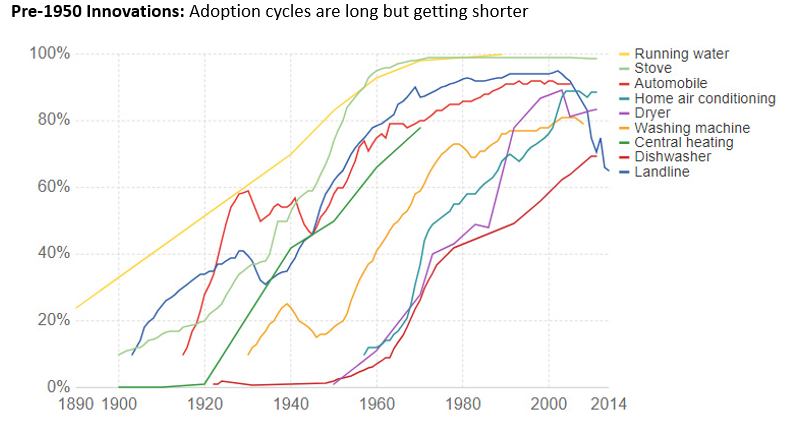
A look back at historical innovations reveals a dramatic shift in the pace of adoption over the last century.

The chart below shows the adoption timelines of key innovations that emerged in the first half of the last century. Technological advancements such as electrical appliances, cars and telephones – tangible and physical innovations – took decades to achieve widespread adoption in a non-digital world. Yet, over this period one can see that adoption cycles are becoming faster, due mainly to the growth in mass communication.
Source: ourworldindata.org, December 2019. The information shown above is for illustrative purposes.

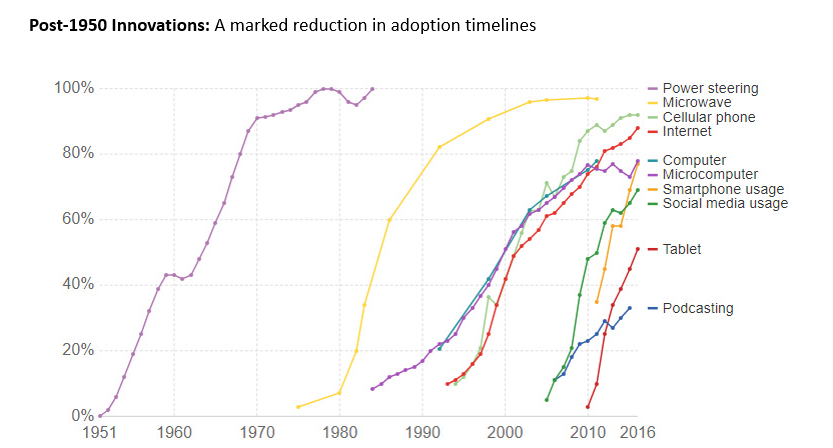
By contrast, the post-1950 period witnessed the rise of digital technologies in an era of mass media and globalisation. Modern innovations—like the internet, smartphones, and now AI—spread at breathtaking speeds, propelled by global connectivity and the network effect.
Source: ourworldindata.org, December 2019. The information shown above is for illustrative purposes.

Given these accelerating adoption rates, it seems reasonable to expect that AI’s adoption will be swift, with corresponding impacts on productivity. Companies and consumers alike are already integrating AI into processes and products, from generative chatbots to advanced robotics. But will faster adoption equate to long-term productivity gains?

A century of unprecedented innovation

To answer that question, we begin by reviewing a century of extraordinary technological advancement. The chart below highlights six technological waves or eras, each of which has had a profound impact on our lives and industry. Together, they have dramatically altered the way we manufacture, work, consume and communicate, improving our health, longevity and quality of life. Surely this has had a beneficial impact on real GDP growth.

Mainframe and early computing
1980-1994
Internet
2005-2011
Cloud computing and big data
2022-present
1950-1979
Personal computing
1995-2004
Mobile and social media
2012-2021
AI

Source: Redwheel, November 2024. The information shown is for illustrative purposes.

Innovation and its relationship with economic growth and productivity

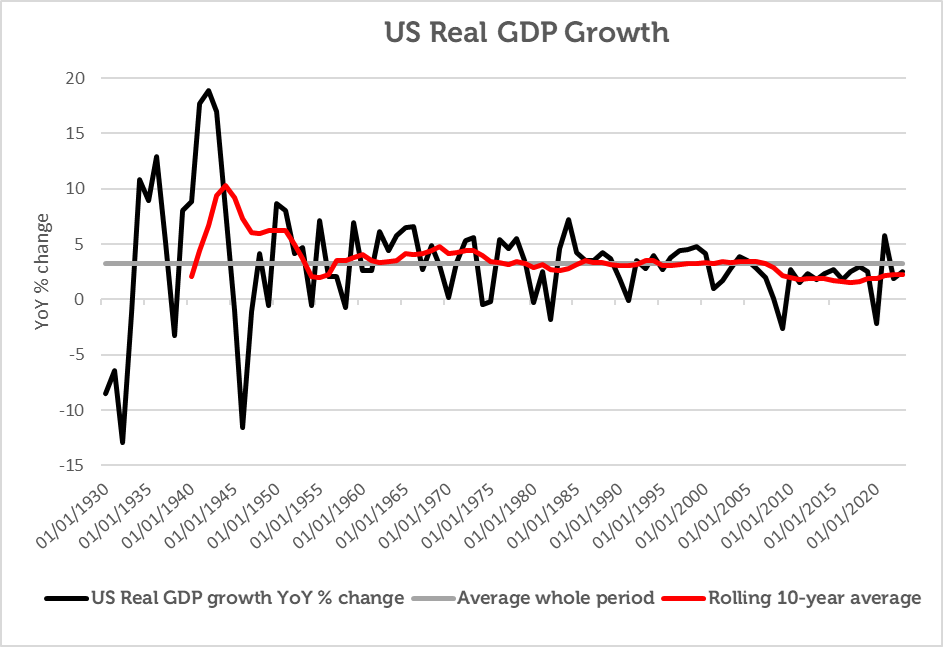
1. US Real GDP Growth is in secular decline

However, an analysis of US real GDP growth since the 1930s reveals a slow but persistent decline in the long-term growth trend. Despite the pick-up during the later years of WWII, overall economic growth has fallen below its historical average of 3.3%. This decline persists despite successive waves of major innovations, from electrification to the digital revolution.
Source: Bloomberg, 31 December, 2023. The information shown above is for illustrative purposes.

Perhaps waning GDP growth has been compensated by a pick-up in labour productivity growth. This measure looks more specifically at the increase in goods and services produced by the US labour force per hour.

Here again, we see a slowdown in 10-year average growth rates. The data points to declining efficiency gains over time despite meaningful innovation revolutions and the emergence of PC’s, jet planes, satellite, email and the internet.

2. US Labour Productivity Growth is also declining
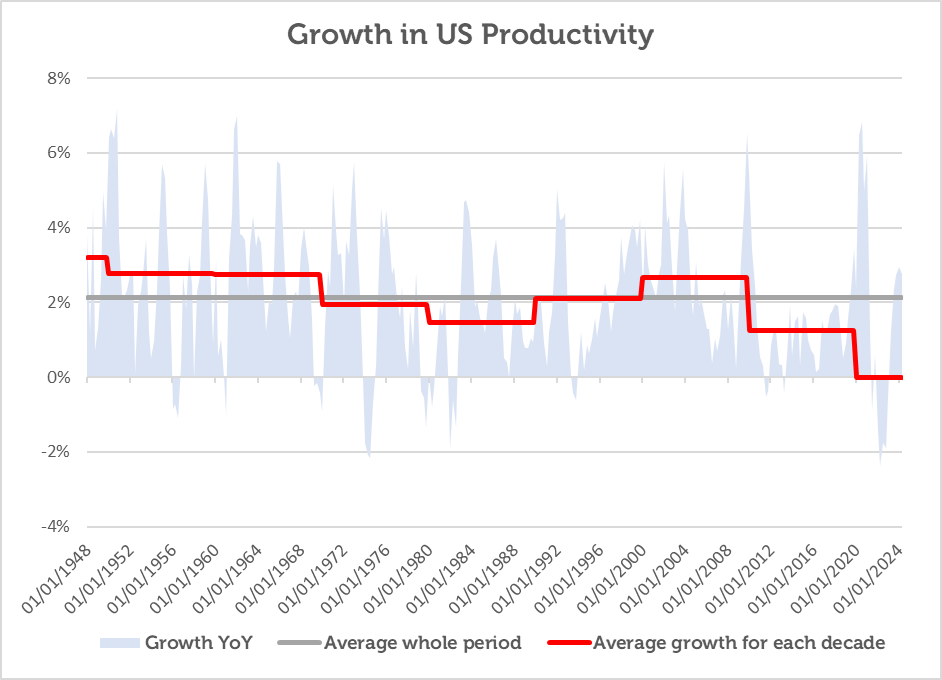
Source: US Bureau of Labor Statistics, 1 April, 2024. The information shown above is for illustrative purposes.

The notion that innovation leads to a marked shift in either economic growth (as measured by GDP) or an increase in productivity seems misplaced. It would appear instead that innovation is a necessity to simply keep economies moving forward, albeit at a slower rate. If anything, more innovation is needed, adopted quickly to arrest declining productivity growth.

Understanding the productivity paradox

The paradox of innovation is that while it undoubtedly enhances specific processes or industries, its broader impacts on productivity often fall short. This is likely to be due a litany of complex and interwoven factors concerning macroeconomics, labour market dynamics and demographics.

However, one key observation is that increasing efficiency often comes with additional complexity and volume. For example, email dramatically reduced the cost and time of communication compared to letters or faxes, but the ease of sending emails has led to a significant increase in message volume, distracting workers and diluting efficiency gains.

Other factors include diminishing marginal returns at scale and systemic complexity. Innovations often introduce complexities that require new skills, infrastructure, or regulatory frameworks, which can mute productivity improvements.

The impact of speculative euphoria on innovation cycles

This realisation that there is no discernable link between potentially game-changing innovation and productivity growth casts a new light on the excessive optimism that innovations can inspire.  As we are seeing with AI today, investors invariably believe that ‘this time it will be different’: capital floods into the sector, valuations soar, and speculative behavior intensifies.

Ironically this capital over-supply tends to aide adoption rates, but it does so by commoditising it. It tends to increase competition and lower entry barriers, creating a high volume of similar options.

For example, the internet era witnessed a surge in speculative investment, particularly during the dot-com bubble. While the internet undoubtedly transformed communication, commerce, and data access, its widespread adoption led to over-supply and commoditization. Cloud computing, too, has transitioned from a disruptive technology to a standard offering, with margins compressed by competition.

In the pre-digital era, utilities exemplified this process. Electricity and power grids were once revolutionary, promising exponential growth as they brought energy to homes and businesses. Early investors flocked to these sectors, expecting sustained high returns. Over time, however, these utilities became commoditized and regulated, shifting from growth investments to stable, income-generating assets. Their perceived value now lies in reliability rather than innovation.

The potential implications for AI investors today

Will AI follow this trajectory, evolving from a transformative force into a utility-like commodity? The pattern appears to be repeating with generative AI set to receive an estimated $300bn in cloud investment by 2030[2]. Markets are pricing in expectations of universal adoption and dramatic impacts on profitability, particularly for chipmakers and AI service providers.

However, as history demonstrates, widespread adoption of an innovation tends to commoditize the technology, reducing its margins and long-term value. Similar dynamics could play out for AI, where increased competition and accessibility may erode the premium associated with early-stage innovation.

Investors therefore need to exercise caution. Unfortunately, it can be hard for allocators to resist the appeal of stocks whose upward trajectory shows no signs of stalling. Fear of missing out dominates, ensuring that bubbles and ensuing concentrations forever reoccur in markets. This is why we believe strict investment disciplines are essential.

The importance of investment disciplines

In the face of innovation hype, disciplined investment strategies serve as essential guardrails to protect against irrational exuberance. Valuation-based approaches help investors navigate speculative bubbles and focus on durable long-term returns.

To illustrate, the Redwheel Global Equity Income Strategy incorporates stringent yield disciplines – both buy and sell – to maximise the statistical power of dividends. The investment team can only buy stocks that yield a greater than 25% premium to the world index. This is of course just one aspect of a broader stock selection process that incorporates rigorous fundamental and valuation analysis. Each stock must offer a compelling combination of yield, durability and positive valuation asymmetry – a combination typically only seen during periods of controversy.

Perhaps more relevant in the era of Magnificent 7 dominance is the sell discipline, which must be sufficient to protect against the behavioural biases associated with excessive valuations. The Strategy’s yield discipline enforces the sale of a holding that yields less than the market, either from yield contraction or dividend-related company decisions.

In the first scenario, the change in yield relative to the market signals that the stock is no longer controversial, the market now accepts the once-contrarian investment thesis and the stock’s risk reward asymmetry has become skewed to the downside. The investment team can then exit the position having correctly identifying a temporary mis-valuation.

This process was exemplified recently when the team closed positions in chipmaker TSMC, which is strongly exposed to the AI investment theme. Reductions began in June 2024 as the dividend yield fell below the market following continued strong performance. Continued upward momentum well beyond intrinsic value prompted the team to eventually close the position in full in September.

Achieving durable returns amid AI euphoria

The allure of innovation will always captivate markets. From electricity to the internet and now AI, transformative technologies offer the promise of reshaping economies and driving prosperity.

Yet both real GDP and Labour productivity are in secular decline. As we have shown above, far from boosting long-term productivity growth, innovation is required to simply sustain it. AI could yet bring substantial change, but like past innovations, its adoption could also lead to commoditization and moderated long-term returns.

For investors, the challenge lies in balancing participation in innovation-driven growth while maintaining discipline to avoid speculative excesses. We believe that by focusing on investment strategies with strict valuation-based disciplines, investors can position themselves to benefit from innovation without falling victim to its hype.

Sources:

[1] Alphabet, Amazon, Apple, Meta, Microsoft, Nvidia and Tesla comprise over a quarter of the S&P 500 by capitalisation, as at 31 October 2024

[2] Goldman Sachs, ‘Cloud revenues poised to reach $2 trillion by 2030 amid AI rollout’, September, 2024

Key Information
No investment strategy or risk management technique can guarantee returns or eliminate risks in any market environment. Past performance is not a guide to future results. The prices of investments and income from them may fall as well as rise and an investor’s investment is subject to potential loss, in whole or in part. Forecasts and estimates are based upon subjective assumptions about circumstances and events that may not yet have taken place and may never do so. The statements and opinions expressed in this article are those of the author as of the date of publication, and do not necessarily represent the view of Redwheel. This article does not constitute investment advice and the information shown is for illustrative purposes only.

In case you missed it

Emerging and Frontier Markets
The ‘Fab 4’ become the ‘FOMO 3’

The Redwheel Emerging and Frontier Markets team explores the concentration challenge facing investors today and maps out under‑owned countries, sectors and themes that the team believes offer a richer blend of structural growth and genuine diversification.

27 July, 2026 | 01:48pm
UK Value & income
When it rhymes it pours

Shaul Rosten, Analyst with the Redwheel Value and Income team looks at the striking similarities between today’s market exuberance and the dotcom era, highlighting stretched valuations, record IPO activity and the dominance of the technology sector.

20 July, 2026 | 07:58pm
UK Value & income
Two beautiful games

As England’s World Cup campaign unfolds, the tournament provides a vivid reminder that sensible bets are grounded in probabilities. Supporters know that backing long-shot teams is unlikely to be rewarded, while favouring stronger sides with clear track records is more prudent. In his latest blog, Shaul Rosten of Redwheel's Value & Income team examines how value investing adopts a similar stance, focusing on quality businesses at attractive valuations, rather than richly priced growth narratives with low odds of delivery.

6 July, 2026 | 07:29pm

Disclaimer

Redwheel ® and Ecofin ® are registered trademarks of RWC Partners Limited (“RWC”). The term “Redwheel” may include any one or more Redwheel branded regulated entities including RWC Asset Management LLP, which is authorised and regulated by the UK Financial Conduct Authority and the US Securities and Exchange Commission (“SEC”); RWC Asset Advisors (US) LLC, which is registered with the SEC;  RWC Singapore (Pte) Limited, which is licensed as a Licensed Fund Management Company by the Monetary Authority of Singapore; Redwheel Australia Pty Ltd is an Australian Financial Services Licensee with the Australian Securities and Investment Commission; and Redwheel Europe Fondsmæglerselskab A/S which is regulated by the Danish Financial Supervisory Authority.

Redwheel may act as investment manager or adviser, or otherwise provide services, to more than one product pursuing a similar investment strategy or focus to the product detailed in this document. Redwheel and RWC (together “Redwheel Group”) seeks to minimise any conflicts of interest, and endeavours to act at all times in accordance with its legal and regulatory obligations as well as its own policies and codes of conduct.

This document is directed only at professional, institutional, wholesale or qualified investors. The services provided by Redwheel are available only to such persons. It is not intended for distribution to and should not be relied on by any person who would qualify as a retail or individual investor in any jurisdiction or for distribution to, or use by, any person or entity in any jurisdiction where such distribution or use would be contrary to local law or regulation.

This document has been prepared for general information purposes only and has not been delivered for registration in any jurisdiction nor has its content been reviewed or approved by any regulatory authority in any jurisdiction.

The information contained herein does not constitute: (i) a binding legal agreement; (ii) legal, regulatory, tax, accounting or other advice; (iii) an offer, recommendation or solicitation to buy or sell shares in any fund, security, commodity, financial instrument or derivative linked to, or otherwise included in a portfolio managed or advised by Redwheel; or (iv) an offer to enter into any other transaction whatsoever (each a “Transaction”). Redwheel Group bears no responsibility for your investment research and/or investment decisions and you should consult your own lawyer, accountant, tax adviser or other professional adviser before entering into any Transaction. No representations and/or warranties are made that the information contained herein is either up to date and/or accurate and is not intended to be used or relied upon by any counterparty, investor or any other third party.

Redwheel Group uses information from third party vendors, such as statistical and other data, that it believes to be reliable. However, the accuracy of this data, which may be used to calculate results or otherwise compile data that finds its way over time into Redwheel Group research data stored on its systems, is not guaranteed. If such information is not accurate, some of the conclusions reached or statements made may be adversely affected. Any opinion expressed herein, which may be subjective in nature, may not be shared by all directors, officers, employees, or representatives of Group and may be subject to change without notice. Redwheel Group is not liable for any decisions made or actions or inactions taken by you or others based on the contents of this document and neither Redwheel Group nor any of its directors, officers, employees, or representatives (including affiliates) accepts any liability whatsoever for any errors and/or omissions or for any direct, indirect, special, incidental, or consequential loss, damages, or expenses of any kind howsoever arising from the use of, or reliance on, any information contained herein.

Information contained in this document should not be viewed as indicative of future results. Past performance of any Transaction is not indicative of future results. The value of investments can go down as well as up. Certain assumptions and forward looking statements may have been made either for modelling purposes, to simplify the presentation and/or calculation of any projections or estimates contained herein and Redwheel Group does not represent that that any such assumptions or statements will reflect actual future events or that all assumptions have been considered or stated. There can be no assurance that estimated returns or projections will be realised or that actual returns or performance results will not materially differ from those estimated herein. Some of the information contained in this document may be aggregated data of Transactions executed by Redwheel that has been compiled so as not to identify the underlying Transactions of any particular customer.

No representations or warranties of any kind are intended or should be inferred with respect to the economic return from, or the tax consequences of, an investment in a Redwheel-managed fund.

This document expresses no views as to the suitability or appropriateness of the fund or any other investments described herein to the individual circumstances of any recipient.

The information transmitted is intended only for the person or entity to which it has been given and may contain confidential and/or privileged material. In accepting receipt of the information transmitted you agree that you and/or your affiliates, partners, directors, officers and employees, as applicable, will keep all information strictly confidential. Any review, retransmission, dissemination or other use of, or taking of any action in reliance upon, this information is prohibited. Any distribution or reproduction of this document is not authorised and is prohibited without the express written consent of Redwheel Group.

Funds managed by Redwheel are not, and will not be, registered under the Securities Act of 1933 (the “Securities Act”) and are not available for purchase by US persons (as defined in Regulation S under the Securities Act) except to persons who are “qualified purchasers” (as defined in the Investment Company Act of 1940) and “accredited investors” (as defined in Rule 501(a) under the Securities Act).

This document does not constitute an offer to sell, purchase, subscribe for or otherwise invest in units or shares of any fund managed by Redwheel. Any offering is made only pursuant to the relevant offering document and the relevant subscription application. Prospective investors should review the offering memorandum in its entirety, including the risk factors in the offering memorandum, before making a decision to invest.

AIFMD and Distribution in the European Economic Area (“EEA”)

The Alternative Fund Managers Directive (Directive 2011/61/EU) (“AIFMD”) is a regulatory regime which came into full effect in the EEA on 22 July 2014. RWC Asset Management LLP is an Alternative Investment Fund Manager (an “AIFM”) to certain funds managed by it (each an “AIF”). The AIFM is required to make available to investors certain prescribed information prior to their investment in an AIF. The majority of the prescribed information is contained in the latest Offering Document of the AIF. The remainder of the prescribed information is contained in the relevant AIF’s annual report and accounts. All of the information is provided in accordance with the AIFMD.

In relation to each member state of the EEA (each a “Member State”), this document may only be distributed and shares in a Redwheel fund (“Shares”) may only be offered and placed to the extent that (a) the relevant Redwheel fund is permitted to be marketed to professional investors in accordance with the AIFMD (as implemented into the local law/regulation of the relevant Member State); or (b) this document may otherwise be lawfully distributed and the Shares may lawfully be offered or placed in that Member State (including at the initiative of the investor).

Information Required for Offering in Switzerland of Foreign Collective Investment Schemes to Qualified Investors within the meaning of Article 10 CISA.

This is an advertising document.

The representative and paying agent of the Redwheel-managed funds in Switzerland (the “Representative in Switzerland”) FIRST INDEPENDENT FUND SERVICES LTD, Feldeggstrasse 12, CH-8008 Zurich. Swiss Paying Agent: Helvetische Bank AG, Seefeldstrasse 215, CH-8008 Zurich. In respect of the units of the Redwheel-managed funds offered in Switzerland, the place of performance is at the registered office of the Swiss Representative. The place of jurisdiction is at the registered office of the Swiss Representative or at the registered office or place of residence of the investor.

No investment strategy or risk management technique can guarantee returns or eliminate risks in any market environment.The term “RWC” may include any one or more RWC branded entities including RWC Partners Limited and RWC Asset Management LLP, each of which is authorised and regulated by the UK Financial Conduct Authority and, in the case of RWC Asset Management LLP, the US Securities and Exchange Commission; RWC Asset Advisors (US) LLC, which is registered with the US Securities and Exchange Commission; and RWC Singapore (Pte) Limited, which is licensed as a Licensed Fund Management Company by the Monetary Authority of Singapore.RWC may act as investment manager or adviser, or otherwise provide services, to more than one product pursuing a similar investment strategy or focus to the product detailed in this audio. RWC seeks to minimise any conflicts of interest, and endeavours to act at all times in accordance with its legal and regulatory obligations as well as its own policies and codes of conduct.This audio is directed only at professional, institutional, wholesale or qualified investors. The services provided by RWC are available only to such persons. It is not intended for distribution to and should not be relied on by any person who would qualify as a retail or individual investor in any jurisdiction or for distribution to, or use by, any person or entity in any jurisdiction where such distribution or use would be contrary to local law or regulation.This audio has been prepared for general information purposes only and has not been delivered for registration in any jurisdiction nor has its content been reviewed or approved by any regulatory authority in any jurisdiction. The information contained herein does not constitute: (i) a binding legal agreement; (ii) legal, regulatory, tax, accounting or other advice; (iii) an offer, recommendation or solicitation to buy or sell shares in any fund, security, commodity, financial instrument or derivative linked to, or otherwise included in a portfolio managed or advised by RWC; or(iv) an offer to enter into any other transaction whatsoever (each a “Transaction”). No representations and/or warranties are made that the information contained herein is either up to date and/or accurate and is not intended to be used or relied upon by any counterparty, investor or any other third party.RWC uses information from third party vendors, such as statistical and other data, that it believes to be reliable. However, the accuracy of this data, which may be used to calculate results or otherwise compile data that finds its way over time into RWC research data stored on its systems, is not guaranteed. If such information is not accurate, some of the conclusions reached or statements made may be adversely affected. RWC bears no responsibility for your investment research and/or investment decisions and you should consult your own lawyer, accountant, tax adviser or other professional adviser before entering into any Transaction. Any opinion expressed herein, which may be subjective in nature, may not be shared by all directors, officers, employees, or representatives of RWC and may be subject to change without notice. RWC is not liable for any decisions made or actions or in actions taken by you or others based on the contents of this audio and neither RWC nor any of its directors, officers, employees, or representatives (including affiliates) accepts any liability whatsoever for any errors and/or omissions or for any direct, indirect, special, incidental, or consequential loss, damages, or expenses of any kind howsoever arising from the use of, or reliance on, any information contained herein.Information contained in this audio should not be viewed as indicative of future results. Past performance of any Transaction is not indicative of future results. The value of investments can go down as well as up. Certain assumptions and forward looking statements may have been made either for modelling purposes, to simplify the audio and/or calculation of any projections or estimates contained herein and RWC does not represent that that any such assumptions or statements will reflect actual future events or that all assumptions have been considered or stated. Forward-looking statements are inherently uncertain, and changing factors such as those affecting the markets generally, or those affecting particular industries or issuers, may cause results to differ from those discussed. Accordingly, there can be no assurance that estimated returns or projections will be realised or that actual returns or performance results will not materially differ from those estimated herein. Some of the information contained in this audio may be aggregated data of Transactions executed by RWC that has been compiled so as not to identify the underlying Transactions of any particular customer.The information transmitted is intended only for the person or entity to which it has been given and may contain confidential and/or privileged material. In accepting receipt of the information transmitted you agree that you and/or your affiliates, partners, directors, officers and employees, as applicable, will keep all information strictly confidential. Any review, retransmission, dissemination or other use of, or taking of any action in reliance upon, this information is prohibited. The information contained herein is confidential and is intended for the exclusive use of the intended recipient(s) to which this audio has been provided. Any distribution or reproduction of this audio is not authorised and is prohibited without the express written consent of RWC or any of its affiliates.Changes in rates of exchange may cause the value of such investments to fluctuate. An investor may not be able to get back the amount invested and the loss on realisation may be very high and could result in a substantial or complete loss of the investment. In addition, an investor who realises their investment in a RWC-managed fund after a short period may not realise the amount originally invested as a result of charges made on the issue and/or redemption of such investment. The value of such interests for the purposes of purchases may differ from their value for the purpose of redemptions. No representations or warranties of any kind are intended or should be inferred with respect to the economic return from, or the tax consequences of, an investment in a RWC-managed fund. Current tax levels and reliefs may change. Depending on individual circumstances, this may affect investment returns. Nothing in this document constitutes advice on the merits of buying or selling a particular investment. This audio expresses no views as to the suitability or appropriateness of the fund or any other investments described herein to the individual circumstances of any recipient.AIFMD and Distribution in the European Economic Area (“EEA”)The Alternative Fund Managers Directive (Directive 2011/61/EU)(“AIFMD”) is a regulatory regime which came into full effect in the EEA on 22 July 2014. RWC Asset Management LLP is an Alternative Investment Fund Manager (an “AIFM”) to certain funds managed by it (each an “AIF”). The AIFM is required to make available to investors certain prescribed information prior to their investment in an AIF. The majority of the prescribed information is contained in the latest Offering Document of the AIF. The remainder of the prescribed information is contained in the relevant AIF’s annual report and accounts. All of the information is provided in accordance with the AIFMD.In relation to each member state of the EEA (each a “Member State”),this document may only be distributed and shares in a RWC fund(“Shares”) may only be offered and placed to the extent that (a) the relevant RWC fund is permitted to be marketed to professional investors in accordance with the AIFMD (as implemented into the local law/regulation of the relevant Member State); or (b) this audio may otherwise be lawfully distributed and the Shares may lawfully offered or placed in that Member State (including at the initiative of the investor).Information Required for Distribution of Foreign Collective Investment Schemes to Qualified Investors in SwitzerlandThe representative and paying agent of the RWC-managed funds in Switzerland (the “Representative in Switzerland”) FIRST INDEPENDENT FUND SERVICES LTD, Klausstrasse 33, CH-8008 Zurich. Swiss Paying Agent: Helvetische Bank AG, Seefeldstrasse 215, CH-8008 Zurich. In respect of the units of the RWC-managed funds distributed in Switzerland, the place of performance and jurisdiction is at the registered office of the Representative in Switzerland.